

Weeks of intense diplomatic efforts, punctuated by threats and outbreaks of violence, have thus far failed to yield a comprehensive agreement to end the ongoing conflict and restore vital energy flow through the Strait of Hormuz. A ceasefire, established on April 8 following nearly 100 days of hostilities initiated by US and Israeli strikes that eliminated Iran’s top leadership, has been in place.
Regional Flare-up Erupts Over Strait of Hormuz
Tensions surged dramatically on Friday when the US military reported striking Iranian radar sites. This action followed the interception of drones reportedly heading towards the Strait of Hormuz. Shortly thereafter, air raid sirens sounded across neighboring Gulf nations Kuwait and Bahrain, both allies of the United States. Explosions were reportedly heard by observers in both countries.
Iran’s Revolutionary Guards stated early Saturday that they had targeted “enemy bases in the area” with missiles in retaliation for what they described as a US “invasion” of Iran’s Sirik and Qeshm islands. The US Central Command (CENTCOM) confirmed that Iran launched seven ballistic missiles toward Kuwait and Bahrain. CENTCOM reported that six of the missiles were intercepted, while the seventh failed to reach its intended target. A statement from CENTCOM asserted, “There are currently no reports of harm to US personnel, and Iranian claims of damaging US 5th fleet headquarters in Bahrain are false.”
Visa Approvals Contrast with Military Actions
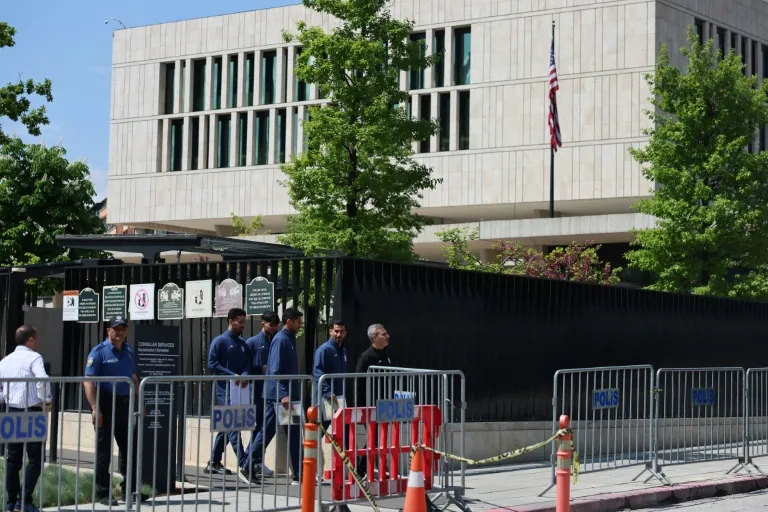
This latest escalation occurred even as the United States proceeded with granting visas to Iran’s national football team, enabling their participation in the Fifa World Cup, which the US is co-hosting with Canada and Mexico. US Ambassador to Turkey, Tom Barrack, confirmed the visa issuances, emphasizing that “sports transcends borders, and we look forward to welcoming competitors and fans from around the world.” However, reports Iran’s Fars news agency indicated that visas had not yet been issued for some members of the team’s “technical and executive staff.” An unnamed US administration official stated, “We will not allow the Iranian team to abuse this system to sneak terrorists into the United States under false pretenses.” The team is scheduled to depart from Turkey for Spain on Saturday before proceeding to their base camp in Mexico, with an expected arrival on Sunday.
Trading Strikes and Defense Measures
Earlier on Friday, CENTCOM reported that its forces had intercepted four Iranian drones targeting the Strait of Hormuz before proceeding to strike Iranian coastal radar installations in Goruk and on Qeshm Island. CENTCOM explained in a statement that the “attack drones posed an immediate threat to regional maritime traffic,” while the radar strikes were intended to “defend against further attacks.”
Iranian state television IRIB reported early Saturday that “several explosions were heard” in Sirik, southern Iran, around 2:30 AM local time. Quoting the Revolutionary Guards, IRIB stated, “Following the invasion of the child-killing and terrorist US army into Sirik and Qeshm Island, enemy bases in the region were hit by aerial missiles.”
Kuwait’s military announced early Saturday that it was responding to “hostile” missile and drone attacks, occurring days after a strike on the country’s international airport resulted in one fatality and numerous injuries. The Kuwaiti military posted on X, “Kuwaiti air defences are currently responding to hostile missile and drone attacks,” without specifying the origin of the attacks.
Missile Stockpile and Diplomatic Stalemate
US President Donald Trump indicated in comments to NBC News on Friday that Iran still possessed approximately “21, 22 percent” of its missile stockpile, a figure higher than the 18 percent previously stated by US officials. This comes amidst repeated claims from US officials that Iran’s military capabilities have been significantly diminished.
Lebanon Appeals for De-escalation
Efforts to transition the existing truce into a lasting settlement have encountered persistent obstacles. The conflict has significantly impacted global markets and intensified political pressure on President Trump domestically ahead of midterm elections. Mohsen Rezaei, a military advisor to Supreme Leader Ayatollah Mojtaba Khamenei, told CNN on Friday that “The negotiations are at a deadlock and Trump must break this deadlock,” also calling for the release of $24 billion in frozen Iranian assets.
Lebanon, which became involved in the conflict when Iran-backed Hezbollah initiated attacks on Israel on March 2, appealed to Iran on Friday to cease its interference in Lebanese affairs. Following a new truce deal being outright rejected by Hezbollah, Israel and the Iran-backed group exchanged attacks. Lebanese Prime Minister Nawaf Salam addressed Iran’s leadership directly during a press conference, pleading, “Have mercy on our south, stop treating it and its people as merely a bargaining chip.” He added, “We are the people of a sovereign nation that refuses to serve as… an open battlefield for their wars.”
Iran’s Foreign Minister Abbas Araghchi responded to similar criticisms from Lebanese President Joseph Aoun early Saturday, urging him to protect Lebanon from its “real foe.” Iran has maintained in peace negotiations with Washington that the ongoing conflicts in Lebanon and the Gulf are intrinsically linked.
