

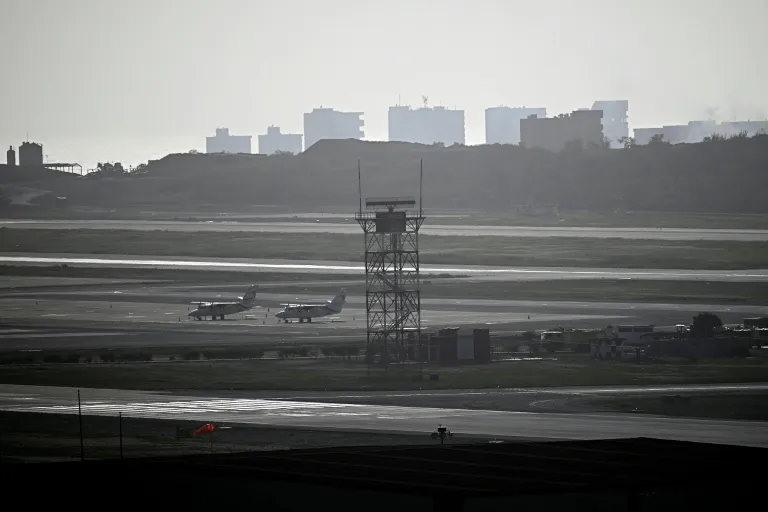
A critical runway at Venezuela’s main international airport has been partially reopened, allowing vital aid flights to land following devastating twin earthquakes. The Simon Bolivar International Airport, serving the capital Caracas, is now operational for specific aircraft, including U.S. military transport planes, facilitating the delivery of essential supplies and personnel.
Airport Operations Resume Amidst Ongoing Relief Efforts
Jeremy Lewin confirmed the partial reopening of the airport, stating, “this morning Simon Bolivar Airport, one of the runways, is operational again and is landing C-17s.” The C-17 is a large U.S. military cargo aircraft capable of transporting significant humanitarian aid. The resumption of operations at the airport is a crucial step in the massive relief effort underway following the powerful earthquakes that struck the nation.
The reopening allows for the immediate arrival of critical medical facilities. “As we got the airport open, we have mobile hospitals coming in today, they’re going to be able to hopefully land at Simon Bolivar,” Lewin added. This includes a Boeing 767 carrying an “Emergency Field Hospital” dispatched by Samaritan’s Purse, a U.S.-based Christian aid organization. International Medical Corps is also deploying mobile medical units and has field hospitals ready for deployment.
The U.S. State Department later confirmed the landing of the aid plane via a post on social media platform X. International Medical Corps also announced plans to transport clean water into the severely affected La Guaira region, highlighting the multifaceted nature of the aid being delivered.
Scale of the Disaster and International Response
The twin earthquakes, registering magnitudes of 7.2 and 7.5, are the strongest to hit Venezuela since 1900. The official death toll has surpassed 1,400, with fears that tens of thousands more remain missing. The sheer scale of the destruction has prompted a significant international response, with numerous countries and humanitarian organizations mobilizing resources.
A senior U.S. administration official detailed the strategic positioning of the USS Fort Lauderdale, an amphibious military ship, off the Venezuelan coast. This vessel is intended to serve as a logistical hub, enabling more rescue flights and providing medical facilities for airlifted individuals. “We’re able to airlift people to use the medical facilities, as necessary, on that vessel, and to use it to do command and control and logistics, and to use their airlift,” the official explained, anticipating an increased capacity for using rotorcraft in rescue operations.
The United States has committed substantial financial aid, releasing approximately $150 million thus far. An additional aid package, described as a “nine-figure” sum, is expected to be announced soon. This financial support is critical for sustaining the extensive relief and recovery operations.
Challenges and Coordination in Aid Delivery
Despite the partial reopening, the airport faces significant challenges. One of the main runways remains completely cracked and inoperable due to the seismic activity. The airport has also become a point of congestion, with a high volume of international and humanitarian groups attempting to deliver aid simultaneously.
The U.S. military is actively involved in managing the airport’s operations. A senior U.S. administration official noted that the U.S. military would be “helping to coordinate flights in the tower.” This assistance is crucial for maintaining order and efficiency amidst the complex logistical demands.
U.S. Southern Command has outlined a comprehensive plan involving multiple U.S. Air Force C-17 cargo planes. Five of these aircraft are scheduled to deliver crews to aid in the further reopening and management of the airport. Another C-17 will transport two search and rescue teams from Miami. Additionally, various other aircraft, including helicopters, are being deployed to the region to bolster support capabilities.
The U.S. Space Force is also contributing by providing satellite imagery and analysis to aid in the planning and execution of relief efforts, offering a critical overview of the affected areas and infrastructure damage.
Key Takeaways
- A runway at Venezuela’s Simon Bolivar International Airport has been partially reopened for aid flights.
- U.S. military transport planes, including C-17s, are among the first aircraft landing at the facility.
- Mobile hospitals and medical units are being delivered to support the overwhelmed healthcare system.
- The death toll from the twin earthquakes exceeds 1,400, with thousands still missing.
- The U.S. has deployed the USS Fort Lauderdale to assist with logistics and medical support.
- Significant U.S. financial aid, totaling over $150 million, has been committed to the relief effort.
- Airport infrastructure damage and high traffic volume present ongoing logistical challenges.
Frequently Asked Questions
What is the current status of Simon Bolivar International Airport?
One runway at Simon Bolivar International Airport has been partially reopened, allowing specific aircraft, including U.S. military cargo planes, to land and deliver humanitarian aid. Another runway remains inoperable due to earthquake damage.
What kind of aid is being delivered to Venezuela?
Aid includes mobile hospitals, emergency field hospitals, medical units, clean water supplies, and search and rescue teams. The U.S. military is also providing logistical and coordination support.
What was the magnitude of the earthquakes that hit Venezuela?
The country was struck by twin earthquakes measuring 7.2 and 7.5 in magnitude, marking the strongest seismic events since 1900.
Conclusion
The partial reopening of Simon Bolivar International Airport marks a critical, albeit challenging, step forward in the international response to Venezuela’s devastating earthquakes. The arrival of aid planes carrying essential medical facilities, supplies, and personnel underscores the global commitment to assisting the nation in its time of crisis. Despite significant infrastructure damage and logistical hurdles, coordinated efforts by national and international bodies, including the U.S. military and various humanitarian organizations, are working to deliver much-needed relief to the affected populations. The ongoing deployment of resources and financial aid signals a sustained effort to support Venezuela’s recovery in the wake of this catastrophic natural disaster.
