

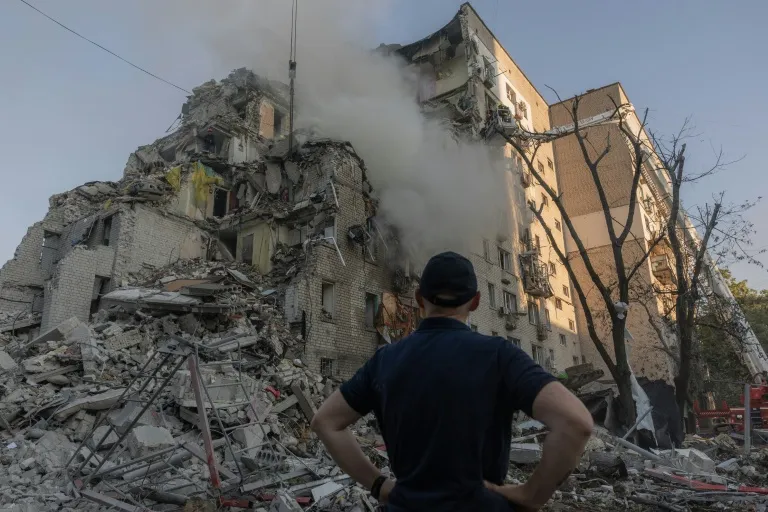
Kyiv residents experienced the most intense Russian aerial assault of the ongoing conflict, with a barrage of missiles and drones striking the capital late Wednesday and early Thursday. The attack, described by Ukrainian officials as the largest targeting Kyiv since the full-scale invasion began, resulted in significant casualties and widespread destruction, leaving many grappling with loss and a renewed sense of vulnerability.
Devastating Impact on Residential Areas
The attack inflicted severe damage, particularly on a high-rise building in the southeastern Darnytskyi district, where a section of the structure was obliterated. Debris rained down on unsuspecting residents, trapping some beneath the rubble and injuring dozens. For many, the sheer proximity and ferocity of the assault were unprecedented.
One survivor, who asked not to be named, recounted the terrifying moments: “I thought he was joking, but then I could hear whistling. I ran back into the building, covered my ears, and then — boom. Debris came crashing down on us.” She described the whistling sound of incoming projectiles and the sudden, violent impact that followed. This resident, who had previously experienced less direct threats from ballistic missiles, expressed the profound shock of being so close to such danger, stating, “I’ll remember this for the rest of my life.”
The experience has prompted a reassessment of safety measures among Kyiv’s population. While air raid alerts have become a grim routine since February 2022, many residents, weary of constant disruptions, have opted to stay in their homes rather than seek shelter in basements or metro stations. However, the recent attack has underscored the grave risks associated with this approach.
“Many people didn’t pay attention — just like I didn’t — because there’s nothing here to hit. But it hit the house directly,” shared another resident, emphasizing the indiscriminate nature of the strike. “So it’s better to go to the basement during an air alert. I’ve realised that now.”
Eyewitness Accounts of Fear and Resilience
Residents in the affected neighborhoods described a scene of chaos and disbelief. Karina Taran, a 25-year-old mother, recounted her decision to seek shelter for the first time: “I’d never gone down to a shelter, but today I did for the first time.” She explained that the sudden appearance of missiles in the sky prompted immediate action. “I grabbed my child and simply ran to the shelter, and I only came out in the morning.” The aftermath left her anxious about the well-being of her loved ones, as she noted, “Many of my close ones aren’t answering. Now we’re trying to get in touch with everyone.”
The scale of the destruction was starkly visible as dawn broke. Dozens of residents returned to find their homes reduced to ruins, their possessions scattered amidst the rubble. Sabina Mambetova, a 32-year-old factory worker who had previously fled from Kramatorsk in eastern Ukraine to Kyiv seeking safety, found herself displaced once again. “Half the building is destroyed. The roof is gone,” she stated, her voice heavy with despair. “I’ve been left without an apartment, alone with my child. I don’t know what to do now.” Her situation highlights the profound personal toll of the conflict, forcing individuals to repeatedly rebuild their lives.
Scope of the Russian Attack
According to data released by the Ukrainian air force, the overnight assault involved a significant deployment of aerial weaponry. Between late Wednesday and early Thursday, Russia launched approximately 496 drones and 74 missiles. This arsenal included a substantial number of ballistic projectiles, which are notoriously difficult to intercept.
The sheer volume of the attack led to an unprecedented surge in the number of people seeking refuge in the city’s underground transport system. The Kyiv metro reported that around 52,000 individuals, including 4,500 children, packed into its stations to shield themselves from the barrage. This figure represents the highest number of people seeking shelter in the metro system in recent years, underscoring the severity of the threat faced by the capital’s residents.
Aftermath and Ongoing Concerns
In the immediate aftermath, emergency services worked tirelessly to rescue those trapped and assess the damage. The attack has not only caused physical destruction but has also inflicted deep psychological scars on the population. The realization that even seemingly secure residential areas are vulnerable has intensified anxieties.
The resilience of Kyiv’s residents is being tested anew as they confront the devastation. The latest barrage serves as a stark reminder of the persistent dangers of the conflict and the urgent need for robust air defense systems. As the city begins the arduous process of recovery, the human cost of such attacks remains a central and tragic focus.
The events of late Wednesday and early Thursday have reinforced the critical importance of heeding air raid warnings, even for those who had grown accustomed to their interruption. The devastating impact on ordinary citizens, their homes, and their sense of security underscores the ongoing humanitarian crisis and the profound challenges faced by Ukraine in defending its cities and its people.
