

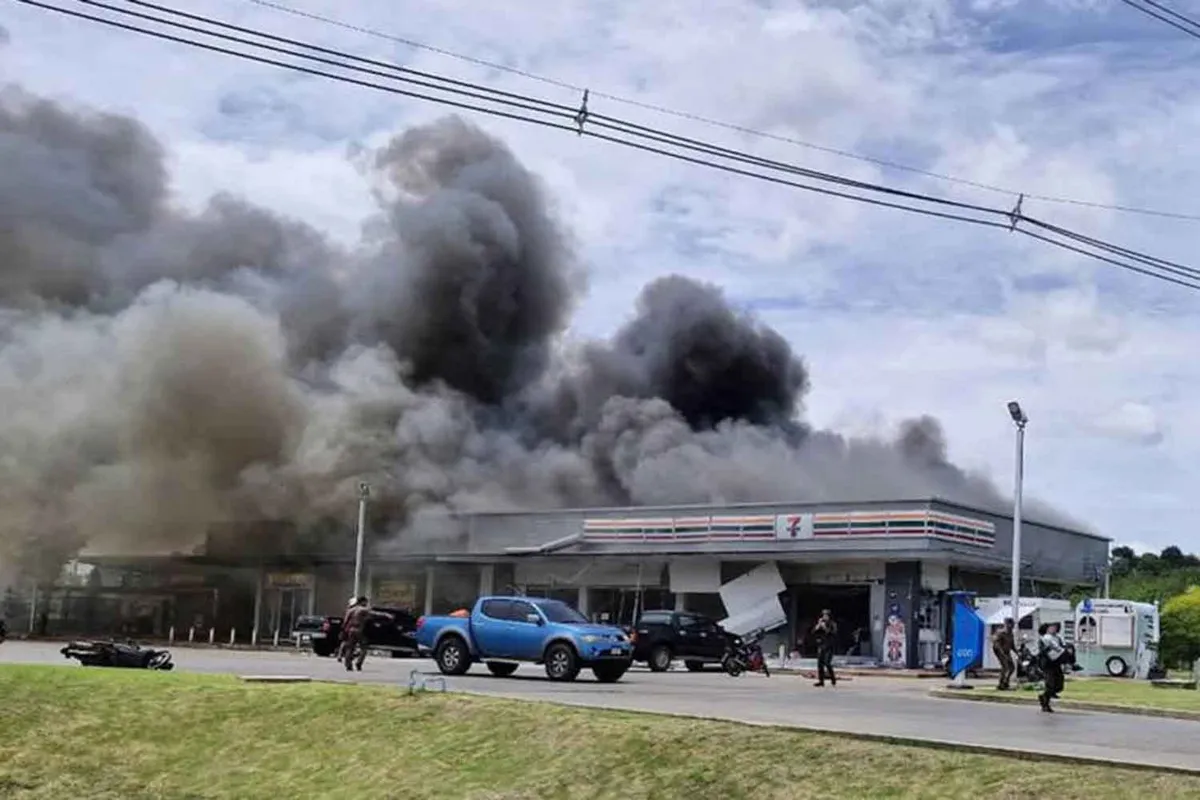
A PTT petrol station in Thailand’s Kantharalak district, which suffered significant damage and loss of life during a cross-border rocket attack from Cambodia last year, has been denied an additional government payout. The owner, Kamolrat Polsretlert, had petitioned parliament seeking further assistance, citing financial strain and the need to use personal savings for business continuity. The incident, which occurred on July 24 during a period of border conflict, resulted in seven fatalities and twelve injuries.
Background of the Border Incident
The rocket strike impacted a PTT Ban Phue petrol station and an adjacent 7-Eleven convenience store. The attack, attributed to the border conflict with Cambodia, caused widespread destruction and tragically claimed the lives of seven individuals, while another twelve sustained injuries. The immediate aftermath saw significant property damage, with the petrol station and the 7-Eleven store bearing the brunt of the impact.
Financial Impact and Compensation Efforts
Kamolrat Polsretlert, the proprietor of the PTT station, stated that the financial repercussions of the attack forced her to dip into funds earmarked for her children’s education to maintain business operations. The property damage to the petrol station alone was estimated at 3.05 million baht. The adjoining 7-Eleven experienced even greater losses, valued at approximately 14 million baht.
Following the incident, compensation processes were initiated. Dhipaya Insurance and PTT, the parent company, provided compensation for the damage to the petrol station. This allowed the station to resume operations by September 5. The 7-Eleven store received 9 million baht from CP All, its parent company, to help mitigate its substantial losses.
Compensation for the seven individuals who lost their lives in the attack was also addressed. The total payout for the fatalities amounted to approximately 58 million baht, and this has reportedly been fully distributed to the victims’ families. Additionally, the twelve individuals who were injured received a combined total of 4.6 million baht. Individual compensation for the injured varied, with amounts ranging from 100,000 to 800,000 baht, depending on the severity of their injuries.
Government Stance on Duplicate Compensation
Government spokeswoman Rachada Dhanadirek confirmed that Prime Minister Anutin Charnvirakul had directed relevant agencies to ensure that all assistance provided was fair and equitable. However, she explained the rationale behind the rejection of the petrol station owner’s request for additional funds from the prime minister’s disaster fund.
Ms. Dhanadirek emphasized that government policy strictly prohibits duplicate compensation for the same losses. Since the property damage to the petrol station had already been covered by insurance and PTT, a further payout from the disaster fund would constitute a duplication of benefits. This principle ensures that public funds are used appropriately and efficiently, preventing individuals or businesses from receiving multiple payments for the same damage.
Reopening and Future Outlook
Despite the denial of further government aid, the PTT Ban Phue petrol station was able to reopen its doors to the public on September 5, following the initial compensation for property damage. The reopening marked a significant step towards recovery for the business and its employees. The incident, however, serves as a stark reminder of the human and economic costs associated with cross-border conflicts.
The government’s approach highlights a commitment to providing aid in disaster situations while adhering to strict guidelines to prevent financial impropriety and ensure the responsible allocation of resources. While the petrol station owner’s plea for additional funds was unsuccessful, the existing compensation framework for victims of the rocket attack, including fatalities and injuries, has been largely implemented.
Conclusion
The case of the PTT Ban Phue petrol station underscores the complexities of disaster relief and compensation following violent incidents, particularly those stemming from cross-border conflict. While the government has facilitated compensation through insurance and corporate support, and has distributed funds to victims and their families, the denial of additional government aid to the petrol station owner reflects a policy against duplicate payments. The focus remains on ensuring that all parties affected by the attack receive appropriate, albeit not duplicated, assistance according to established protocols.
