

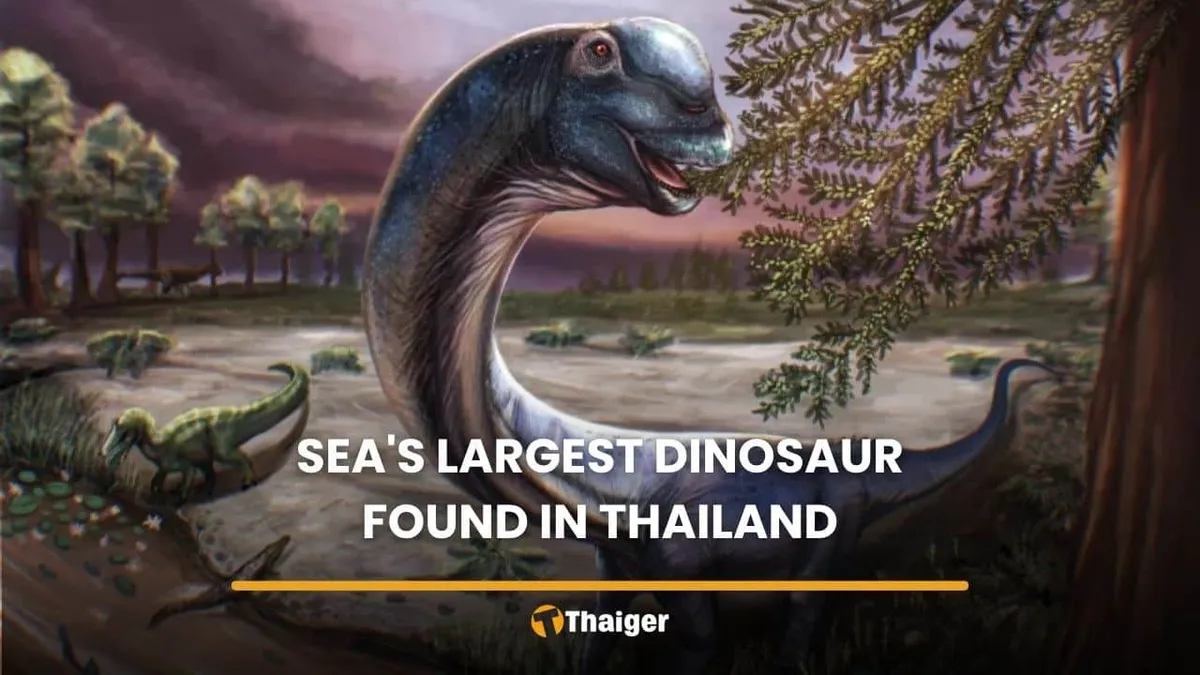
Scientists have identified a new dinosaur species in Thailand, marking the largest ever discovered in Southeast Asia. Fossils unearthed near a pond in Chaiyaphum province belong to a massive long-necked sauropod, estimated at 27 meters long and weighing 27 to 30 tonnes.
The species, Nagatitan chaiyaphumensis, roamed between 100 and 120 million years ago in the late Early Cretaceous period, about 40 million years before Tyrannosaurus rex. Researchers published the findings in Scientific Reports. The name blends “naga,” a mythical serpent from Southeast Asian folklore, “titan” for its immense size, and “chaiyaphumensis,” denoting its origin in Chaiyaphum province.
Discovery and Excavation
Local resident Thanom Luangnan first spotted the bones in 2016 along the banks of a public pond, describing them as unusual rocks. He alerted Thailand’s Department of Mineral Resources, sparking initial excavations from 2016 to 2019. Work paused due to funding issues but resumed in 2024 with new support.
The team recovered spine, rib, pelvis, and leg bones, including a front leg nearly six feet long. These form the most complete sauropod specimen from the Khok Kruat Formation to date. No full skeleton exists, but these elements enable precise size estimates.
Research Team Insights
Thitiwoot Sethapanichsakul, a doctoral student at University College London, led the study with Sita Manitkoon from Mahasarakham University, who directed the excavation. Palaeontologists Paul Upchurch from UCL and Pedro Mocho from Universidade de Lisboa provided key analysis.
Mocho highlighted that prior large dinosaur finds in Thailand consisted only of fragments. Sethapanichsakul dubbed Nagatitan Thailand’s “last titan,” as it hails from the youngest dinosaur-bearing rock layer in the region. Subsequent flooding turned the area into a shallow sea, making further major sauropod discoveries unlikely in Southeast Asia.
This marks the 14th dinosaur species named in Thailand. Manitkoon emphasized the nation’s rich fossil diversity, positioning it as potentially the third most abundant in Asia for dinosaur remains.
Size and Evolutionary Role
Weighing 27 to 30 tonnes, Nagatitan outweighed nine adult Asian elephants or over three T. rex individuals, though it ranks in the upper-middle tier among history’s giants. Later Cretaceous sauropods ballooned to 70 tonnes.
Nagatitan belongs to the somphospondyli group, known for elongated forelimbs and broad stances relative to other sauropods. The find signals an early phase in Cretaceous sauropod gigantism.
Climate and Ancient Habitat
During Nagatitan‘s era, Thailand lay nearer the equator amid open, arid shrublands. Earth experienced hothouse conditions with elevated CO2 and global temperatures, possibly spurring giant herbivore evolution.
Upchurch noted the paradox of large animals in extreme heat but suggested warmer climates altered vegetation, favoring massive plant-eaters. Comparisons with later Asian giants like China’s 60-tonne Ruyangosaurus reinforce how warm, dry habitats propelled sauropod size increases.
