

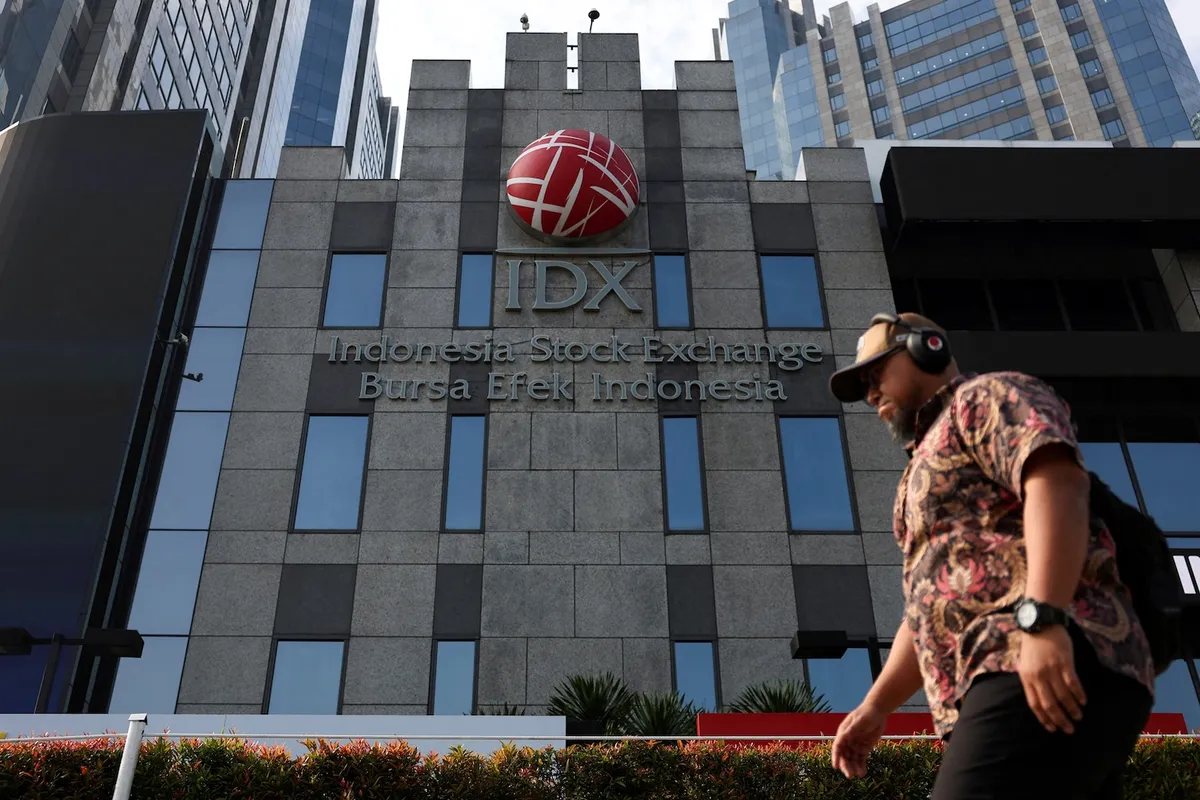
The Indonesian stock market has received a temporary reprieve from the threat of a downgrade to a “frontier market” status, following a decision to postpone a review by a key index provider. However, investors remain cautious, suggesting that this delay will not immediately entice long-term capital back into the struggling market.
Market Reaction and Potential Impact
The benchmark index experienced a 1.6% decline immediately after the announcement that the review would be pushed to November. This deferral, rather than an outright removal of the threat, means Indonesia could still be reclassified from an “emerging market” to a “frontier market.” Such a downgrade could lead to significant capital outflows, with estimates from US investment bank Goldman Sachs suggesting as much as $13 billion could exit Indonesian equities. This comes at a time when the Jakarta market’s capitalization has already seen a substantial drop, shrinking from over $900 billion in January to its current $600 billion.
Background of Market Volatility
Indonesian assets have faced considerable pressure since January. The situation intensified when the index provider initially froze the country’s stocks in its indices and introduced the possibility of a downgrade. In response, authorities initiated a series of reforms, including measures aimed at increasing free-float levels. Year-to-date, the index has fallen by 30%, positioning it as the world’s worst-performing major stock market, with overseas investors net selling approximately $3.9 billion worth of shares.
Investor Perspectives on the Reprieve
Tan Altundag, an investment manager specializing in emerging equities at Pictet Asset Management, commented that while keeping the market open to a wider range of funds is beneficial for the Jakarta bourse, it does not automatically restore investor confidence or halt capital outflows. “This is not a clear-cut recovery narrative, and the bar for re-engagement remains high,” he stated.
Analysis of the index provider’s statement indicates that the measures implemented by Jakarta were acknowledged as a “step in the right direction.” However, a warning was issued that a downgrade would still be considered if sufficient progress was not evident by November. Gary Tan, a portfolio manager at Allspring Global Investments, noted that the outcome aligned with market expectations, characterizing the tone of the statement as more cautionary than definitively negative. “What stood out is the clear shift toward implementation and measurable outcomes, signalling that announced reforms alone are not sufficient,” Tan observed. He added, “The extension of the review to November keeps pressure on regulators and effectively kicks the decision down the road.”
Momentum for Reforms and ETF Considerations
Indonesia’s financial regulator has indicated that the MSCI announcement will serve as a catalyst to strengthen and accelerate the capital market reform agendas that were launched in January. For passive emerging market funds and exchange-traded funds (ETFs), the impact of any potential downgrade is likely to be limited. Kunhee Park, an investment strategist for ETF equities at State Street Investment Management, pointed out that Indonesia’s weighting in the MSCI emerging markets index has already more than halved this year, now standing at less than 0.5%.
Broader Economic Concerns
Investor unease has been growing, partly fueled by concerns surrounding President Prabowo Subianto’s spending agenda. While this agenda supports initiatives like universal free meals, it has also contributed to the rupiah’s slide to record lows, creating a fragile overall investment backdrop. Earlier this year, credit rating firms Moody’s and Fitch both adjusted their debt rating outlooks for Indonesia to negative, citing a reduction in policymaking credibility.
The Path Forward
Mohit Mirpuri, a Singapore-based fund manager at SGMC Capital, described the MSCI extension as a more favorable outcome than many had anticipated. He emphasized that the responsibility now lies with Indonesian regulators. “The next few months will be about execution, credibility and evidence rather than further policy announcements,” Mirpuri concluded.
