

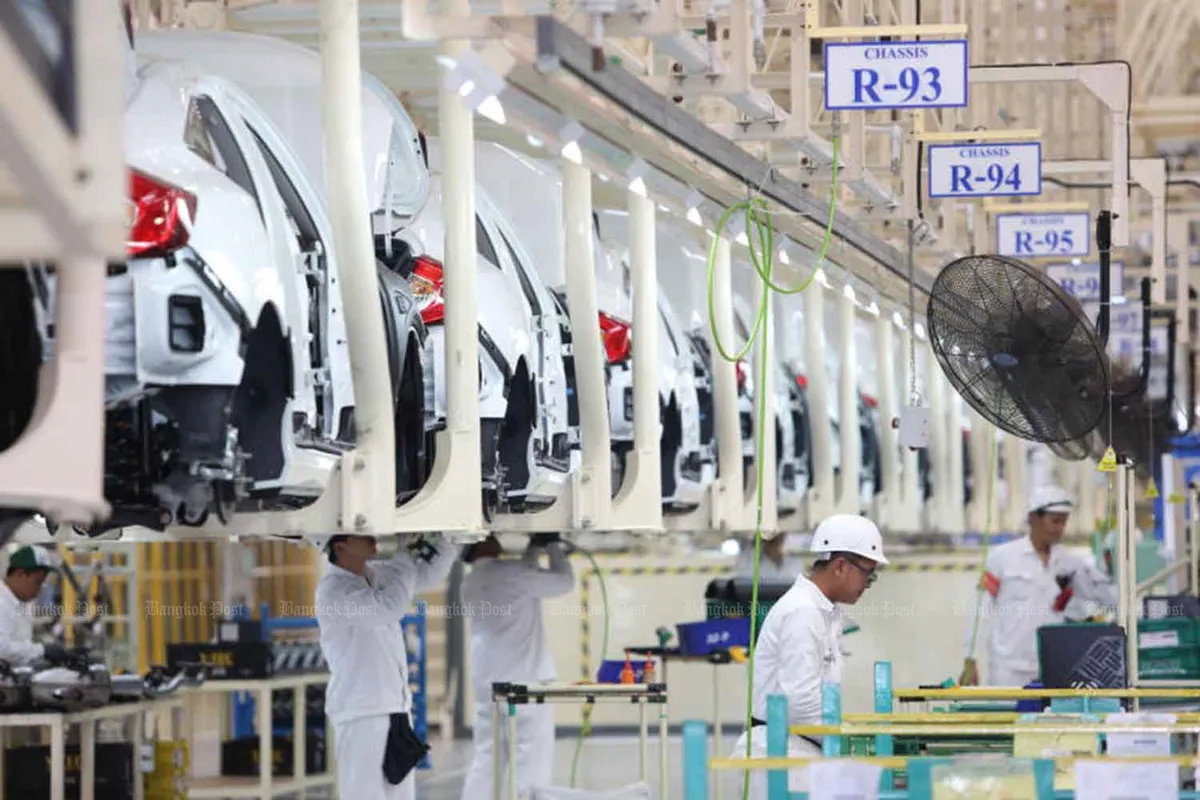
Thailand’s automotive industry has experienced a significant downturn in production and exports during the first five months of the year. This decline is primarily attributed to geopolitical tensions, specifically the conflict involving Iran, which has severely disrupted global trade routes and impacted the nation’s vehicle shipments. In May alone, overall vehicle production saw a sharp decrease of 17.9% compared to the previous year, with a total of 114,214 units manufactured.
Impact of Middle East Conflict on Exports
The Federation of Thai Industries (FTI) highlighted the closure of the Strait of Hormuz, a vital shipping artery, as a major impediment to Thailand’s car exports, particularly to the Middle East. This region represents the country’s third-largest market for vehicles, following Asia and Australia. While demand for pickup trucks in the Middle East remains robust, the logistical challenges have led to a substantial reduction in shipments.
Surapong Paisitpatanapong, an advisor and spokesman for the FTI’s Automotive Industry Club, noted that this situation marks an unprecedented shift where car production destined for export has fallen below that intended for the domestic market. In May, car production for export plummeted by 36.2% year-on-year. This included a 22.6% drop in passenger car output and a staggering 38.7% decrease in pickup truck production. Exports to the Middle East bore the brunt of this downturn, falling by 66.1% year-on-year in May to 59,434 units.
Challenges in Other Export Markets
Beyond the Middle East, other key export destinations have also shown declines. Oceania, which includes Australia, experienced a 37.1% reduction in vehicle shipments. This decrease is partly attributed to the increasing presence of Chinese battery electric vehicle (BEV) brands in the Australian market, alongside Australia’s stringent carbon policies. These policies are part of the nation’s broader strategy to achieve climate neutrality by the year 2040.
Cumulatively, Thailand’s total vehicle exports from January to May decreased by 8.53% year-on-year, reaching 333,618 units. This figure underscores the widespread challenges facing the export segment of the automotive sector.
Domestic Sales Show Resilience
In contrast to the export figures, domestic vehicle sales have demonstrated considerable resilience. Production for the local market saw a healthy increase of 12.7% in May. Over the first five months of the year, overall domestic sales climbed by 14.1% year-on-year, totaling 288,242 units. May alone recorded a 10.6% rise in domestic sales, reaching 57,765 units.
Several factors are contributing to this domestic strength. There is a growing demand for battery electric vehicles (BEVs) and sport utility vehicles (SUVs) within Thailand. Furthermore, rising global crude oil prices have spurred increased interest in more energy-efficient vehicle models, further boosting sales of certain segments.
Economic Outlook and Lingering Concerns
Despite the challenges in the export market, Mr. Paisitpatanapong expressed a degree of cautious optimism. He pointed to government stimulus measures as a potential positive influence on the economy. The government has also adjusted its GDP growth forecast for 2026, projecting it at 2.3%.
However, significant concerns remain for the automotive sector’s future. High levels of household debt continue to be a pressing issue, potentially dampening consumer spending. Additionally, the broader global economic slowdown, exacerbated by the ongoing conflict in the Middle East, poses a persistent threat to both domestic and international market stability for Thailand’s automotive industry.
Key Factors Affecting the Automotive Sector
- Geopolitical Instability: The conflict involving Iran has disrupted critical shipping lanes like the Strait of Hormuz, severely impacting export routes.
- Reduced Export Demand: Shipments to key markets, particularly the Middle East, have seen sharp declines due to logistical barriers and trade route disruptions.
- Market Competition: The growing presence of Chinese BEV brands and stringent environmental policies in markets like Australia add competitive pressure.
- Domestic Market Strength: Robust local demand for BEVs and SUVs, coupled with interest in fuel-efficient vehicles due to oil prices, supports domestic sales.
- Economic Headwinds: High household debt and the global economic slowdown present ongoing challenges for the sector.
The automotive industry in Thailand is navigating a complex landscape, balancing the resilience of its domestic market against significant headwinds in its export markets, largely driven by global geopolitical and economic factors.
