

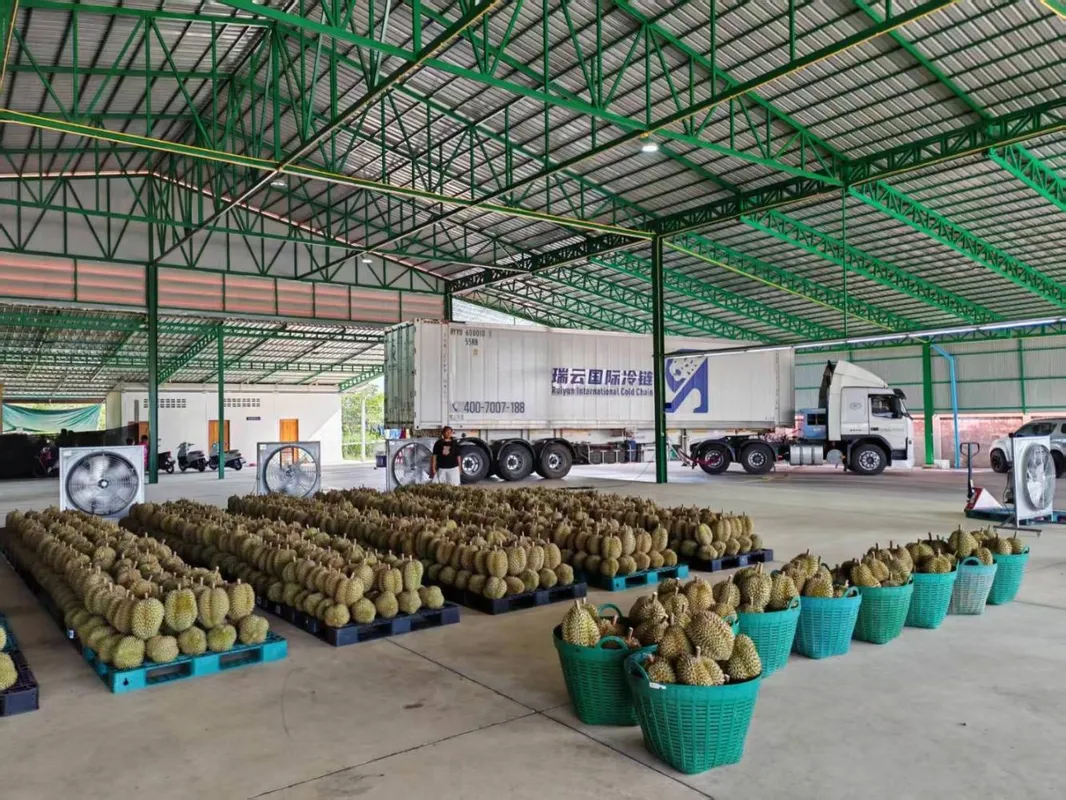
Thailand’s border trade with third countries experienced a significant expansion in May, primarily propelled by robust demand for durian exports, particularly to China. This surge in trade with nations beyond its immediate neighbors offset a decline in trade with its direct bordering countries, highlighting a dynamic shift in regional commerce. The Department of Foreign Trade (DFT) reported that this specific category of border trade, which involves using transit routes through neighboring countries to reach final destinations, was the main engine of overall border trade activity during the month.
Third-Country Border Trade Soars in May
In May, the total value of border trade with third countries reached 145.4 billion baht, marking a substantial year-on-year increase of 26.2%. Exports within this segment grew by 24.3% to 91.2 billion baht, while imports saw an even more impressive rise of 29.6%, totaling 54.1 billion baht. This performance underscores the growing importance of these indirect trade routes for Thailand’s economy.
Durian Dominates Export Growth
The star performer in Thailand’s export basket for May was undoubtedly durian. The country exported a staggering 311,587 tonnes of the fruit, generating 39.4 billion baht in revenue. This represents a significant year-on-year jump of 30.9%. Crucially, nearly all of these exports, amounting to 311,549 tonnes, were destined for China, underscoring the immense market for Thai durian in the People’s Republic of China.
Key Import Categories Show Strong Gains
On the import side, border trade with third countries also demonstrated considerable strength. Several key categories experienced notable growth. Computer-related goods were particularly strong, with magnetic tape and magnetic disks for computers increasing by 8%. More dramatic gains were seen in computers and peripherals, which surged by 87.7%, and computer components, up by 74.7%. These figures suggest a robust demand for technology goods flowing into Thailand through these indirect channels.
China Leads Trade Value, Singapore and Vietnam Follow
China emerged as Thailand’s largest trading partner in May under the third-country border trade category, with a total trade value of 92.7 billion baht, an increase of 19.8% compared to the previous year. Following China, Singapore and Vietnam also showed significant trade growth, expanding by 55.8% and 52.1%, respectively. These statistics highlight the expanding economic ties between Thailand and key Asian markets.
Year-to-Date Performance Reflects Strong Growth
The positive momentum observed in May extended to the first five months of the year. Border trade with third countries accumulated a total value of 557.9 billion baht, a remarkable growth of 38.2% compared to the same period last year. Exports during this period reached 308.3 billion baht, up 40.3%, while imports climbed by 35.7% to 249.6 billion baht. This sustained growth indicates a healthy and expanding trade relationship through these indirect routes.
Border Trade with Neighboring Countries Declines
In contrast to the performance with third countries, Thailand’s border trade with its four immediate neighboring countries—Malaysia, Laos, Myanmar, and Cambodia—experienced a downturn in May. The overall trade value in this segment fell by 13.5% year-on-year to 74 billion baht. Exports saw a sharper decline of 24.9%, reaching 41.1 billion baht, while imports decreased by 6.6% to 32.9 billion baht.
Malaysia Leads, Cambodia Trade Remains Stagnant
Among the neighboring countries, Malaysia recorded the highest trade value, followed by Laos and Myanmar. However, border trade with Cambodia remained at zero, attributed to ongoing border closures which have significantly hampered commercial activity. Major export goods in this category included diesel and other refined petroleum products, along with concentrated latex.
First Five Months Show Decline for Neighboring Countries
The trend of decline was also evident in the cumulative figures for the first five months of the year for trade with neighboring countries. The total border trade value dropped by 18.2% to 351.5 billion baht. Exports fell by 22.5% to 202.3 billion baht, and imports decreased by 11.6% to 149.1 billion baht. This persistent decline suggests ongoing challenges in trade relations with these immediate neighbors, contrasting sharply with the growth seen in third-country trade.
Conclusion
The May trade data reveals a bifurcated landscape for Thailand’s border commerce. While the lucrative export of durians and strong demand for technology goods fueled a significant expansion in trade with third countries, persistent challenges have led to a contraction in trade with direct neighbors. The DFT’s findings underscore the strategic importance of indirect trade routes and the immense potential of markets like China for key Thai agricultural products. Moving forward, understanding and navigating these distinct trade dynamics will be crucial for Thailand’s economic strategy.
