

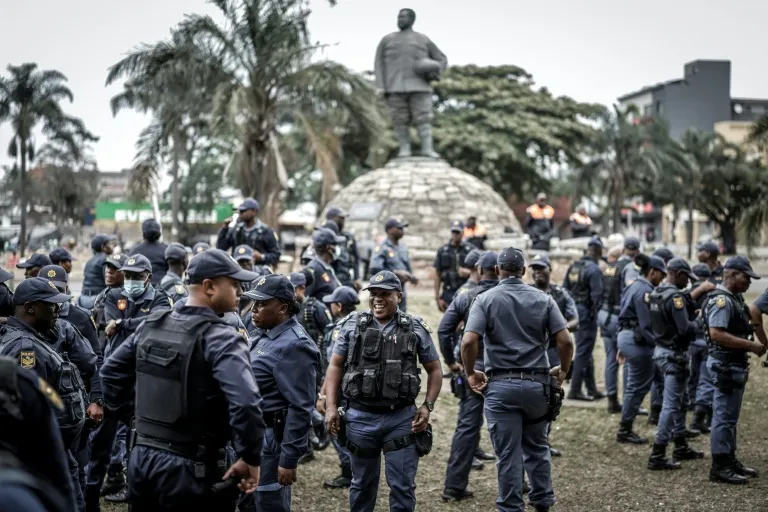
South Africa saw a significant police presence on the streets as tensions surrounding anti-migrant sentiment escalated, with authorities working to prevent violence and looting. Hundreds of foreign nationals sought refuge in various cities, expressing an urgent desire to leave the country. The situation led to many businesses remaining closed, particularly in downtown Johannesburg, which experienced an unusual quietness as law enforcement officers patrolled the area.
Roots of the Unrest
The recent protests were reportedly organized by a diverse coalition of smaller political parties and citizen-led vigilante groups. Analysts suggest these organizations are well-coordinated and possess substantial resources, leveraging a strong presence on social media platforms. However, this online activity has also been noted to include the spread of disinformation, which has been fact-checked and debunked.
In Durban, a city in the country’s southeast, smaller gatherings of protesters were observed. Dressed in traditional Zulu attire and carrying symbolic sticks and shields, they sang chants, including the phrase “abahambe,” which translates to “Let them go.” Security forces maintained a watchful presence during these demonstrations.
One protester, identified as Selwyn Anderson, a 64-year-old pensioner, shared his perspective, stating, “I travelled a bit in Africa. All these countries are messed up and South Africa is the America of Africa.” He expressed a belief that undocumented foreign nationals had taken over many small businesses within the country.
Escalating Violence and Repatriation Efforts
The growing anti-immigrant sentiment has been accompanied by tragic violence. In recent weeks, at least two individuals from Mozambique, one from Ethiopia, and one from Malawi have been killed in incidents linked to anti-immigrant hostility. In response, several African governments have initiated repatriation plans, arranging for planes and buses to help their citizens return home.
South Africa, despite being one of the continent’s more prosperous nations, faces significant challenges. It attracts a large number of migrant workers, yet struggles with a high unemployment rate exceeding 30 percent, persistent crime, and deteriorating public services in many regions. The current anti-migrant push is occurring in the lead-up to local government elections scheduled for November.
“Politically Weaponised” Migration Concerns
Labor analyst Dale McKinley commented on the situation, suggesting that the anti-migrant movement has been “politically weaponised.” He argued that the underlying issues driving the xenophobia are not the fault of migrant groups but stem from broader problems with governance, corruption, and mismanagement. “The xenophobic groups have got it wrong,” McKinley stated.
In response to the escalating situation, Uganda announced an “evacuation plan” to begin shortly, aiming to assist nearly 750 of its citizens in departing South Africa. As a self-imposed deadline of June 30 approached, thousands of people, predominantly from Malawi and Zimbabwe, gathered in major cities like Cape Town and Johannesburg, awaiting assistance to return to their home countries.
Many shared stories of hardship, including being evicted by landlords or dismissed by employers who feared repercussions from officials or attacks by vigilante groups. Malawian national Peter Madsoan, 45, a builder, explained his decision to leave: “I decided to go to avoid being attacked. It is better for me to go than to die in South Africa.”
Evelyn Chinooneka, 29, from Zimbabwe, described camping outside the Zimbabwean consulate in Cape Town with her 10-month-old baby for days, enduring rain and discomfort while waiting for transport. She had worked on a farm outside Cape Town for four years before being asked to leave.
Calls for “Rolling Mass Action” and Government Response
Jacinta Ngobese-Zuma, a leader associated with the anti-immigrant March and March group, had previously announced plans for “a national march to freedom, a rolling mass action” to commence on June 30, with the objective of deporting all undocumented foreign nationals. She emphasized that their movement was not calling for violence or looting.
The government, concerned about a potential recurrence of the widespread unrest experienced five years prior, which resulted in approximately 350 fatalities due to looting and riots, ordered a significant security deployment. Authorities also issued warnings against opportunistic criminal activity.
The July 2021 unrest was initially triggered by the brief imprisonment of former president Jacob Zuma. In the period leading up to June 30, President Cyril Ramaphosa outlined enhanced government strategies to address illegal immigration and appealed to traditional leaders to help de-escalate tensions.
Thami Ntuli, the premier of KwaZulu-Natal province, stated that regardless of concerns about undocumented migration or legitimate frustrations, the province would not permit a repeat of the violence seen previously. He stressed that such actions would not be tolerated, whether driven by criminality or xenophobia.
Historical Context of Xenophobic Violence
South Africa has a history of violent incidents targeting undocumented foreign nationals. In 2008, riots resulted in the deaths of 62 people. However, the current situation is notable for the coordinated repatriation efforts by multiple governments simultaneously assisting thousands of their citizens to leave.
The government’s response includes increased police visibility and efforts to manage the influx of foreign nationals, alongside addressing the underlying socio-economic factors contributing to xenophobia. The situation highlights the complex interplay of migration, unemployment, governance, and social cohesion in South Africa.
