

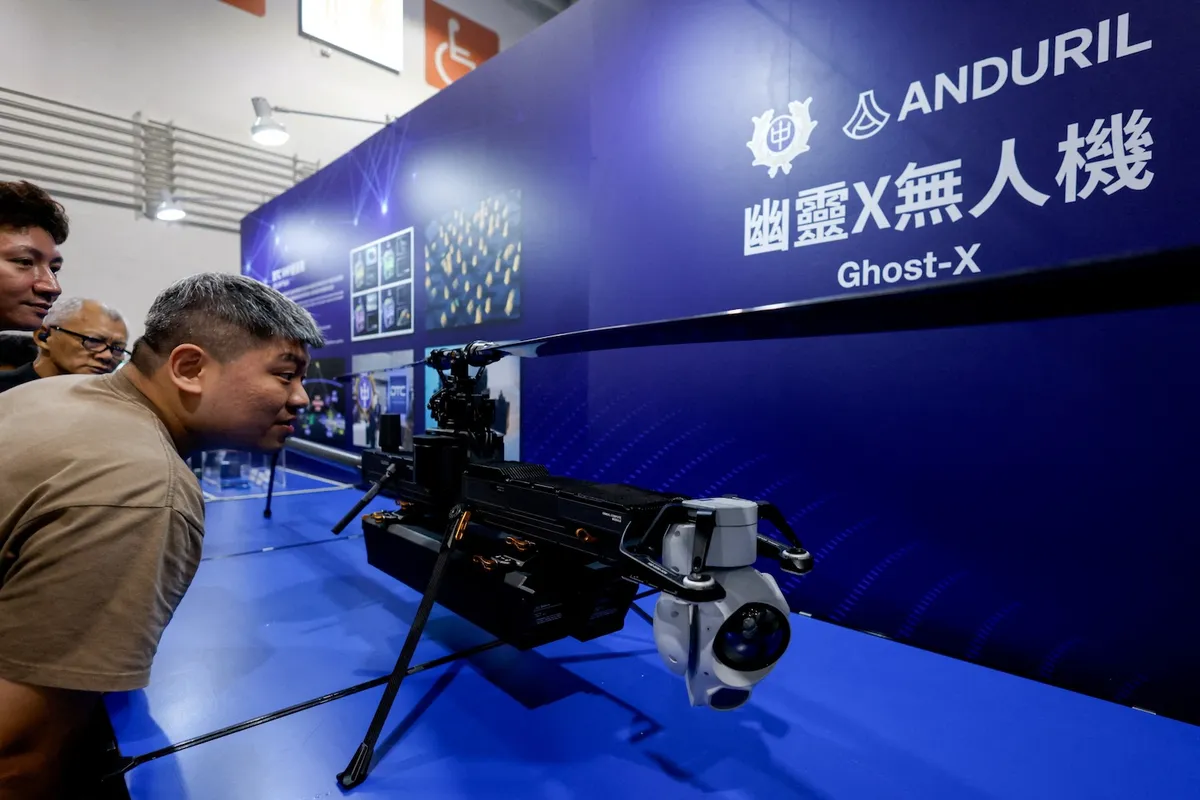
Taiwan should develop a comprehensive network of aerial, surface, and subsurface drones to deter potential aggression, according to a senior US diplomat. Raymond Greene, director of the American Institute in Taiwan and the de facto US ambassador, emphasized that such a strategy could significantly bolster the island’s security and contribute to regional stability.
The Strategic Importance of Drones
Speaking at a forum focused on drone technology in Taichung, Greene highlighted drones as a “game-changing opportunity” for enhancing Taiwan’s defense capabilities. He noted that the technology has already proven effective in empowering defenders, even when facing numerically superior adversaries, citing the ongoing conflict in Ukraine as a prime example. Greene suggested that transforming Taiwan into a “hornets’ nest” of drones would serve as a powerful deterrent against conflict.
The American Institute in Taiwan, representing US interests in the absence of formal diplomatic relations, has consistently supported Taiwan’s military modernization efforts and increased defense spending. This backing is crucial for Taiwan, which faces escalating threats from China. Beijing considers the self-governing island its territory and has not ruled out the use of force to achieve unification.
Greene also pointed to the potential for the US and Taiwan to collaborate on “democratic” drone production. Such partnerships, he argued, could strengthen the collective deterrence posture of democratic nations worldwide.
Taiwan’s Defense Modernization and Drone Initiatives
Taiwan’s government has recognized the critical need to bolster its defenses against China’s assertive stance. President Lai Ching-te has made building asymmetric combat capabilities a national priority, describing it as a “race against time” given the evolving geopolitical landscape and modern warfare tactics. Lai firmly rejects Beijing’s sovereignty claims, asserting that Taiwan’s future can only be decided by its own people.
In line with this strategy, Taiwan has been prioritizing the development and acquisition of drones and other asymmetric defense systems. However, the path to securing adequate funding has faced political hurdles.
Legislative and Funding Challenges
In May, the opposition-controlled parliament approved only two-thirds of the approximately US$40 billion in additional defense spending requested by President Lai. The funds that were allocated were specifically earmarked for arms procured from the United States.
Undeterred, the government has since proposed a new defense package amounting to $6.6 billion. This package, intended to cover the period through 2031, focuses on acquiring surveillance drones, coastal attack drones, and small unmanned surface drones. These systems are designed to enhance Taiwan’s ability to monitor its territory, project power along its coast, and counter potential maritime threats.
Opposition Proposals
Taiwan’s main opposition party, the Kuomintang (KMT), has also put forward its own drone-related legislation. The KMT’s proposal includes a spending cap of $7.5 billion over six years. A key difference in their plan is the proposed funding mechanism: the KMT suggests allocating funds for drones from the main government budget, whereas the current administration prefers a special budget dedicated to these defense initiatives.
President Lai emphasized the urgency of acquiring drones during a recent meeting with his Democratic Progressive Party. He reiterated that developing asymmetric capabilities is essential for national defense in the face of changing geopolitical dynamics and the advancements in modern warfare.
The Broader Context of Regional Security
The strategic discussions surrounding Taiwan’s drone capabilities occur against a backdrop of heightened tensions in the Indo-Pacific region. The United States, as Taiwan’s primary international supporter, plays a significant role in ensuring the island’s security. The emphasis on asymmetric warfare, particularly through drone technology, reflects a broader shift in military thinking, prioritizing agility, cost-effectiveness, and the ability to counter larger, more conventional forces.
By developing a robust drone defense network, Taiwan aims to create a formidable deterrent that would make any potential invasion prohibitively costly for an aggressor. This strategy aligns with principles of asymmetric defense, where a smaller, technologically advanced force can effectively counter a larger, more traditional military power. The success of such initiatives will depend not only on technological advancements but also on sustained political will and adequate financial investment, navigating the complexities of legislative approval and inter-party cooperation.
