

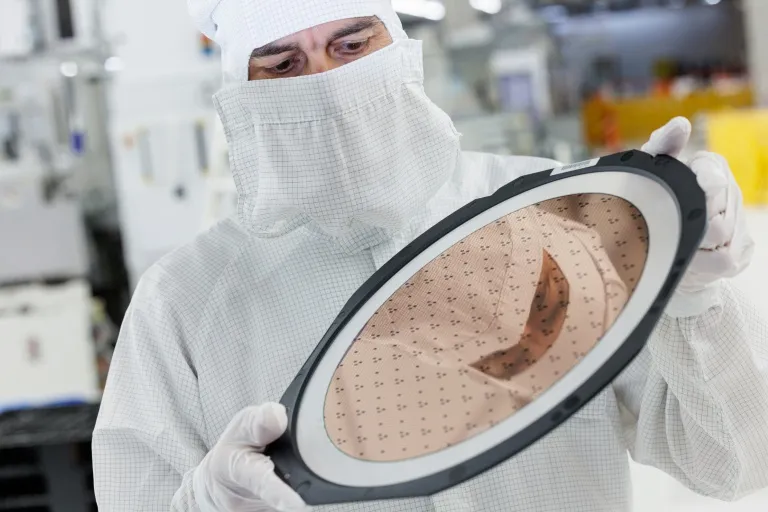
Infineon Technologies has officially inaugurated its state-of-the-art “Smart Power Fab” in Dresden, Germany, a significant development aimed at bolstering Europe’s semiconductor manufacturing capabilities. The facility, completed three months ahead of schedule, is positioned as a key element in the European Union’s strategy to reduce reliance on Asian and American suppliers for critical electronic components.
Strengthening Europe’s Semiconductor Hub
The opening ceremony underscored the ambition to enhance Europe’s standing in the global semiconductor market. Infineon CEO Jochen Hanebeck emphasized that achieving technological sovereignty requires tangible investments in manufacturing infrastructure, stating, “And technological sovereignty does not begin with words, but with factories like this one.” The new plant is designed to produce advanced chips essential for intelligent power management, catering to a wide range of modern technologies including electric vehicles, renewable energy systems like wind turbines and solar plants, and the data centers that power artificial intelligence.
Operating around the clock, the highly automated facility features specialized “clean rooms” where air is meticulously filtered to remove nearly all dust particles. Employees working within these sensitive environments don protective suits, hoods, masks, gloves, and boots to prevent any form of contamination, ensuring the precision required for semiconductor fabrication.
Strategic Investment and EU Support
The development of the “Smart Power Fab” received substantial backing through the EU’s Chips Act, with approximately one billion euros in subsidies. This initiative is part of a larger EU policy framework designed to double the bloc’s share of global semiconductor production from the current 10 percent to 20 percent by the year 2030. German Chancellor Friedrich Merz, addressing the event via video link, highlighted the plant’s strategic importance for Germany’s digital sovereignty, economic resilience, and overall independence. He noted the record-breaking investments in data centers, driven by the AI boom, and stressed that foundational investments made today are crucial for the industries of the future.
A Pivot for Infineon and ‘Silicon Saxony’
The Dresden facility represents the largest single investment in Infineon’s history and marks a strategic shift for the company, which is headquartered outside of Munich. Historically a major supplier to the automotive sector, Infineon is now also focusing on capitalizing on the burgeoning demand driven by massive investments in artificial intelligence. This pivot, however, occurs amidst considerable market volatility for AI-related stocks, fueled by concerns about the profitability of these large-scale investments.
The plant’s location in Dresden places it at the heart of Germany’s “Silicon Saxony,” a region renowned for its vibrant microchip industry cluster. This area has a long history of semiconductor innovation, dating back to investments made during the era of communist East Germany. Dresden’s ecosystem benefits from nine universities, providing a steady supply of trained engineers sought after by the approximately 2,500 companies operating in the region’s technology sector. Germany’s digital minister, Karsten Wildberger, pointed out the regional significance, stating, “One in three chips produced in Europe is made in Saxony.”
Economies of Scale in Chip Manufacturing
Experts explain that while the initial construction of advanced semiconductor facilities like the “Smart Power Fab” involves immense costs, the subsequent cost per unit of microchips produced will be significantly lower. Wolfgang Weber, head of the German electronics association ZVEI, elaborated on this principle: “The chip industry is a business driven by extreme economies of scale.” He further explained, “The first chip is incredibly expensive because you have to build a factory first — an investment that can run into the billions of euros. Once production is up and running, unit costs drop sharply.” This dynamic highlights the strategic necessity of large-scale, advanced manufacturing facilities to remain competitive in the global semiconductor market.
Future Outlook and Challenges
The opening of the Infineon plant in Dresden is a critical step towards achieving greater semiconductor self-sufficiency within the European Union. By investing in advanced manufacturing and fostering regional expertise, Germany and the EU aim to secure a more stable supply chain for essential electronic components. The success of such initiatives will depend not only on technological advancement and production efficiency but also on navigating the economic complexities and market fluctuations inherent in the high-stakes semiconductor industry.
