

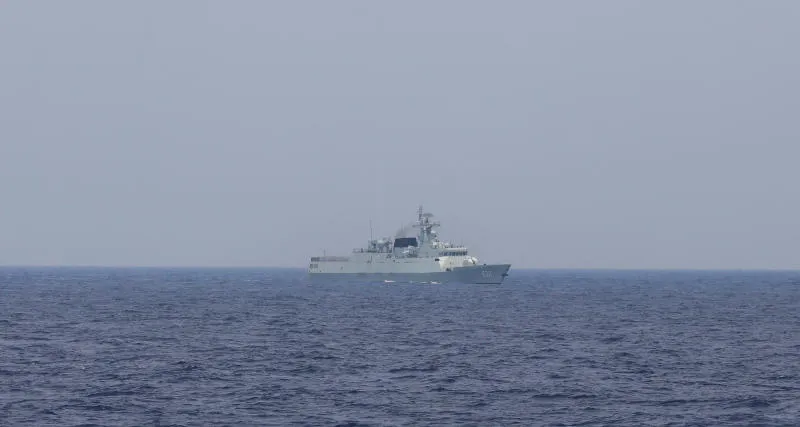
A Philippine sailor sustained a head injury during a recent encounter with the China Coast Guard near the Second Thomas Shoal in the South China Sea. The incident, which involved the use of a wooden baton and resulted in damage to a Philippine vessel, has heightened tensions in the disputed waters.
Details of the South China Sea Encounter
The Philippine government reported that two of its rubber boats were dispatched to deter a China Coast Guard inflatable boat, reportedly carrying eight personnel. This Chinese vessel had approached a deliberately grounded Philippine Navy warship, the BRP Sierra Madre, which serves as a maritime outpost. According to Manila, a Chinese coast guard member struck a Filipino sailor on the head with a wooden baton, causing injury. Additionally, one of the Philippine rubber boats sustained damage during the confrontation.
The Department of Foreign Affairs in the Philippines issued a strong statement, declaring, “Any act of violence against Filipino personnel is unacceptable and will merit the appropriate diplomatic action.”
Background of the Dispute
The Second Thomas Shoal, a feature in the South China Sea, is controlled by Manila but claimed by Beijing. The BRP Sierra Madre, a tank landing ship, has been intentionally grounded on the shoal since 1999 to assert Philippine presence. This latest incident follows a series of confrontations in the region. Notably, in 2024, a previous encounter saw a Filipino sailor lose a finger after a Chinese vessel allegedly rammed a Philippine boat.
In an effort to de-escalate tensions, Beijing and Manila had reached a temporary agreement earlier in 2024. However, the Philippine military stated that this most recent event “escalates tensions” within the strategically vital South China Sea.
Conflicting Accounts of the Incident
The South China Sea is a focal point of overlapping territorial claims, with China asserting sovereignty over most of the waters, including areas also claimed by the Philippines, Brunei, Malaysia, Vietnam, and Taiwan. In response to the Philippine account, the China Coast Guard issued its own statement, asserting that the Philippine side had “distorted the facts and falsely accused” China. Beijing claimed that Philippine personnel initiated the confrontation by attacking Chinese law enforcement officers using implements such as oars and sticks.
According to the Chinese statement, a small Chinese coast guard patrol boat was conducting a routine patrol when the “illegally grounded” Philippine warship deployed two rubber boats. These boats, the statement alleged, ignored multiple warnings and proceeded to approach and dangerously collide with the Chinese patrol boat.
Broader Implications and Regional Stability
This confrontation underscores the persistent challenges to maritime security and freedom of navigation in the South China Sea. The area is a critical global trade route, and disputes over its waters have been a source of regional instability for decades. China’s expansive claims, often referred to as the “nine-dash line,” are not recognized by international arbitration tribunals, yet Beijing continues to assert its presence through its coast guard and maritime militia.
The Philippines, as a claimant state and treaty ally of the United States, has been increasingly vocal in challenging what it describes as aggressive actions by the China Coast Guard. These actions often involve water cannon use, blocking maneuvers, and, as in this instance, alleged physical altercations. The diplomatic fallout from such events can be significant, potentially impacting regional alliances and international relations.
The international community closely monitors these incidents, with many nations calling for adherence to international law, particularly the UN Convention on the Law of the Sea (UNCLOS), and for the peaceful resolution of disputes. The repeated confrontations highlight the difficulty in maintaining stability despite diplomatic efforts and agreements aimed at managing these complex maritime disagreements. The injury to the Philippine sailor serves as a stark reminder of the human cost of these ongoing territorial disputes.
Future Diplomatic and Military Responses
Following the incident, the Philippines is expected to pursue diplomatic channels to address the actions of the China Coast Guard. This may involve lodging formal protests, engaging in bilateral consultations, and potentially raising the issue in multilateral forums. The Philippine military will likely review its operational protocols and readiness in the face of continued challenges at sea.
The response from China will also be closely watched. Beijing’s consistent assertion of its claims and its narrative of self-defense in these encounters suggest a continued strategy of asserting control over the disputed territories. The interplay between diplomatic pressure, international law, and on-the-ground actions will shape the future of maritime interactions in the South China Sea.
Conclusion
The recent injury of a Philippine sailor during an encounter with the China Coast Guard at the Second Thomas Shoal marks another escalation in the long-standing territorial disputes in the South China Sea. With conflicting accounts from both sides, the incident underscores the volatile nature of the region and the challenges in achieving a peaceful resolution. The Philippines has vowed diplomatic action, while China maintains its stance on routine patrols and alleges provocation by Filipino personnel. This event serves as a critical reminder of the ongoing geopolitical tensions and the importance of de-escalation and adherence to international maritime law.
