

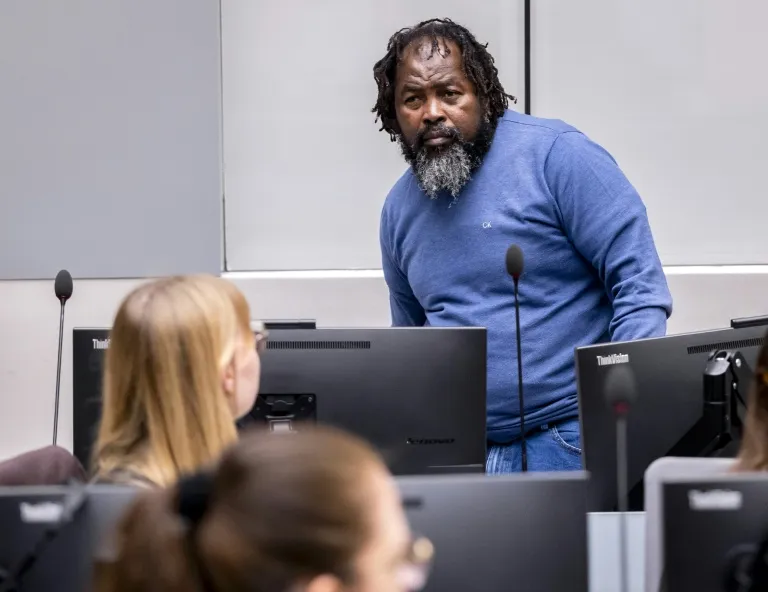
Mahamat Said Abdel Kani, a 56-year-old former rebel leader in the Central African Republic (CAR), has been convicted by the International Criminal Court (ICC) for overseeing severe beatings and mistreatment. The crimes occurred in 2013 when Kani headed a notorious detention facility during the CAR’s descent into civil war. During the proceedings, Kani, dressed in casual attire, repeatedly shook his head as presiding judge Miatta Maria Samba detailed the charges.
Conviction for Crimes Against Detainees
The ICC found Mahamat Said Abdel Kani guilty of overseeing torture and inhumane treatment while he was in charge of the Central Office for the Repression of Banditry (OCRB) detention center in the capital, Bangui. This facility became a site where prisoners endured horrific acts. Judge Samba described a torture method known as “arbatachar,” which involved tightly binding a detainee’s hands, elbows, and feet behind their back. Other victims reported being beaten with ropes and whips, and subjected to having water poured on them.
The court recognized the profound suffering of the victims, many of whom testified about the enduring psychological and physical trauma inflicted by the mistreatment. One victim shared with the court how the abuse had left him “completely unbalanced and that his life had been completely destroyed by the mistreatment he suffered.”
Further evidence presented detailed Kani’s practice of holding detainees in a cramped, unsanitary cell located beneath his office. The judge stated, “Detainees had to urinate and defecate inside the underground cell. The underground cell was dark, cramped, dirty, and insufficiently ventilated,” adding that “The floor was covered in waste and it smelled of faeces and urine.” Kani was implicated in the interrogation and mistreatment of detainees and was reportedly present during instances of torture, according to the court’s ruling.
Background of the Central African Conflict
Mahamat Said Abdel Kani was a significant figure within the predominantly Muslim Seleka rebel coalition. This group was instrumental in overthrowing President Francois Bozize, an action that plunged one of the world’s poorest nations into a brutal sectarian conflict. The Seleka’s rise to power ignited a devastating civil war, resulting in thousands of civilian deaths and widespread allegations of war crimes committed by various factions.
In response to the Seleka’s actions, Bozize-aligned militias, largely composed of Christian and animist members and known as “anti-Balakas,” emerged to challenge the rebels and attempt to regain control. International intervention, including French troops operating under a United Nations mandate, helped stabilize key urban areas starting in 2014.
A peace agreement signed in Khartoum in 2019 marked a significant step towards stabilizing the nation, which has a population of approximately five million. President Faustin-Archange Touadera has since been elected to multiple terms, campaigning on a platform of restoring order after decades of instability.
Previous ICC Convictions in the CAR
This conviction follows earlier rulings by the ICC concerning atrocities committed during the CAR conflict. In the preceding year, the court found two prominent anti-Balaka leaders guilty of war crimes. These individuals included:
- Patrice-Edouard Ngaissona: A former sports minister and a high-ranking leader within the anti-Balaka movement.
- Alfred Yekatom: A former Member of Parliament who commanded anti-Balaka forces on the ground.
Yekatom received a 15-year prison sentence for 20 counts of war crimes and crimes against humanity, encompassing murder and torture. Ngaissona was sentenced to 12 years for his involvement in 28 counts of war crimes and crimes against humanity.
The Role of the International Criminal Court
Established in 2002, the International Criminal Court serves as the world’s primary independent judicial body tasked with prosecuting individuals accused of the most heinous crimes, including genocide, war crimes, and crimes against humanity, when national courts are unable or unwilling to do so.
Sentencing and Acquittals
The ICC has indicated that a separate sentencing hearing will be scheduled at a later date to determine the penalty for Mahamat Said Abdel Kani’s conviction. He was acquitted on three counts of war crimes during the trial.
The court’s decision underscores the ongoing efforts to hold individuals accountable for grave offenses committed during the CAR’s period of intense conflict, aiming to provide justice for victims and deter future atrocities.
