

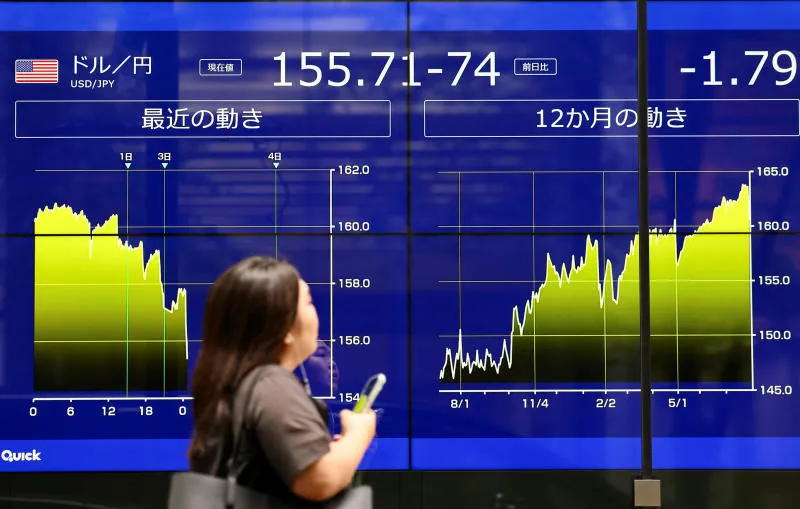
The Japanese yen experienced a significant surge in Asian trading, climbing as much as 1.4% against the US dollar to reach 155.20. This level, last observed on May 6, followed speculation of a coordinated intervention between Japan and the United States. This joint action is believed to have contributed to a substantial 3.8% appreciation of the yen over the preceding Thursday and Friday.
Market participants are interpreting the recent coordinated intervention as a strong signal that increases the cost and risk for those betting against the yen. Experts suggest this move not only caught speculative traders off guard but also heightened the possibility of further action, prompting investors to exercise greater caution when establishing short positions on the Japanese currency.
Impact on Japanese Markets
The abrupt strengthening of the yen had a noticeable negative effect on Japanese equity markets. The Nikkei index saw a sharp decline, retreating from its one-week high reached on Friday. It fell by as much as 2.6% during morning trading. Similarly, the broader Topix index tumbled by 3.1%. A stronger yen typically diminishes the value of overseas earnings for Japan’s numerous large export-oriented companies, directly impacting their profitability.
Automakers Lead Declines
Within the Tokyo Stock Exchange’s 33 industry sectors, automakers were the most significantly affected, with the sector dropping 4.2%. Major automotive manufacturers experienced substantial losses, with Toyota’s stock price falling by 4.6%. This sector’s vulnerability highlights the direct correlation between currency strength and the financial performance of Japan’s export-heavy industries.
Bond Yields Rise Amid Policy Tightening Speculation
Japanese government bonds (JGBs) also saw a decline, leading to an increase in their yields. The joint intervention has fueled speculation among investors that the Bank of Japan (BOJ) might accelerate its pace of monetary policy normalization. This prospect of tighter monetary policy in Japan, coupled with the widening yield differentials compared to other major economies, has put the yen under pressure for an extended period.
The BOJ’s gradual approach to tightening policy has historically kept interest rates in Japan significantly lower than in other developed nations, making the yen a less attractive investment for yield-seeking investors. However, recent market movements suggest a potential shift in this dynamic.
US Support for Intervention and Policy Tightening
US Treasury Secretary Scott Bessent has publicly stated that Washington is prepared to engage in further joint intervention if necessary. He reiterated calls for the Bank of Japan to consider raising its interest rates. This stance from a key US official underscores the international pressure on Japan to address yen weakness through monetary policy adjustments.
While the Bank of Japan maintained its policy rate at its recent meeting, it issued a notable warning. For the first time, the central bank indicated that underlying inflation could potentially exceed its target. Furthermore, it signaled that future policy discussions would prioritize potential upside risks to price stability. This suggests a growing internal consideration within the BOJ for a less accommodative monetary stance.
Record Yields on Short-Term Bonds
The yield on Japan’s 2-year government bond, a sensitive indicator of monetary policy expectations, climbed by as much as 4 basis points to reach 1.545%. This marks a significant level, representing a high not seen in three decades. The yield on the benchmark 10-year JGB also increased, adding 2 basis points to stand at 2.815%.
Market Outlook and Expert Commentary
Market analysts suggest that the comments from US Treasury Secretary Bessent may carry more weight than the intervention itself. The explicit support from the US for further action and its encouragement for Japan to tighten monetary policy could be a pivotal factor in stabilizing the yen.
One senior market analyst commented that the recent developments make it a strong possibility that the Japanese yen has reached its lowest point for the year. The combination of joint intervention and clear signals from the US regarding monetary policy could indeed mark a turning point for the currency.
The intervention aims to curb excessive volatility and restore order to the foreign exchange market. However, the long-term strength of the yen will likely depend on the Bank of Japan’s future policy decisions and the broader economic fundamentals influencing global currency flows. The market will be closely watching for any further signs of policy shifts from the BOJ and continued coordination with international partners.
