

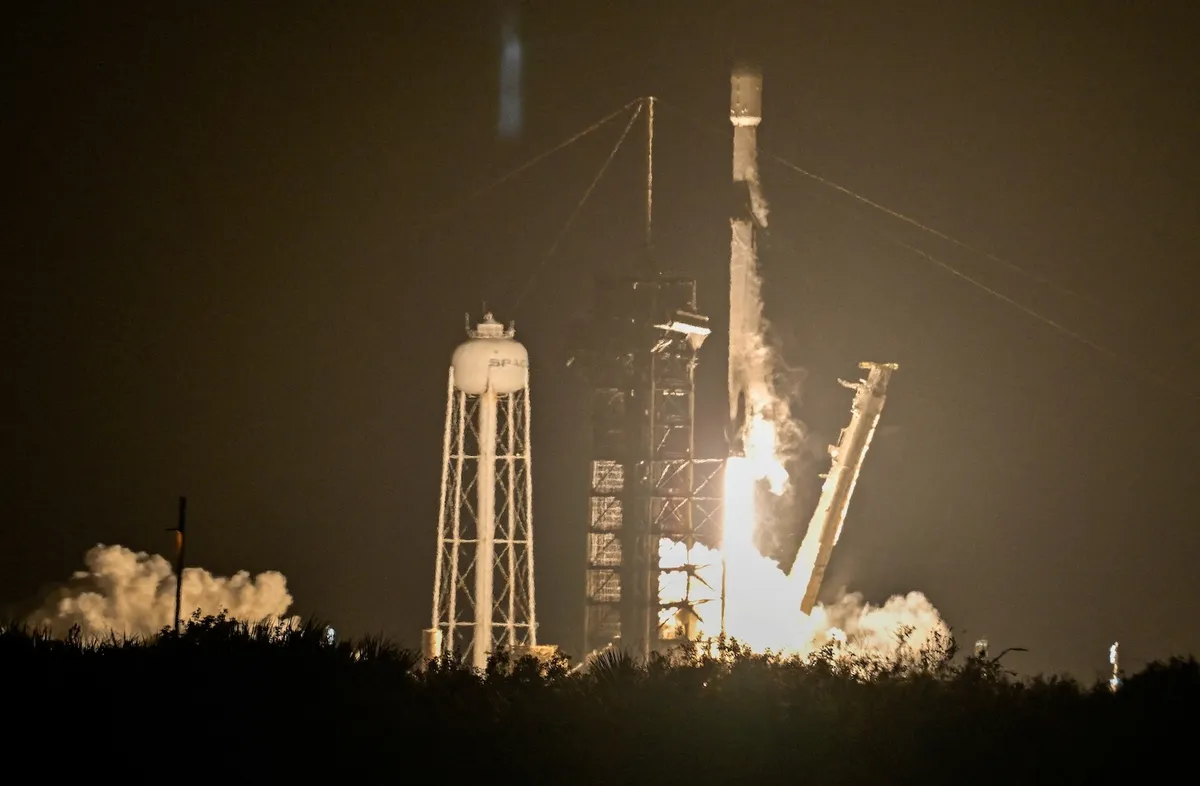
A piece of SpaceX rocket hardware, believed to be the second stage of a Falcon 9 rocket, has impacted the moon, marking a rare instance of space debris reaching the lunar surface. The object, roughly the size of a school bus and weighing approximately 4 tonnes, was part of the launch for Firefly Aerospace’s lunar lander mission in January 2025. It was expected to hit Einstein Crater on the moon’s western limb, an area often challenging to observe from Earth.
Unintentional Lunar Impact
The collision was not planned. SpaceX confirmed that the rocket stage’s trajectory was a result of cosmic forces, including solar activity and gravity, which altered its path after it had completed its primary mission. Unlike typical rocket stages that re-enter Earth’s atmosphere and burn up or fall into the ocean, this particular stage remained in space. This was because the lunar lander mission required more thrust, leaving the second stage in an uncontrolled orbit. It was not until earlier this year that astronomers identified its trajectory would end on the moon.
The impact occurred at a high velocity, estimated at 8,690 kilometers per hour. While the event was expected to create a plume of lunar dust illuminated by sunlight, it was unlikely to be visible to the naked eye from Earth. Scientists anticipated needing several hours after the predicted impact time to confirm the crash by analyzing data from telescopes, particularly those in the Americas.
Understanding Space Debris on the Moon
Space junk impacting the moon is an infrequent occurrence. In March 2022, a Chinese rocket stage met a similar fate after a lunar test mission. Historically, NASA has intentionally crashed rocket stages into the moon. In 2009, a deliberate impact was conducted to study the resulting plume of lunar material. Furthermore, during the 1970s, NASA intentionally impacted stages from its Saturn V moon rockets to analyze seismic effects on the lunar surface.
The unintentional nature of this SpaceX rocket’s impact highlights concerns about the long-term management of space hardware. Bill Gray, an astronomer who developed software used to track such objects, noted that while this incident poses no danger, it underscores a need for greater care in disposing of leftover space equipment. “What has happened is essentially a mixture of solar activity and gravity forces have put it on a path toward the moon,” explained Julianna Scheiman, SpaceX’s director of NASA science and Dragon programs. She added, “This may be of some—probably minor—scientific interest, and we may learn some things from it.”
Preventing Future Lunar Collisions
The increasing activity in lunar exploration necessitates strategies to prevent future collisions with space debris. NASA and SpaceX are reportedly discussing methods to mitigate such risks. This initiative is particularly relevant as NASA prepares for its ambitious Artemis program, which aims to establish a lunar base and conduct routine astronaut missions to the moon’s surface starting later this decade. Ensuring the safety of these future lunar assets from errant space junk is a key priority.
Previous Lunar Landing Failures
Recent years have seen several missions aiming for a soft lunar landing instead end in crashes. Russia’s Luna-25 mission, which was nuclear-powered, spun out of control and impacted the moon in 2023. Its plutonium-238 power source is believed to remain on the surface, posing no apparent harm. India’s Chandrayaan-2 lander mission also experienced a crash landing in 2019, as did Israel’s Beresheet lander in the same year. The Beresheet lander carried microscopic tardigrades, known for their resilience, which may still be present on the lunar surface.
The recent event serves as a reminder of the challenges inherent in space travel and the growing issue of space debris. As humanity expands its presence beyond Earth, careful planning and responsible disposal of rocket stages and other hardware become increasingly critical for the success and safety of future missions.
