

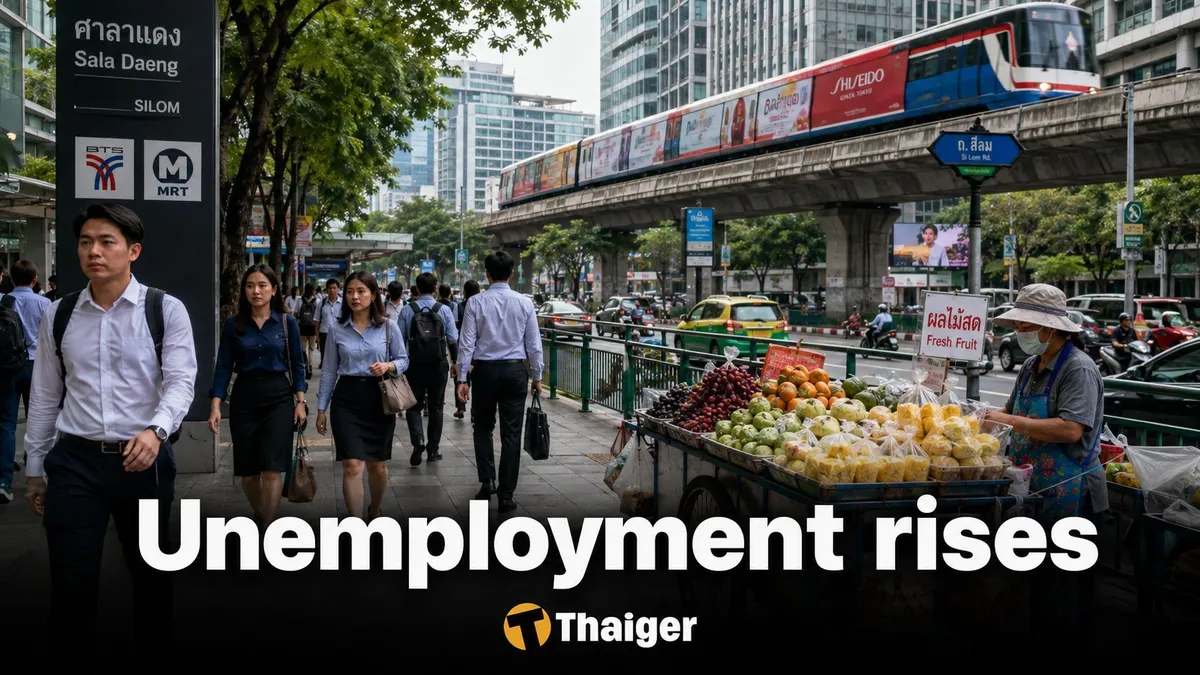
Thailand’s unemployment figures have seen an uptick, with approximately 400,000 individuals out of work during the second quarter of 2026. This rise in unemployment occurred even as the total number of employed persons expanded. The national jobless rate consequently reached 0.95%, according to data released by the National Economic and Social Development Council (NESDC).
Labor Market Dynamics in Q2 2026
Despite the overall increase in employment, which saw a 5.1% year-on-year rise to 41.5 million people, driven largely by seasonal demands in agriculture and the service sector during holiday periods, underlying labor market conditions reveal signs of strain. Analysis of the figures indicates a notable increase in individuals who had previously held jobs but subsequently lost them, with this category growing by 71,000 people. A significant portion of these job losses, nearly half, were attributed to voluntary resignations, particularly within the wholesale, retail, and manufacturing industries.
Education and Unemployment
Interestingly, the data highlights that workers possessing a university degree faced the highest unemployment rate among all educational attainment groups, standing at 1.70%. This suggests that higher education does not necessarily equate to greater job security in the current economic climate.
Economic Indicators Point to Pressure
Further indicators of economic pressure include a rise in applications for unemployment benefits filed through the social security system, which climbed to 290,000. Business closures also saw an increase, with 7,024 businesses shutting down in the first half of 2026, marking a 12.5% increase compared to the same period in the previous year.
Underemployment and Long-Term Joblessness
The issue of underemployment, defined as individuals working fewer hours than they desire, also worsened, with the number of such workers rising by 8% to reach 2.2 million. Compounding these concerns, long-term unemployment—jobs lost for over a year—affected 81,000 people, an increase from previous figures.
Wage Stagnation and Real Income Decline
A critical factor contributing to the strain on households is the decline in real wages. Average nominal wages saw a slight decrease of 0.25% to 15,937 baht per month. Self-employed individuals experienced a more pronounced drop in earnings, with their average monthly income falling by 1.96% to 16,059 baht. While wages for those in registered employment saw a modest increase of 0.90% to 15,853 baht, these gains were insufficient to offset rising costs.
Impact of Inflation on Purchasing Power
When inflation is taken into account, the real wages in Thailand fell by a significant 2.88% during the quarter. Thailand’s inflation rate for the same period was recorded at 2.70%. This disparity means that the purchasing power of average earnings has diminished, making it harder for individuals to maintain their standard of living.
Increased Working Hours Amidst Rising Costs
In response to the declining real wages and rising cost of living, many workers are resorting to longer working hours. While average working hours saw a slight reduction, the number of individuals working more than 50 hours per week increased by 3.3% to 6.5 million. Officials attribute this trend to workers taking on additional hours to supplement their income and cope with escalating expenses.
New Employee Welfare Fund Law on the Horizon
Looking ahead, a new employee welfare fund law, set to take effect on October 1, 2026, under Section 126 of Thailand’s Labour Protection Act, aims to provide a financial cushion for workers upon job separation. This legislation is designed to offer a lump-sum payment to employees leaving their jobs, particularly benefiting those in companies with ten or more employees that do not already provide comparable benefits like provident funds.
Scope and Contribution Details
The new fund is anticipated to cover over 107,000 businesses, representing approximately 80.7% of the targeted group, and will impact around 5.7 million workers. Both employers and employees will be required to contribute 0.25% of wages to the fund from October 2026 until September 2031. Following this initial period, the contribution rate will double to 0.5% for each party starting October 2031.
Penalties and Awareness
Non-compliance with the new law carries significant penalties. Employers failing to register or submitting false information could face up to six months in prison, a fine of up to 10,000 baht, or both. Late or underpaid contributions will incur a monthly penalty of 5% on the outstanding amount. Officials have noted that many workers are still unaware of their rights and entitlements under this new welfare fund and have called for a comprehensive public awareness campaign to ensure a smooth transition when the law becomes effective.
Conclusion
The latest economic data from Thailand paints a complex picture of the labor market. While overall employment figures show growth, the rise in unemployment, coupled with falling real wages and increased underemployment, signals considerable economic pressure on individuals and households. The upcoming employee welfare fund law aims to provide some relief, but effective implementation and public understanding will be crucial for its success in mitigating the impact of job market volatility.
