

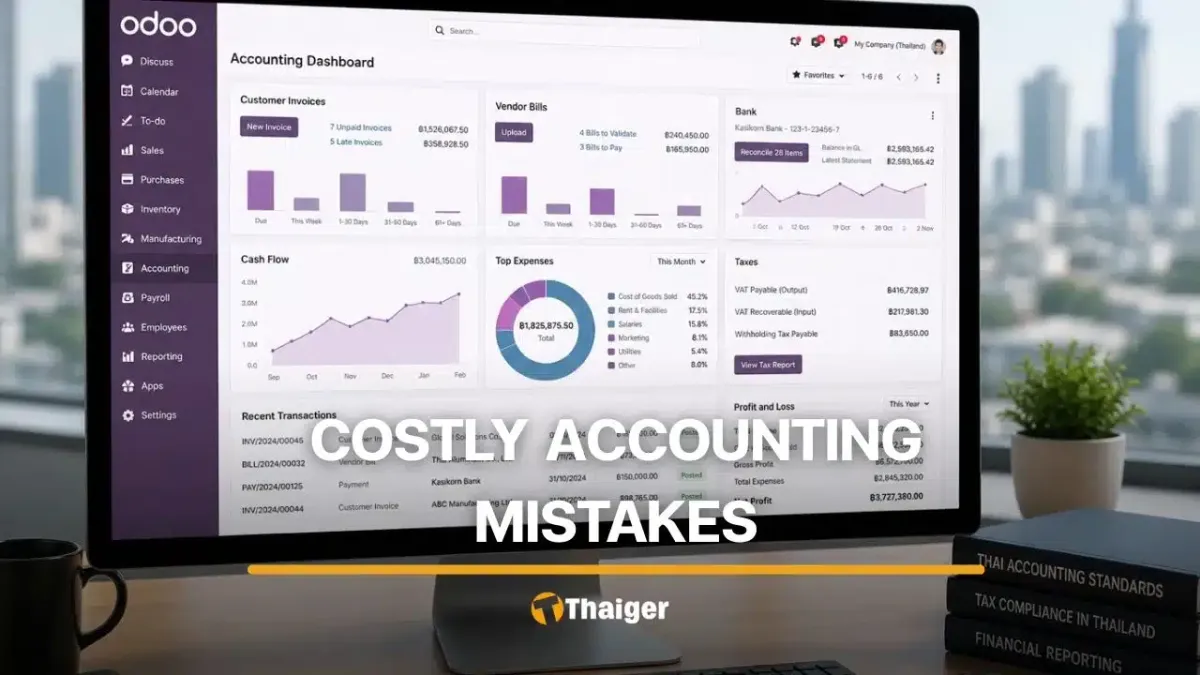
Implementing an Enterprise Resource Planning (ERP) system in Thailand can be a significant undertaking for foreign businesses, promising streamlined operations from sales to inventory management. However, many foreign business owners stumble into common accounting errors that can undermine the entire project. These mistakes often arise not from the ERP software itself, which can be highly capable, but from a disconnect between the system’s configuration and Thailand’s specific statutory accounting and tax requirements. Understanding these potential pitfalls is crucial for a successful ERP rollout and ongoing compliance.
1. Misconfiguring the Chart of Accounts
While many ERP solutions, such as Odoo, offer localized Thai fiscal modules that provide a starting point with pre-configured withholding tax rates and accounts, this is often insufficient for direct filing. These modules typically do not generate the official PND 3 or PND 53 forms required by the Thai Revenue Department. Foreign businesses frequently make the mistake of configuring their chart of accounts based on their parent company’s structure rather than adhering strictly to Thai statutory requirements. This necessitates either exporting data for manual form completion, extensive report customization, or developing bespoke modules. To avoid this, businesses should ensure the chart of accounts is designed with Thai legal and tax obligations as the primary focus from the outset, rather than treating localization as a mere add-on.
2. Underestimating Thailand’s Tax and Document Formatting Rules
A significant oversight by foreign businesses is underestimating the complexity and stringency of Thailand’s tax and document formatting regulations. Statutory accounting books, for instance, must be maintained in Thai or accompanied by an official Thai translation. Financial statements require auditing by a Thai-licensed Certified Public Accountant (CPA) and submission in a structured XBRL format to the Department of Business Development. Furthermore, tax filing deadlines are strict: VAT returns are due by the 15th of each month (or the 23rd for online filers), regardless of whether any transactions occurred. Withholding tax returns are due within seven days of the month’s end (fifteen days for online filers). These critical compliance details are often not highlighted during the software demonstration phase, leading businesses to believe their ERP system will handle all reporting needs without further adaptation.
3. The ERP Implementation Handover Gap
ERP implementations in Thailand are frequently managed by software implementation firms. While these companies excel at technical aspects like data migration, workflow design, and system integration, their expertise often doesn’t extend deeply into the nuances of Thai tax configuration. This creates a critical handover gap. The accounting firm or internal accountant, who is responsible for tax filings, often inherits a system and chart of accounts they had no input in designing. This disconnect means the tax logic is not correctly embedded from the start. Consequently, businesses may face extended month-end closing periods, needing to reconcile figures in both the new ERP and traditional spreadsheets due to a lack of trust in the system’s tax data. A more effective approach involves integrating the expertise of both the ERP implementers and the Thai accounting professionals throughout the entire project lifecycle. When the team responsible for designing the chart of accounts is also the one filing the tax returns, tax logic is built correctly the first time, mapping withholding tax rates to actual business transactions rather than generic templates.
4. Migrating Poor-Quality Accounting Data
The reliability of any ERP system is fundamentally dependent on the quality of the data migrated into it. A common and consistent mistake is treating data migration as purely a technical exercise, neglecting the crucial step of accounting reconciliation. Years of historical accounting data can be riddled with issues such as duplicate supplier or customer entries, outdated accounts, inaccurate opening balances, unreconciled bank transactions, outstanding receivables and payables, incorrect inventory counts, or obsolete fixed assets. If this flawed data is transferred without thorough review and cleansing, the new ERP system simply inherits and perpetuates the problems of the legacy system. Before migration, finance teams must conduct structured reconciliations of key areas:
- Trial Balance: Ensure the closing trial balance from the old system precisely matches the opening balances in the new ERP.
- Accounts Payable and Receivable: Reconcile supplier balances against invoices and remove old, disputed, or already-paid items. Cleanse master data of duplicates.
- Bank and Cash: Fully reconcile all accounts to bank statements as of the cut-off date, resolving any unidentified transactions.
- Inventory: Verify that ERP quantities and values align with physical stock counts and accounting records.
- VAT and Withholding Tax: Reconcile outstanding balances with relevant tax records and filings.
By addressing data quality proactively, businesses ensure their new ERP system starts with a clean and accurate foundation.
5. Separating the ERP Team from the Accounting Team
Thai statutory accounting mandates the involvement of qualified Thai accountants; it is not merely a preference but a legal requirement dictated by the country’s filing systems. A prevalent error is the operational separation of the ERP implementation team from the accounting team responsible for compliance. The most effective model integrates these functions. For instance, the professionals configuring withholding tax settings should be the same individuals responsible for filing the resulting returns. They should also be capable of explaining the configuration in clear terms to management. This integrated approach ensures that tax implications are fully understood and correctly implemented within the ERP system from the ground up.
Key Questions for ERP Partners in Thailand
Before committing to an ERP partner in Thailand, businesses should ask critical questions to gauge their understanding of local requirements:
- How will PND 3 and PND 53 forms be generated, and who will be responsible?
- What is the process for maintaining localization modules after the project concludes?
- Which licensed professional will audit and sign off on the financial statements produced by the system?
- What will the actual month-end closing process entail in the first quarter post-go-live, beyond what is shown in a demo?
By addressing these points and ensuring alignment between technical implementation and Thai accounting expertise, foreign businesses can significantly mitigate the risks associated with ERP system deployment in Thailand, paving the way for accurate financial management and compliance.
