

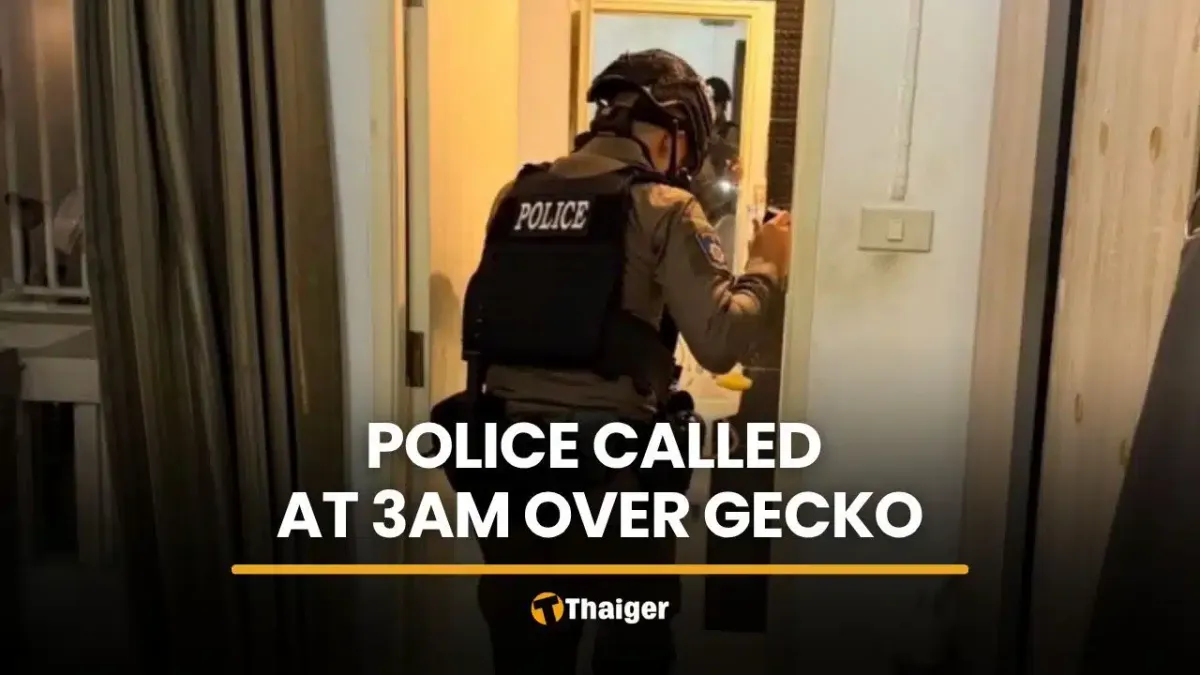
A late-night call to emergency services in Nonthaburi, Thailand, took an unusual turn when a woman requested police assistance to remove a gecko from her room. The incident occurred in the early hours of September 4th, highlighting the diverse range of situations that can prompt a call to the authorities.
Unusual Emergency Call Received
The Rattanathibet Police Station received a distress call at approximately 3:00 AM. The dispatcher at the station’s radio center relayed the request for assistance to patrol officers, who were dispatched to a dormitory located in the Tha Sai subdistrict of Mueang district. The nature of the emergency was, to say the least, unconventional: a resident reported a gecko had entered her living space and she required help to have it removed.
Police Response and Search
Upon arrival, two patrol officers met with the distressed resident and a dormitory caretaker. The woman explained her predicament, emphasizing her desire for the reptile to be safely captured and evicted from her room. The officers, demonstrating a commitment to public service regardless of the perceived scale of the problem, agreed to assist.
Accompanied by the resident and the caretaker, the officers entered the room to begin their search. They meticulously checked various nooks and crannies, common hiding spots for small creatures like geckos. The search continued for nearly 30 minutes, with the officers and the caretaker diligently looking for the elusive reptile.
Search Concludes Unsuccessfully
Despite their best efforts, the gecko remained unfound. As the time was late and the search had yielded no results, the officers made the decision to conclude their efforts. Their primary concern was the potential for continued noise to disturb other residents in the dormitory, who would likely be asleep at that hour.
The officers advised the woman that if the gecko reappeared, she should contact the dormitory management or caretaker for further assistance. This recommendation aimed to provide a more sustainable and appropriate solution for future occurrences, leveraging the resources available within the residential facility.
Police Superintendent Comments on Response
Pruet Chamroonsart, the superintendent of the Rattanathibet Police Station, later commented on the officers’ response. He emphasized that patrol officers are expected to respond to calls for assistance from the public, irrespective of whether the issue might seem minor to an outsider. Superintendent Chamroonsart stated that individuals who contact the police are genuinely seeking help, and it is the duty of law enforcement to provide assistance whenever possible.
He drew a parallel between this gecko incident and the general principles of police work. The superintendent explained that for someone facing an uncomfortable or potentially unnerving situation late at night, especially when dealing with an unknown creature, calling the police can be a safer first step than attempting to handle it alone or seeking help from less official sources. This approach ensures that individuals have a reliable point of contact in times of need.
Superintendent Chamroonsart further elaborated on the role of the emergency hotline, 191. He noted that if police officers themselves are unable to provide the specific assistance required, they have the capability to coordinate with relevant rescue foundations or other specialized agencies. This ensures that even if the police cannot directly resolve the issue, they can facilitate the involvement of those who can, offering a comprehensive safety net for the community.
The Role of Police in Minor Incidents
The incident serves as a reminder of the broad spectrum of responsibilities undertaken by law enforcement. While often associated with serious crimes, police officers also frequently deal with situations that, while not criminal, cause distress or inconvenience to citizens. The decision to respond to the gecko call reflects a policy of prioritizing public welfare and ensuring that residents feel supported, even in unusual circumstances.
The presence of geckos, while common in many tropical regions, can be a source of anxiety for some individuals. Their sudden appearance in a private living space, particularly in the dead of night, can be startling. The woman’s decision to call the police, though unusual, stemmed from a genuine feeling of needing help to resolve the situation.
Preventative Measures and Community Resources
While the police search was unsuccessful, the advice given to the resident to contact the dormitory caretaker highlights the importance of utilizing community-specific resources. Dormitory management often has established protocols for pest control or can provide assistance with such issues, offering a more practical solution than emergency services.
This event also underscores the importance of clear communication between residents and building management regarding maintenance and pest control services. Proactive measures, such as regular checks for entry points and appropriate deterrents, can help prevent such encounters.
Conclusion
The 3:00 AM gecko incident in Nonthaburi, while perhaps amusing in retrospect, underscores the commitment of local police to respond to public calls for help. It also highlights the diverse nature of calls received by emergency services and the importance of having clear protocols for handling non-criminal but distressing situations. The superintendent’s remarks reinforce the idea that police are a crucial first point of contact, ensuring public safety and well-being, no matter how small the perceived problem may seem.
