

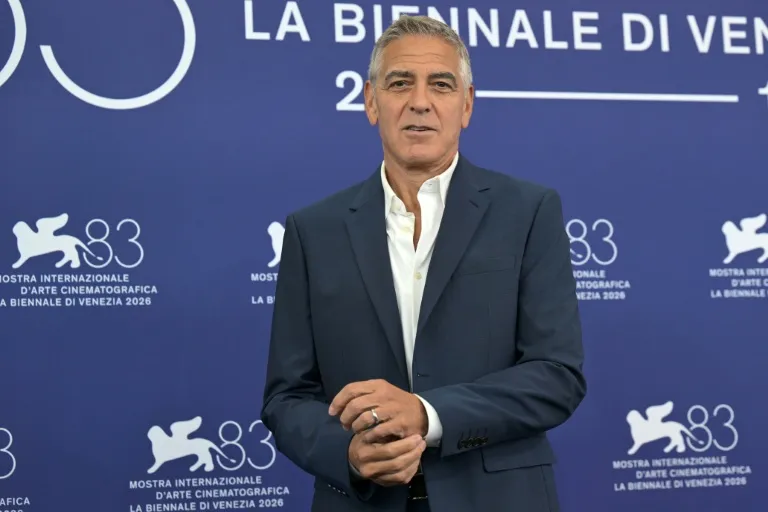
Renowned actor and director George Clooney has voiced strong criticism regarding the current state of American leadership, describing the United States as potentially being run by a “kakistocracy” – a government composed of the least qualified individuals. Clooney made these remarks during a press conference at the Venice Film Festival, where he was honored with a Golden Lion for his lifetime achievements in filmmaking.
Concerns Over Current Governance
Speaking to journalists on the opening day of the festival, Clooney, 65, expressed a profound sense of disappointment with the direction of the U.S. government. “We’re at a moment in time that’s unfortunate. I think that’s an understatement,” he stated, reflecting on broader issues including artificial intelligence, climate change, and the evolving landscape of the film industry.
He introduced the term “kakistocracy,” defining it as a system of governance by the least suitable or competent citizens. “I think maybe we have a kakistocracy right now, but we’ll get through it,” Clooney remarked, conveying a sentiment of both concern and resilience.
Hopes for Future Elections
Clooney expressed optimism that upcoming political events could help steer the nation back toward stability. He suggested that the midterm elections in November might offer a crucial “check and balance” on current trends. Looking further ahead, he voiced hope for a “restoration into some normalcy” by 2028.
Describing himself as an optimist, Clooney drew parallels to challenging periods in American history that he has personally witnessed. He recalled the tumultuous year of 1968, a period marked by widespread civil unrest following the assassinations of Martin Luther King Jr. and Robert F. Kennedy. “There was tons of violence. The Capitol was surrounded with tanks,” he remembered, underscoring that while the nation has navigated difficult times before, the present moment presents its own unique set of challenges.
Specific Example of Lacking Decency
As an illustration of what he perceives as a decline in public discourse and decency, Clooney cited a recent social media post attributed to U.S. Defense Secretary Pete Hegseth. The post reportedly mocked the physical appearance of an overweight female Canadian soldier who was presenting a medal at a youth camp.
“Where’s the sense of decency in all of this? And I’m ashamed of all of that, but we will get through it,” Clooney stated, expressing his personal embarrassment over such incidents. He concluded his remarks on a hopeful note, asserting his belief that the country will ultimately emerge from its current difficulties stronger. “And we will come out better on the other side.”
Clooney’s Career and Venice Recognition
The Venice Film Festival appearance marked a significant personal milestone for Clooney, as he received the Golden Lion for Lifetime Achievement. This prestigious award recognized his extensive and influential career in Hollywood, spanning decades and encompassing both acting and directing roles. His films have garnered numerous accolades, and he has become a prominent figure not only in cinema but also in public discourse on various social and political issues.
Throughout his career, Clooney has not shied away from expressing his views on matters of public interest. His willingness to engage in these discussions, even when controversial, has cemented his reputation as an artist who uses his platform to address pressing societal concerns. The timing of his critical remarks on American governance, juxtaposed with the celebration of his cinematic legacy, highlighted the dual nature of his public persona – that of a celebrated artist and a concerned citizen.
The Concept of Kakistocracy
The term “kakistocracy,” which Clooney employed, originates from the Greek words “kakistos” (worst) and “kratos” (rule). It describes a form of government where the least qualified or most incompetent citizens are in power. Historically, the concept has been used to critique political systems perceived to be failing due to the ineptitude of their leaders. Clooney’s use of the term suggests a belief that the current U.S. administration embodies such a failing, characterized by a lack of competence or qualification among its key figures.
While Clooney acknowledged the gravity of his assessment, his underlying message remained one of enduring optimism. He believes that despite the current challenges and the perceived shortcomings in leadership, the fundamental resilience of the American populace and its democratic institutions will ultimately prevail. This perspective draws on historical precedents, suggesting that periods of turmoil have often been followed by periods of renewal and progress.
Broader Context of Political Discourse
Clooney’s comments arrive at a time of heightened political polarization and intense public debate in the United States and globally. The specific incident he highlighted—the alleged mocking of a soldier—speaks to broader concerns about the tone and substance of political rhetoric, particularly among those in positions of authority. Such exchanges can shape public perception and influence the level of respect and trust citizens place in their leaders and institutions.
The actor’s reflections on historical parallels, such as the unrest of 1968, serve to contextualize the present moment within a longer arc of American history. By recalling periods of significant national trial, he implies that current difficulties, while severe, are not unprecedented. This historical perspective is often employed to foster a sense of collective endurance and to suggest that societal challenges, however daunting, can be overcome through perseverance and a commitment to democratic ideals.
Conclusion: A Call for Decency and Resilience
In essence, George Clooney’s remarks at the Venice Film Festival served as both a critique of contemporary American governance and an affirmation of faith in the nation’s capacity for recovery. By labeling the current situation a potential “kakistocracy” and lamenting a perceived lack of decency, he articulated a deep-seated concern shared by many. Yet, his invocation of historical resilience and his optimistic outlook suggest a belief that the United States possesses the inherent strength to navigate these turbulent times and emerge with its democratic principles intact and perhaps even strengthened.
