

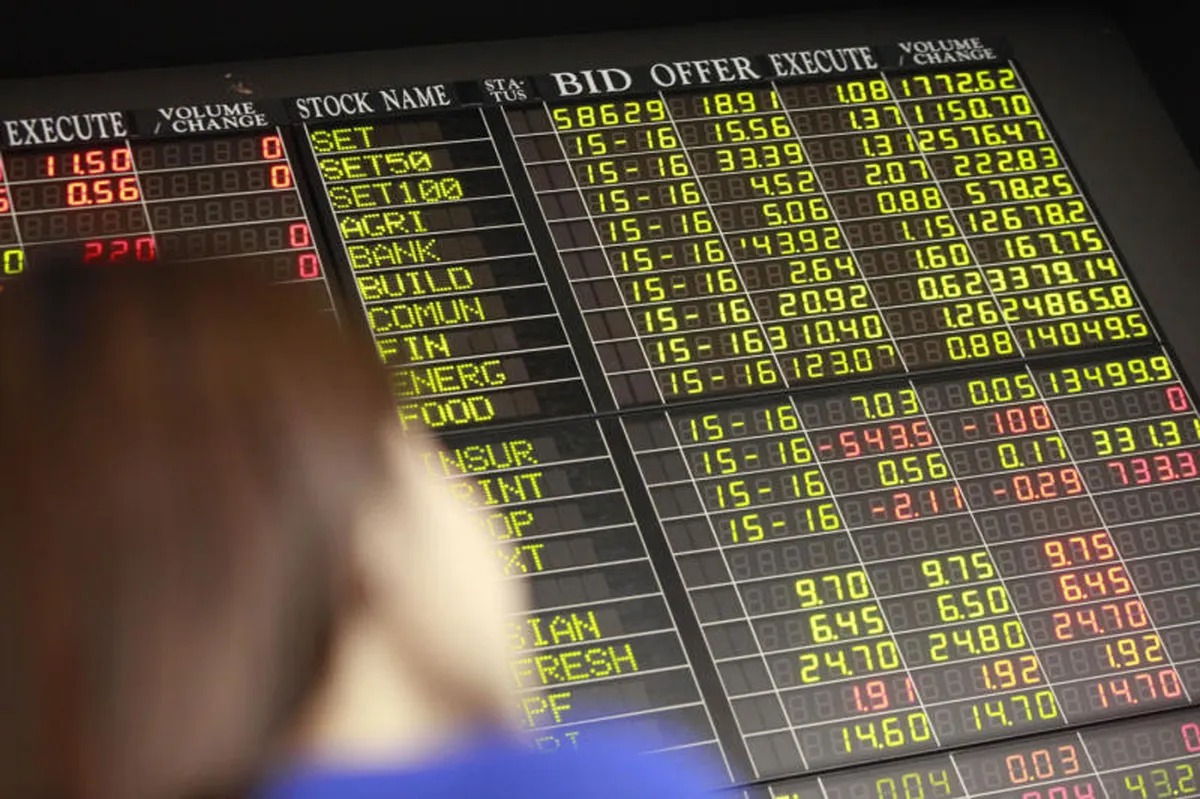
The Thai stock market, represented by the Stock Exchange of Thailand (SET) index, has reached valuation levels that are capturing the attention of global investors, fueling renewed foreign fund inflows and speculative buying. The market experienced a notable 5% surge in May, largely propelled by the global artificial intelligence boom that significantly boosted the electronics sector by 12.2%. This sector emerged as a primary driver of the market’s recent advance. Construction stocks also saw a substantial increase, climbing 14.7%, while tourism-related shares appreciated by 7.93%.
SET Index Reaches Three-Year High Amidst Global Uncertainty
The Thai index recently soared to a three-year peak, surpassing the 1,600-point mark. This ascent occurred even as other Asian bourses faced declines due to renewed tensions between the US and Iran. The geopolitical unease prompted investors to shift towards safer assets, yet the Thai market demonstrated resilience.
June Outlook: Range-Bound Trading Expected
Despite the positive momentum, expectations for June suggest the SET index will likely trade within a range of 1,540 to 1,630 points. Analysts anticipate that future gains will stem from sector rotation rather than a broad-based market rally, indicating a more limited upside potential ahead.
Key Risks and Long-Term Growth Factors
Looking towards the following year, investors are advised to remain cognizant of emerging risks. Fiscal constraints and elevated public debt levels could potentially hinder the government’s capacity to implement further economic stimulus measures. Long-term market growth, it is argued, requires clear economic catalysts rather than being solely dependent on short-term sentiment influenced by global events.
Investment Strategy: Focus on Fundamentals and Value
A disciplined, fundamentally grounded investment approach is recommended, steering clear of emotion-driven trading. Investors should closely monitor upcoming policy decisions from key central banks, including the Federal Reserve, the European Central Bank, and the Bank of Japan, as these could influence bond yields and trigger market shifts. The most promising opportunities are identified in cheap, fundamentally sound stocks, particularly value plays that have not yet fully recovered from past market weaknesses. The aviation sector, bolstered by a continuing tourism recovery, and high-dividend companies, some offering yields up to 8% annually, are highlighted as attractive. Consumer finance, power, healthcare, and tourism stocks are also anticipated to benefit from the current market surge.
Selective investment in companies demonstrating strong earnings per share growth is advised. Stock selection is becoming increasingly critical as performance diverges across different sectors. The emphasis is on prioritizing fundamentals over momentum and seeking undervalued companies whose market prices have not yet fully reflected their intrinsic value.
US Tariff Impact on Thai Equities Appears Muted
Analysis suggests that the proposed 12.5% US tariff under Section 301 on imports from countries deemed ineffective in preventing imports linked to forced labor is unlikely to significantly impact the Thai stock market. Products such as integrated circuits, minerals, and pharmaceuticals are expected to receive exemptions. For listed companies under coverage, excluding electronics exporters, revenue exposure to the US market represents less than 0.5% of the SET’s aggregate revenue. However, export-oriented firms, including i-Tail Corporation (ITC), Thai Union Group (TU), Sri Trang Gloves (Thailand) (STGT), and Sri Trang Agro-Industry (STA), could face more considerable pressure.
Any market weakness stemming from tariff concerns is viewed as a potential buying opportunity. Fundamentally strong companies with solid earnings growth and attractive dividends, such as Gulf Development (GULF), WHA Utilities and Power (WHAUP), Krung Thai Bank (KTB), SCB X (SCB), and Moshi Moshi Retail Corporation (MOSHI), are recommended for investment.
