

Current valuations on the Stock Exchange of Thailand (SET) are appearing increasingly stretched, with the market trading at approximately 16 times earnings, despite limited prospects for profit growth among listed companies and a subdued domestic economic outlook.
Concerns Over Stagnant Earnings and Economic Growth
Analysis indicates that the SET’s earnings per share have largely remained capped around 95 baht for the past decade and are not expected to significantly deviate from this level in the current year. Concurrently, the Thai economy is projected to experience growth below 2% annually over the next one to two years. This combination of factors suggests that current market valuations may be overextended.
Market Concentration and Foreign Investment Trends
Further highlighting potential risks, market concentration has become a notable concern. Recent gains have been predominantly fueled by a select group of large-cap stocks, particularly those in technology-related and specialized sectors, rather than a broad-based market rally. While foreign capital has been flowing back into Asia, Thailand has captured a smaller portion of these inflows compared to technology-centric markets like Taiwan and South Korea, which are major beneficiaries of the global artificial intelligence (AI) boom.
Investment Recommendations for Investors
In light of these market conditions, a strategic focus on high-dividend stocks is recommended. These should possess robust balance sheets, stable cash flows, and minimal debt. The banking sector continues to present an attractive proposition, offering dividend yields in the range of 5-6%. Industrial estate operators are also poised to benefit from increasing foreign direct investment, while electronics companies are expected to see indirect advantages from global AI-driven demand.
Opportunities are also identified in Thai real estate investment trusts (REITs), which provide dividend yields between 6-8%. These REITs could be further bolstered by a global interest rate cycle that appears to be approaching its peak. A positive outlook is maintained for global investment-grade bonds, supported by the expectation that US policy rates are nearing their terminal levels.
“We advise investors to diversify their portfolios and increase the weighting of global equities relative to local stocks to capture better returns over the long term,” stated Wajana Wongsupasawat, Managing Director.
Addressing Retirement Readiness Challenges
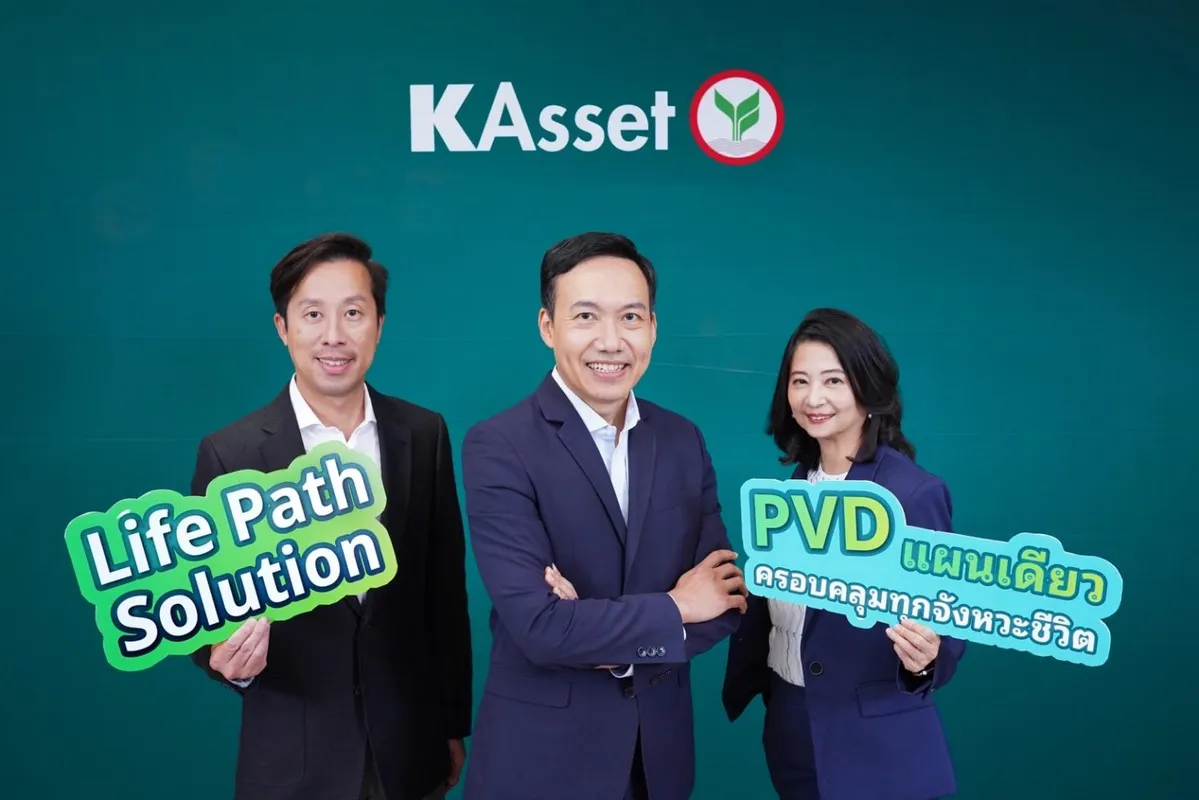
Beyond immediate market concerns, a long-term initiative is underway to address the retirement readiness of Thai citizens. Executive Chairman Win Phromphaet announced the launch of “Life Path Solution” for provident fund members. This program aims to assist investors in navigating increased life expectancies and insufficient retirement savings through automated portfolio management.
Lifecycle Investment Approach
The solution employs a lifecycle investment strategy, dynamically adjusting asset allocation based on a member’s age. Younger investors, aged 25-45, are permitted to allocate up to 85% of their portfolios to global equities to maximize long-term growth potential. As retirement nears, exposure to riskier assets is progressively reduced to preserve capital and mitigate volatility.
At the core of this strategy is the K-WPULTIMATE fund within the K-WealthPLUS Series, which utilizes dynamic asset allocation across global equities, fixed-income securities, and alternative investments. Despite geopolitical tensions and market uncertainties, the K-WPULTIMATE fund has achieved a year-to-date gain of approximately 9%.
Combating Behavioral Investment Challenges
Life Path Solution also addresses common behavioral investment pitfalls, such as poor market timing and a lack of long-term discipline, by eliminating the need for active portfolio management by members. The initial adoption has been positive, with assets under management from individual participants increasing by 54%, the number of members growing by 30%, and participating companies rising by 14%. This growth reflects an increasing demand for structured retirement solutions as Thailand transitions into an aged society.
K-Asset currently manages 278 billion baht in provident funds and aims to reach 300 billion baht by the end of the year. The firm’s total assets under management stand at 1.9 trillion baht, with a target of 2 trillion baht by year-end.
