

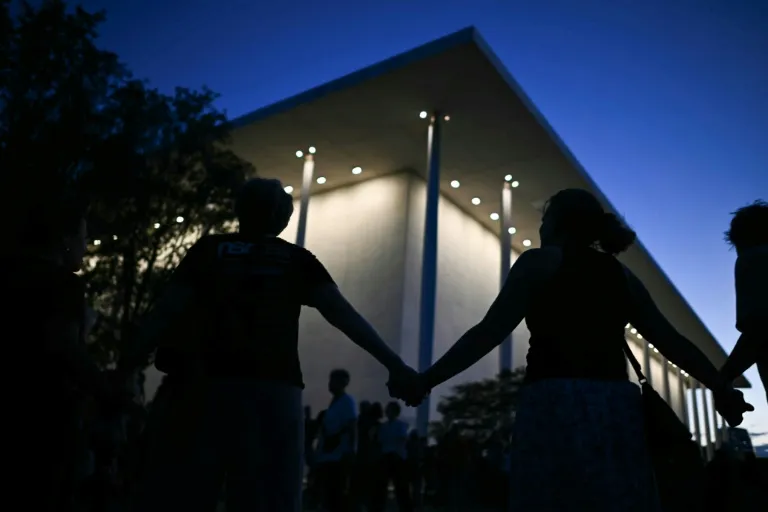
Protesters gathered outside the Kennedy Center in Washington D.C. to voice their opposition to potential long-term closure and demolition plans, which they attribute to President Trump’s administration. The iconic arts venue’s main building has been temporarily closed since Wednesday, with a judge currently reviewing proposals for a more extensive shutdown to facilitate extensive renovations championed by the current administration.
Background of the Kennedy Center Controversy
The Kennedy Center, inaugurated in 1971 as a living memorial to President John F. Kennedy, came under the administration’s control last year. The administration has asserted that the facility was in a state of disrepair under previous leadership and has advocated for significant renovations. This initiative is part of a broader pattern where the current administration has sought to leave its distinctive mark on prominent national projects, sometimes pushing the boundaries of executive authority.
A contentious move last year involved the Kennedy Center’s board, appointed by President Trump, voting to officially rename the institution the “Trump-Kennedy Center.” This proposed change, which would have included updating building signage and online branding, was ultimately reversed by a judicial ruling. Reports from The Washington Post indicated that this renaming attempt led to a significant downturn in ticket sales, artist boycotts, and a notable decrease in donor contributions.
Demonstrations Against Proposed Closures and Demolition
In response to the recent temporary closure and the ongoing judicial review of long-term closure plans, concerned citizens and arts advocates organized demonstrations. Waving placards with slogans such as “hands off Kennedy Center” and “Donny, you are no JFK,” the crowd assembled beneath the scaffolding and tarps that have become a fixture since President Trump’s name was removed from the building in June following a court order.
The protesters formed a human chain that extended onto the esplanade overlooking the Potomac River as nightfall approached. They arranged themselves around barriers erected after the center’s closure this week, expressing their dismay and resistance to the administration’s actions.
Voices of Dissent
Many attendees voiced strong emotions regarding the situation. Neal Racioppo, a Washington resident and marketing professional for a theater, expressed his deep disappointment. “It makes me sick to my stomach,” Racioppo stated. “Trump can’t get his name on this cherished building, so he is depriving the world of what it could be.” He emphasized the center’s importance as a cultural hub, noting, “It has been an important home for the arts for this city and this country and the world. What President Trump is doing is despicable.”
Lizzy Andrew, an artist who has performed at the Kennedy Center multiple times, including with the National Symphony Orchestra, conveyed her anger at the administration’s perceived threat to demolish the venue. “He does not have a right to decide that an institution, a living memorial to a past president, can be demolished,” Andrew said. She added, “I think you can see tonight that the people of D.C. and the people of America do not agree with that decision.”
Lela Agnew, a long-time visitor who frequently brings her children to the center, attended the protest to defend an institution she believes belongs to the public. “I’ve been coming here for about 50 years,” Agnew shared. “It’s not a place that needs to be demolished. It’s just not a political place.” Her sentiment highlights a common theme among protesters: the Kennedy Center is viewed as a national treasure for the arts, separate from political agendas.
The Legal and Administrative Landscape
The ongoing legal review by a judge is critical to the future of the Kennedy Center. The administration’s push for extensive renovations and the associated closure proposals are being scrutinized, particularly concerning their impact on the arts community and public access. The administration’s stated goal is to modernize and restore the aging facility, arguing that these measures are necessary for its long-term viability and to uphold its legacy.
However, the protests underscore a significant public concern that these renovations and potential closures are driven by motives beyond preservation and improvement. Critics argue that the administration’s actions are an attempt to exert control and impose a personal legacy on a national cultural landmark, potentially at the expense of its established identity and accessibility. The outcome of the judicial review will be pivotal in determining whether the administration’s renovation plans proceed and what form the future of the Kennedy Center will take.
Conclusion: A Battle for a Cultural Institution
The situation at the Kennedy Center represents a clash between administrative directives for renovation and public sentiment that champions the venue as an apolitical sanctuary for the arts. As the legal process unfolds, the demonstrations serve as a powerful reminder of the deep connection the public feels to this institution and their determination to protect it from what they perceive as undue political influence and potential destruction. The coming weeks will be crucial in shaping the future of this vital American cultural landmark.
