

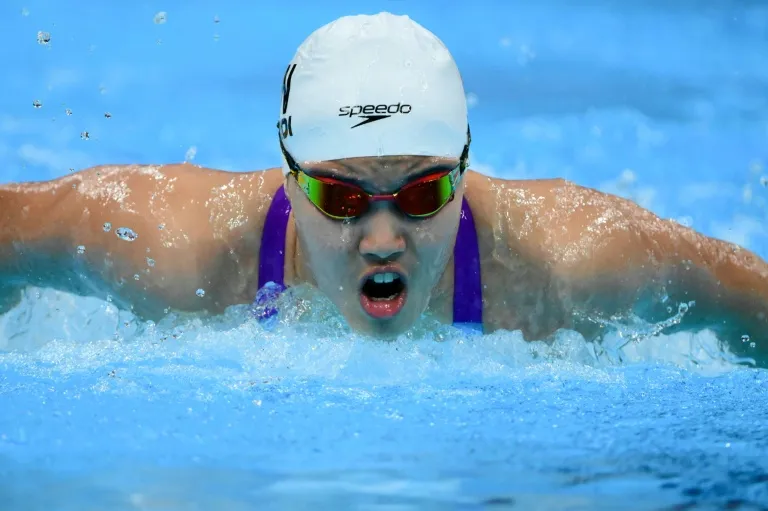
Japan has claimed the inaugural gold medal of the Asian Games, with Takumi Hojo winning the men’s individual triathlon. The multi-sport event, featuring a record number of athletes, commenced with competition in triathlon and swimming. In the pool, 13-year-old Yu Zidi of China delivered a standout performance in the women’s 200m butterfly heats, signaling her potential as a strong medal contender.
Hojo Claims Historic Triathlon Gold
The first of 469 gold medals to be awarded at the 19th Asian Games was won by Japan’s Takumi Hojo in the men’s individual triathlon. Competing in Gamagori city, near Nagoya, Hojo completed the 750m swim, 20km bike ride, and 5,000m run in 52 minutes and 56 seconds. He finished nine seconds ahead of China’s Zhang Xirui, who secured the silver medal, with Kazakhstan’s Arlan Zhanabay taking bronze, a further six seconds behind.
Hojo, a 30-year-old athlete, expressed his delight, noting that the victory provided a significant boost to the Japanese team. “As it’s our first gold medal, it’s given the Japanese team a real boost,” Hojo stated. He also highlighted that this win could qualify him for the 2028 Olympic Games in Los Angeles. Reflecting on his performance, he added, “I was really fired-up. Even the rain held off, and I was in top form right up until I stood on the starting line.” Hojo had previously won the Asian Games test triathlon on the same course a year prior.
Chinese Swimmers Impress in Pool Heats
The swimming competitions also commenced, showcasing promising talent. Yu Zidi, a remarkably young competitor from China who is not yet 14, dominated the women’s 200m butterfly heats. She posted the fastest time by a significant margin, touching the wall nearly 2.70 seconds ahead of her compatriot Chang Mohan. Yu is now considered a strong favorite to win gold in the final scheduled for Sunday evening.
Adding to China’s strong showing in the pool, Pan Zhanle, the reigning world record holder and Olympic champion in the men’s 100m freestyle, also advanced to the final as the fastest qualifier. He clocked a time of 48.07 seconds. However, his lead was narrow, finishing just 0.06 seconds ahead of South Korea’s Hwang Sun-woo. Despite the close race, Pan issued a confident statement to his competitors, declaring, “I think tonight I will be better.”
Asian Games Underway Amidst Organizational Challenges
The two-week sporting spectacle was officially declared open on Saturday by Emperor Naruhito of Japan. The event, which features more athletes than the Olympics, will see over 40 sports contested across Nagoya and the Aichi prefecture. Despite the excitement, a notable number of empty seats were observed at the 30,000-capacity stadium during the opening ceremony.
The Games, which run until October 4, offer qualification opportunities for the 2028 Los Angeles Olympics. However, the build-up has been marred by several logistical issues. Organizers faced significant challenges in accommodating the more than 11,000 athletes and 6,000 officials, partly due to the decision to forgo a traditional athletes’ village to reduce costs. Competitors are being housed in a mix of temporary container-style accommodations, hotels, and the cruise ship Costa Serena.
Logistical Hurdles and Apologies
Reports emerged of athletes experiencing difficulties, including being stranded at the airport due to transportation failures. Several teams also raised concerns about the quality of the temporary housing, citing issues such as beds being too short. In a notable incident, Games organizers issued “deepest apologies” after North Korea’s national anthem was mistakenly played for South Korea’s men’s hockey team prior to a preliminary match on Friday.
China Dominates Women’s Triathlon
While Japan secured the first gold, China demonstrated its strength in the women’s individual triathlon. Lin Xinyu, who had won a silver medal at the previous Asian Games in Hangzhou, improved her standing by claiming the gold medal with a time of 57 minutes and 37 seconds. China achieved a one-two finish in the event, as Huang Anqi secured the silver medal, finishing 21 seconds behind Lin. Japan’s Manami Hayashi earned the bronze medal, clocking 58 minutes and 36 seconds.
Diverse Sporting Program
As is customary for the Asian Games, which originated in 1951, the event combines globally recognized Olympic sports like athletics and swimming with popular regional disciplines such as sepak takraw and kabaddi. This diverse program aims to celebrate the breadth of athletic talent across the continent.
