

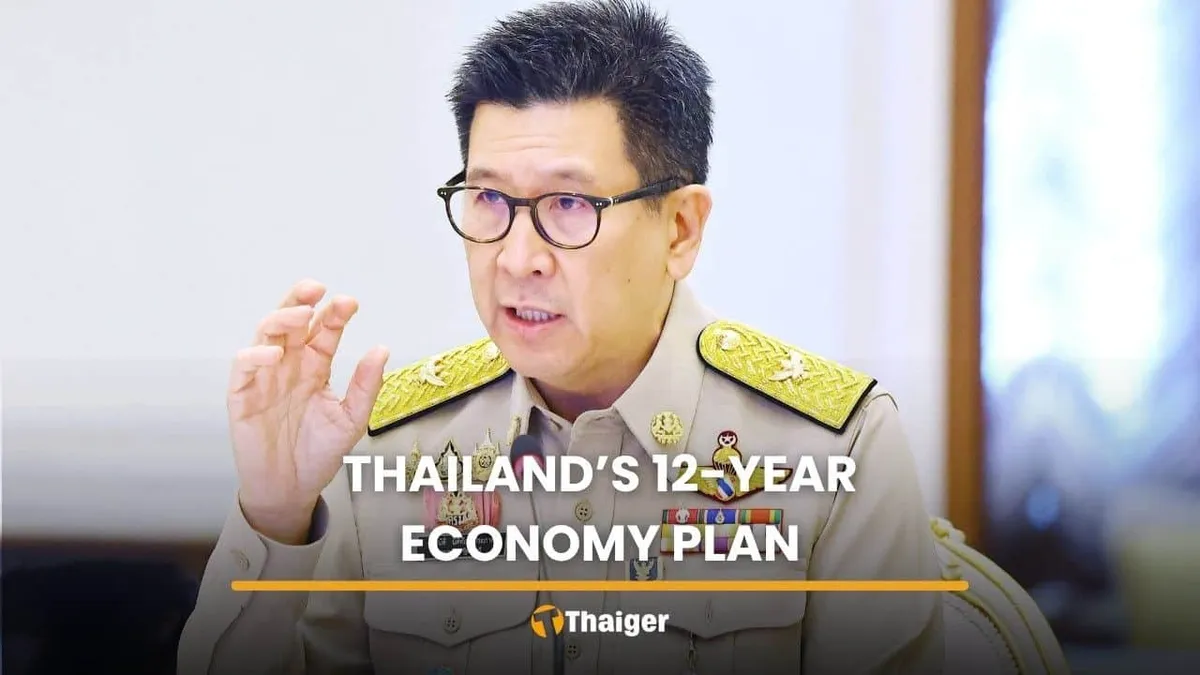
Thailand’s government and private sector have united behind a comprehensive 12-year strategy designed to elevate the nation to high-income country status. This ambitious plan was solidified following the inaugural meeting of the Joint Public-Private Consultative Committee on June 22.
Key Objectives and Timeframes
Deputy Prime Minister and Finance Minister Ekniti Nitithanprapas detailed the committee’s objectives, outlining clear goals across three distinct timeframes. The overarching long-term aspiration is to achieve high-income status for Thailand within the next 12 years.
The medium-term goal, set for 2030, focuses on significantly boosting Thailand’s global standing. The nation aims to rank among the top 20 countries worldwide for competitiveness and increase its economic potential from the current 2.7% to 3% or higher. Minister Nitithanprapas clarified that this 3% figure represents economic potential and competitiveness capacity, distinct from GDP growth rates.
Strategic Framework
Employing a football analogy to explain the committee’s operational structure, Minister Nitithanprapas described the strategic pillars. ‘Defence’ encompasses fiscal discipline and economic stability. ‘Midfield’ involves strengthening infrastructure, including power, water, clean energy, and digital and AI systems, alongside the development of clear regulations and a skilled workforce. ‘Attack’ is dedicated to boosting revenue-generating sectors.
Minister Nitithanprapas highlighted that consistent fiscal discipline maintained over the past seven to eight months has contributed to the Thai economy’s stability and reassured international credit rating agencies.
Identifying Strengths and Growth Engines
The private sector has identified seven areas where Thailand currently possesses significant strengths:
- Quality agriculture and food production
- Food security
- Future mobility and the automotive sector
- Digital electronics
- Pharmaceuticals and healthcare
- Trade and commerce
- The creative economy
Four Pillars of Progress
To drive this economic advancement, the committee has established four dedicated working groups, operating under the unifying theme of “Reinvent Thailand.” These groups are tasked with developing actionable plans within one month and will provide progress reports every two months. Each group will pursue immediate ‘quick wins’ within six to 12 months, alongside more significant structural goals to be achieved within four years.
1. New Investment
Chaired by Minister Ekniti Nitithanprapas, this group will focus on positioning Thailand as a leading investment hub for emerging sectors such as AI and digital infrastructure, data centers, financial services, the green economy, and smart automotive technologies. A key objective is to ensure that small and medium-sized enterprises (SMEs) and domestic businesses benefit from inbound investment.
2. Trade and Services
Led by Deputy Prime Minister and Commerce Minister Suphajee Suthumpun, this group will prioritize the growth of tourism and wellness, agriculture, the creative economy, retail commerce, and international trade. Accelerating the finalization of free trade agreements is also a key focus.
3. Human Capital
Under the leadership of Deputy Prime Minister and Higher Education Minister Yotchanun Wongsawat, this group will concentrate on advancing research, innovation, and education in science, technology, engineering, and mathematics (STEM). Upskilling and reskilling the workforce, fostering startups, and enhancing AI literacy are also critical components.
4. Government Efficiency
Chaired by Deputy Prime Minister Pakorn Nilprapan, this group will address regulatory hurdles, promote digital government initiatives, improve the ease of doing business, implement anti-corruption measures, and undertake public sector restructuring and asset management.
Investment Targets and Funding Mechanisms
Minister Nitithanprapas stated that Thailand’s current investment-to-GDP ratio stands at 22%, with a strategic target of approximately 30%. This increase is considered a crucial indicator for sustainable economic growth. He emphasized that fiscal limitations will not impede large-scale investments, as the government intends to expand public-private partnership (PPP) mechanisms.
Private capital and capital markets will be mobilized through the Thailand Future Fund to facilitate co-investment in public infrastructure projects. It was noted that the upcoming 2027 budget draft, scheduled for parliamentary review, may reflect a reduced public investment share, signaling a strategic shift towards PPPs and the Thailand Future Fund.
