

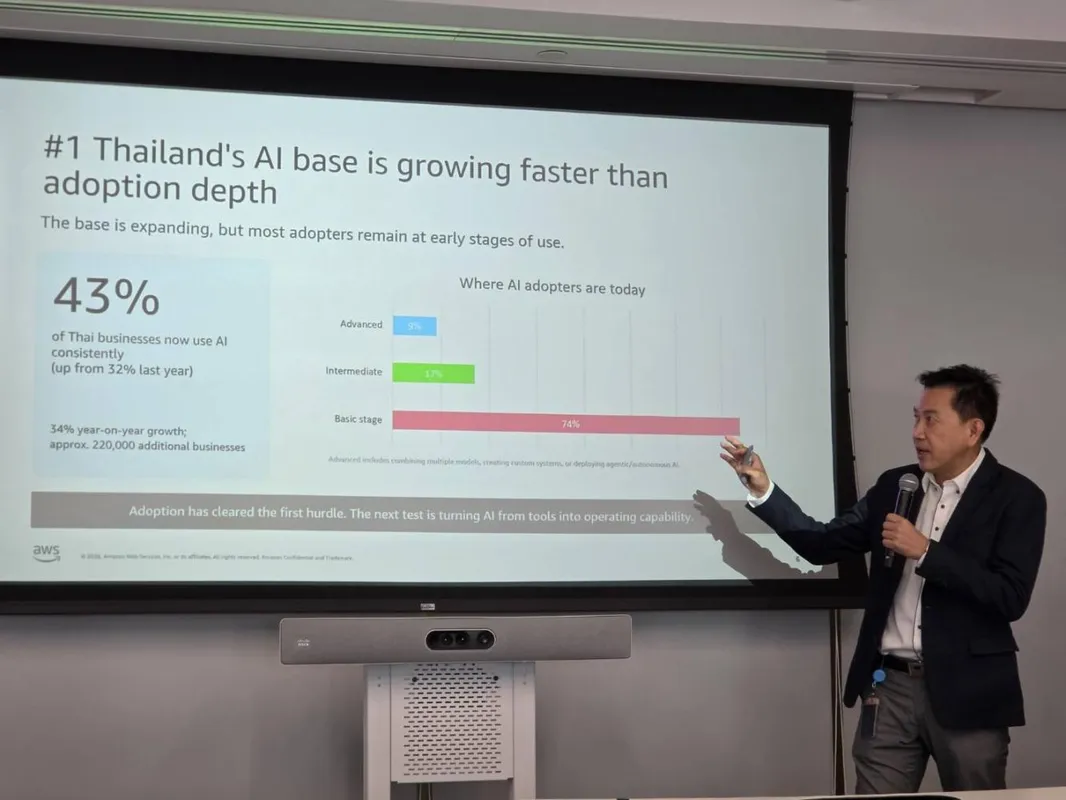
Artificial intelligence (AI) adoption is rapidly expanding across Thai businesses, with a significant increase in companies integrating the technology. However, current usage largely remains at a foundational level, highlighting a critical need for more advanced implementation to unlock AI’s full potential and generate substantial business value. This trend was revealed in the “Unlocking Thailand’s AI Potential 2026” study conducted by Amazon Web Services (AWS).
AI Momentum and Current Adoption Landscape
The study indicates a substantial growth in AI adoption, with approximately 220,000 additional businesses embracing AI. This surge is driving tangible benefits, as reported by a large majority of adopters. Specifically, 84% of businesses using AI have experienced productivity gains, 71% have seen an increase in revenue, and 64% report accelerated innovation timelines. These positive outcomes underscore the real momentum of AI in the Thai market, with many companies transitioning from initial experimentation to active production environments.
Despite this widespread adoption, the depth of AI integration varies significantly. The research found that a considerable 74% of businesses are currently operating at a basic level. Their primary use of AI involves straightforward applications such as posing questions, conducting preliminary research, and generating short texts or summaries. Only a smaller segment, 17%, has reached the intermediate phase, while a mere 9% are considered advanced users. These advanced adopters are moving towards more profound and integrated applications of AI, including the development of specialized internal knowledge bases, such as sophisticated medical databases tailored for healthcare professionals.
The Gap in Advanced AI Implementation
The transition to more sophisticated AI applications, such as agentic AI, is still in its early stages. Only 19% of businesses feel fully or very prepared to adopt these next-generation AI technologies. This suggests a significant gap between the current basic utilization and the advanced capabilities that AI can offer.
Experts advise that in the current economic climate, businesses should adopt a strategic approach to AI implementation. Instead of focusing solely on productivity enhancements, companies should identify select use cases where AI can generate greater overall value, create new revenue streams, and foster innovation. This strategic deployment is crucial for maximizing the return on AI investments.
Bridging the Skills and Governance Divide
A notable shift is occurring in how AI is being utilized within organizations. More than 70% of frequent AI users are now found in non-IT departments, including sales, marketing, and human resources. This widespread use outside of traditional IT functions presents new challenges, particularly in governance. Currently, only 19% of organizations have extended their AI governance policies to these non-IT departments.
This oversight gap has contributed to the rise of “Shadow AI,” a phenomenon where employees independently subscribe to AI tools and input sensitive corporate data into public AI models to streamline their daily tasks. To combat this, organizations must establish clear policies, implement robust review processes, and ensure that data infrastructure foundations are secure and accessible for all employees, not just the IT team.
The Human Element: Oversight and Skills
The readiness for advanced AI adoption is intrinsically linked to practical execution capabilities. Several barriers hinder progress, with 56% of businesses citing skills shortages as a major obstacle. Insufficient internal financial resources (48%) and legal uncertainties stemming from AI and digital regulations (41%) also present significant challenges.
Modernizing legacy systems by migrating to cloud-based, “serverless” architectures is identified as a critical step. These architectures offer cost efficiencies by charging only for active application usage. Furthermore, AI can play a role in transforming and updating outdated code, significantly reducing engineering time and eliminating costly legacy licensing fees.
Given the escalating difficulty and expense of hiring external AI experts, a strong emphasis is being placed on reskilling the internal workforce. A substantial 72% of organizations recognize the necessity of this approach, leveraging the existing organizational knowledge held by their employees. A key future skill identified by 61% of businesses is the ability to interpret, validate, and challenge AI-generated outputs. However, a significant 52% of employees report uncertainty about when to trust or question AI-generated information, underscoring the continued essential role of human oversight in complex tasks where AI can err.
“For businesses, the practical need is clearer guidance on when to rely on AI, when to challenge it and when to escalate,” stated Vatsun Thirapatarapong, country manager of Thailand at AWS. This highlights the ongoing necessity for human judgment and intervention to ensure the accurate and effective use of AI technologies.
Energy Efficiency and Cloud Infrastructure
In the context of rising AI demand, the efficiency of data center operations is becoming increasingly important. Cloud data centers, benefiting from massive economies of scale, are up to four times more energy-efficient than private servers. This efficiency advantage raises questions about the continued reliance on less efficient, power-intensive systems, especially as Thailand’s demand for AI capabilities grows.
The path forward for Thai businesses involves not only adopting AI but also maturing its application through strategic implementation, robust governance, and a focus on developing human skills to complement AI capabilities. This comprehensive approach is vital for harnessing the full transformative power of artificial intelligence.
