

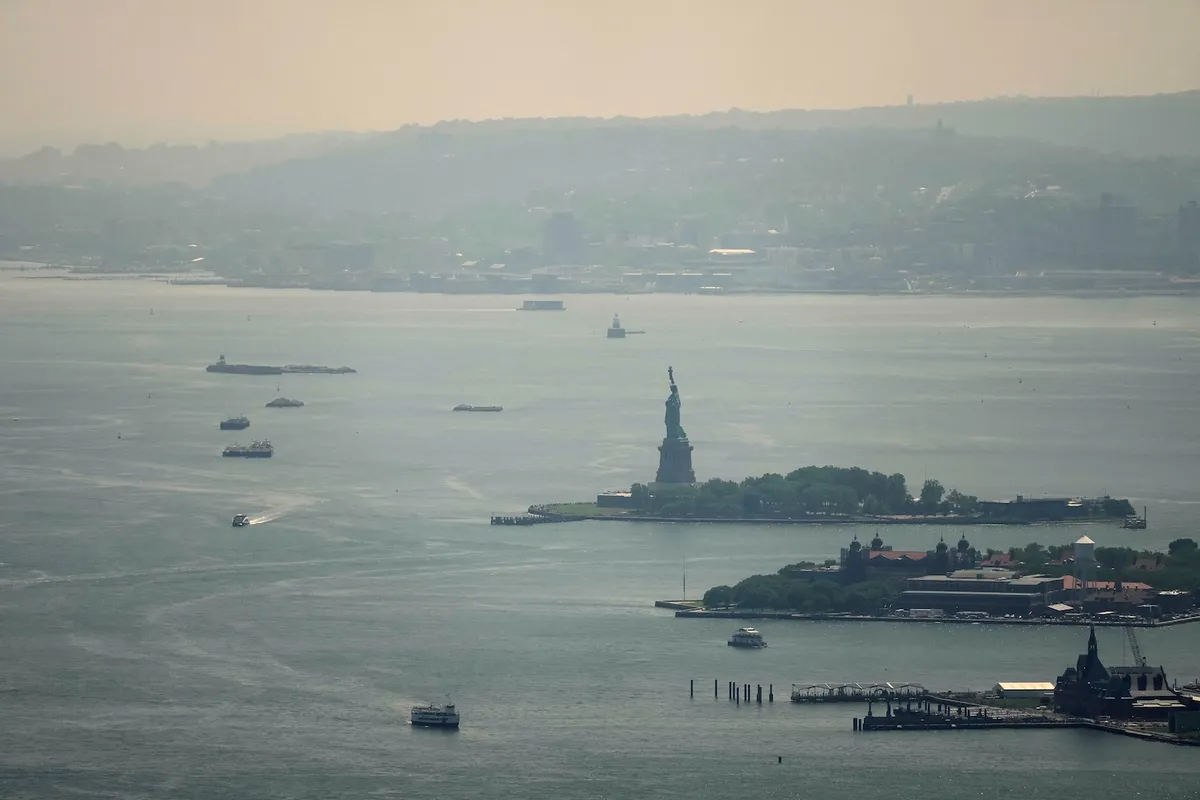
Thick smoke billowing from hundreds of wildfires across Canada blanketed large portions of the United States, stretching from the Midwest to the Northeast on Thursday and Friday. The hazardous air quality prompted public health advisories urging residents to remain indoors. Amidst the environmental crisis, a prominent political figure, Donald Trump, issued a threat to impose tariffs on Canada, citing the smoke as an unacceptable consequence of the nation’s forest management practices.
Trump Blames Canada for Air Quality, Threatens Tariffs
Donald Trump, who has previously expressed a contentious relationship with Canadian Prime Minister Mark Carney, stated his intention to contact the Canadian leader to address the situation. He described the influx of smoke as “totally unacceptable” and asserted that Canada was failing to properly maintain its forests. In a post on his social media platform, Truth Social, Trump declared, “We are holding Canada responsible for the fact that they are not properly maintaining their Forests… and the United States is being unnecessarily invaded by filthy, polluted, and unhealthy air.” He characterized this as “Willful Negligence” and a recurring issue that costs the United States billions of dollars, suggesting these costs should be added to existing tariffs imposed on Canada.
Canada’s Response and Forest Management Investments
In response to the accusations, Canada’s minister of emergency management and community resilience, Eleanor Olszewski, highlighted the government’s significant investment in forest sustainability and fire prevention. She stated that Canada has allocated US$8.5 billion towards these efforts since 2020, acknowledging the increasing challenges posed by drier, warmer weather conditions. Olszewski also emphasized the long-standing history of collaboration between the United States and Canada in combating wildfires that occur on both sides of their shared border. “At this time, our first priority is protecting Canadians and keeping communities safe,” Olszewski affirmed in a statement, underscoring the immediate focus on domestic safety.
Climate Change and the Escalation of Wildfires
Climate experts attribute the recent surge in wildfires in Canada, home to vast forest landscapes, to rising global temperatures. These warmer conditions contribute to drier timber, creating a more conducive environment for fires to ignite and spread rapidly. Mike Flannigan, a professor specializing in wildland fire at Thompson Rivers University in British Columbia, explained the connection: “As our climate warms, we’re seeing… more extreme weather, and we’re going to see more fire.” This scientific perspective suggests that the current wildfire situation is part of a broader trend driven by climate change.
Historical Context and Potential Meeting
The current situation also brings to mind past trade actions. Shortly after taking office in 2025, Donald Trump implemented tariffs on several key imports from Canada. While Prime Minister Mark Carney’s office did not immediately comment on Trump’s latest remarks, Carney himself had previously suggested on Thursday that the United States could increase its efforts to combat climate change, which he linked to prolonged droughts and rising global temperatures. Speculation arose that the two leaders might have an opportunity to meet at the Fifa World Cup final in New Jersey on Sunday, potentially offering a platform for direct discussion.
Impact on Communities and Evacuations
The majority of the current blazes are concentrated in the remote and sparsely populated northwestern region of Ontario, approximately 2,000 kilometers north of New York City. This area, largely accessible only by air, is experiencing a severe fire season. As of the reports, 650,000 acres have burned, a slight increase compared to the 600,000 acres affected at the same point last year. Thousands of residents have been forced to evacuate their homes.
Devastation in Namaygoosisagagun First Nation
The Namaygoosisagagun First Nation, also known as Collins First Nation, located in northwestern Ontario, was engulfed by flames. Residents were compelled to flee their homes by boat, seeking refuge in Thunder Bay. Matthew Hoppe, the community’s incident commander, described the scene to Reuters, stating, “There was nothing remaining. So as you can imagine, the membership is totally distraught, upset, overwhelmed, lost.” This firsthand account highlights the profound emotional and material toll the wildfires have taken on Indigenous communities.
Thunder Bay Overwhelmed by Evacuees
Thunder Bay, a city of 110,000 situated on the northern shore of Lake Superior, more than 1,300 kilometers northwest of Toronto, is currently at its maximum capacity for sheltering evacuees. Mayor Ken Boshcoff reported that the city is housing wildfire victims from across northwestern Ontario, indicating the widespread nature of the displacement. In an effort to bolster firefighting capabilities, Ontario Premier Doug Ford announced on Friday that the province would acquire 11 new aircraft. Ford also addressed criticisms regarding the province’s wildfire response, defending the campaign as robust.
US Fire Season Also Above Average
The United States is also contending with an unusually active fire season. According to the National Interagency Fire Center, 3.7 million acres have burned to date in 2026, significantly exceeding the 10-year average of 2.7 million acres. This indicates that both nations are facing heightened wildfire risks, exacerbated by environmental conditions.
Conclusion
The severe wildfire situation in Canada has not only caused widespread environmental damage and displacement but has also ignited political tensions, with threats of economic repercussions. As climate change continues to influence weather patterns, leading to more frequent and intense wildfires, the need for robust forest management, international cooperation, and effective climate action becomes increasingly critical for both Canada and the United States.
