

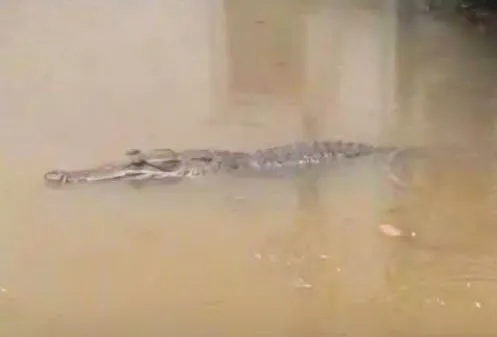
A high school in Chon Buri, Thailand, experienced a brief but intense scare when a seemingly realistic image of a crocodile near its library circulated widely on social media and within the school’s messaging groups. The incident, which triggered a swift response from local authorities and rescue teams, was ultimately revealed to be the result of an AI-generated image created by a student.
The Initial Report and Rising Fears
The alarm was raised after a teacher at Singsamut High School reported the widespread sharing of a photograph depicting a crocodile in the water near the school’s library. The image appeared particularly convincing due to recent heavy rainfall that had caused flooding in the area the previous night. This environmental context fueled immediate concerns that a real crocodile might have entered the school campus, posing a significant threat to students and the surrounding community.
Emergency Response and Investigation
In response to the potential danger, rescue personnel from the Sawang Rojanathammasathan Sattahip Foundation, alongside local police and municipal officials, were dispatched to the scene. They established a cordon around the affected area and initiated a thorough search operation. More than ten individuals dedicated approximately 30 minutes to meticulously combing through the standing water and examining potential hiding places for the alleged reptile. Despite their efforts, no physical evidence of a crocodile was found.
Unraveling the Mystery: The AI Revelation
The mystery surrounding the crocodile sighting was eventually solved when school administrators contacted a Matthayom 5 (equivalent to Year 11) student. The student was identified as the source of the circulated photograph. Upon arriving at the school, the student expressed remorse and confessed to using artificial intelligence (AI) to digitally add a crocodile to an authentic photograph taken on the school grounds.
Student’s Explanation and Intent
The student explained that he had created and shared the edited image with friends as a prank. He stated that he had not anticipated the image spreading so rapidly across social media platforms or being mistaken for a genuine crocodile encounter. The student emphasized that his actions were impulsive and that he never intended to cause alarm, disruption, or public panic. He acknowledged acting without fully considering the potential consequences of sharing manipulated content.
Public Official’s Involvement and Reaction
The false alarm also captured the attention of Thanatharn Pramoonpong, a Member of Parliament for Sattahip representing the People’s Party. Upon hearing reports of the crocodile sighting, he made his way to the school to assess the situation. Mr. Pramoonpong commended the student for his honesty in admitting his role in creating the AI-generated image. He also extended his gratitude to all the agencies and individuals who responded promptly and diligently to the incident.
Lessons Learned and Public Advisory
Following the resolution of the incident, officials from Sattahip and the rescue workers issued a joint appeal to the public. They strongly urged individuals to exercise caution and critical thinking when encountering information and images online. The advisory specifically highlighted the importance of verifying the source and credibility of content, particularly AI-generated material, before sharing it. The aim is to prevent the unnecessary spread of misinformation that can lead to public anxiety and the misallocation of valuable resources for investigating non-existent threats.
The Growing Challenge of AI-Generated Content
This incident underscores a growing challenge in the digital age: the ease with which artificial intelligence can be used to create highly convincing, yet entirely fabricated, visual content. While AI offers numerous beneficial applications, its potential for misuse, such as generating fake news or causing public disturbances, is becoming increasingly apparent. Educational institutions and public safety organizations are grappling with how to address the spread of such deceptive content and educate the public on digital literacy and responsible online behavior.
Preventing Future False Alarms
Moving forward, authorities emphasize the need for a multi-faceted approach to combatting false alarms stemming from manipulated media. This includes:
- Public Education: Raising awareness about the capabilities of AI in image generation and the importance of critical evaluation of online content.
- Technological Solutions: Exploring and implementing tools that can help identify AI-generated or manipulated media.
- Community Vigilance: Encouraging a culture where individuals are encouraged to question and verify information before sharing, especially if it seems sensational or alarming.
- Clear Communication Channels: Establishing reliable channels for reporting suspicious content and for authorities to disseminate accurate information quickly.
The Singsamut High School AI crocodile incident serves as a potent reminder of the evolving landscape of digital information and the collective responsibility to navigate it with discernment and caution.
