

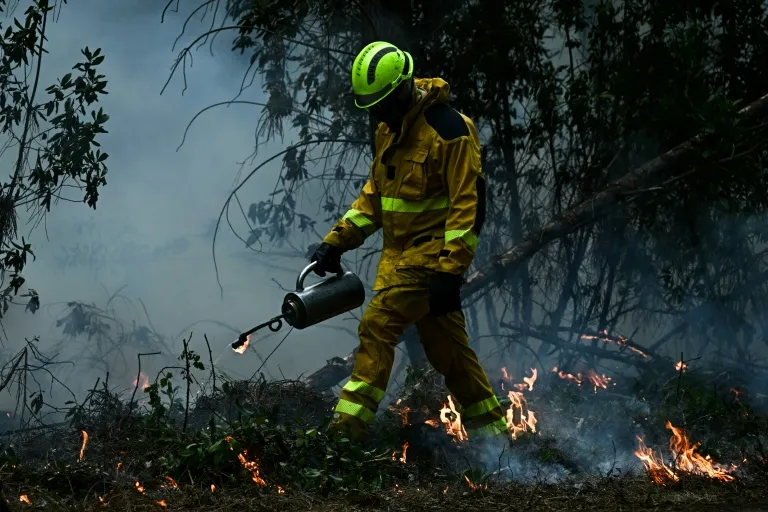
As Europe grapples with an intensifying wildfire season, France and Spain are reporting some signs of reprieve from major blazes, while other regions, including Greece, Portugal, and Turkey, continue to battle significant outbreaks. Scientists highlight that the unusual severity of these fires underscores the escalating risk posed by climate change, which is drying out vegetation and exacerbating emergency conditions across the continent.
France: A Glimmer of Hope Amidst Devastation
In southwestern France, firefighters battling a massive wildfire west of Bordeaux expressed cautious optimism. This blaze, which had previously necessitated the evacuation of 220,000 people, showed signs of being contained. Light morning rain provided a welcome boost to efforts, though crews remained vigilant for flare-ups from smoldering embers within the vast affected area, which spans a larger territory than the island of Malta.
Firefighting chief Marc Vermeulen described the situation as reaching a “new threshold, a kind of tipping point.” He noted a reduction in active hotspots from six to three. The wildfire has been devastating, destroying over 200 homes and scorching 42,000 hectares (approximately 104,000 acres). Tragically, two firefighters lost their lives when their truck was engulfed by flames last week.
Local business owner Nina Rosazza characterized the event as “the start of the end of the fire — but the start of the crisis.” She emphasized the long-term catastrophe facing the region in terms of tourism, the environment, and visual impact.
Smaller fires have also affected other parts of southern France. In Brignoles, a blaze on Wednesday forced actor George Clooney, his wife Amal, and their nine-year-old twins to evacuate their estate. The couple, in a statement to the mayor of Brignoles, expressed their concern for their home and their commitment to the community’s recovery.
Spain: State of Emergency Lifted, but Vigilance Remains
Spain’s Prime Minister Pedro Sanchez announced the lifting of a state of emergency for a wildfire that had threatened areas near Madrid. Officials confirmed that there were no longer any “active fronts” in that particular blaze. While over 60,000 people had been evacuated during the peak of the fires, most residents were permitted to return home by Thursday.
However, the threat is far from over. In the adjoining Avila region, a separate inferno, which began last week, has become the largest wildfire recorded in Spain since records began in 1961, consuming 50,000 hectares. Adding to the concern, Spain is currently experiencing another heatwave, with officials warning of the potential for reignited fires in the Madrid area.
Near the Spanish border with Portugal, a new fire erupted in Fermoselle on Wednesday, prompting the evacuation of over 600 residents, according to emergency services.
Greece: Facing Difficult Days Ahead
Greece has tragically reported the deaths of three firefighters battling blazes. Two lost their lives on the island of Crete when winds shifted unexpectedly, trapping them, while another collapsed and died while fighting fires near Gythelo on the mainland.
Prime Minister Kyriakos Mitsotakis cautioned that “difficult days” lie ahead as the summer heat persists and Greece’s typical wildfire season intensifies. In southwest Crete, fires that began overnight forced the evacuation of 8,000 people, as the flames threatened the village resort of Agia Galini. Approximately 300 firefighters were engaged in combating two major blazes in the area.
The mayor of Agia Galini, Maria Lioni, indicated that homes and farm animals are believed to have been lost, though the full extent of the damage remained unclear. An Austrian tourist, Daniela Schmidt, recounted her fear as wildfires swept through parts of the island, leading to her family’s evacuation in their swimwear.
Portugal and Turkey Continue Firefighting Efforts
In northern Portugal, nearly 800 firefighters were deployed to combat a spreading forest fire in Valpacos. The civil protection service reported that five individuals sustained minor injuries, including three firefighters and a police officer.
Meanwhile, firefighters in Turkey were actively engaged in battling forest fires near popular tourist destinations, including Antalya and the Dardanelles. Agriculture Minister Ibrahim Yumakli stated that 105 out of 110 fires that had broken out across the country were under control. Turkey’s forestry agency reported that intensive ground and aerial operations were underway to tackle blazes along frequently affected coastal routes from Antalya to Alanya, and from Mugla to Fethiye.
Climate Change as a Driving Factor
Experts consistently point to climate change as a significant factor exacerbating the frequency and intensity of wildfires across Europe. Prolonged heatwaves, reduced rainfall, and drier vegetation create ideal conditions for fires to ignite and spread rapidly, posing a growing threat to communities, ecosystems, and economies throughout the continent. The ongoing events serve as a stark reminder of the urgent need for climate action and enhanced wildfire management strategies.
