

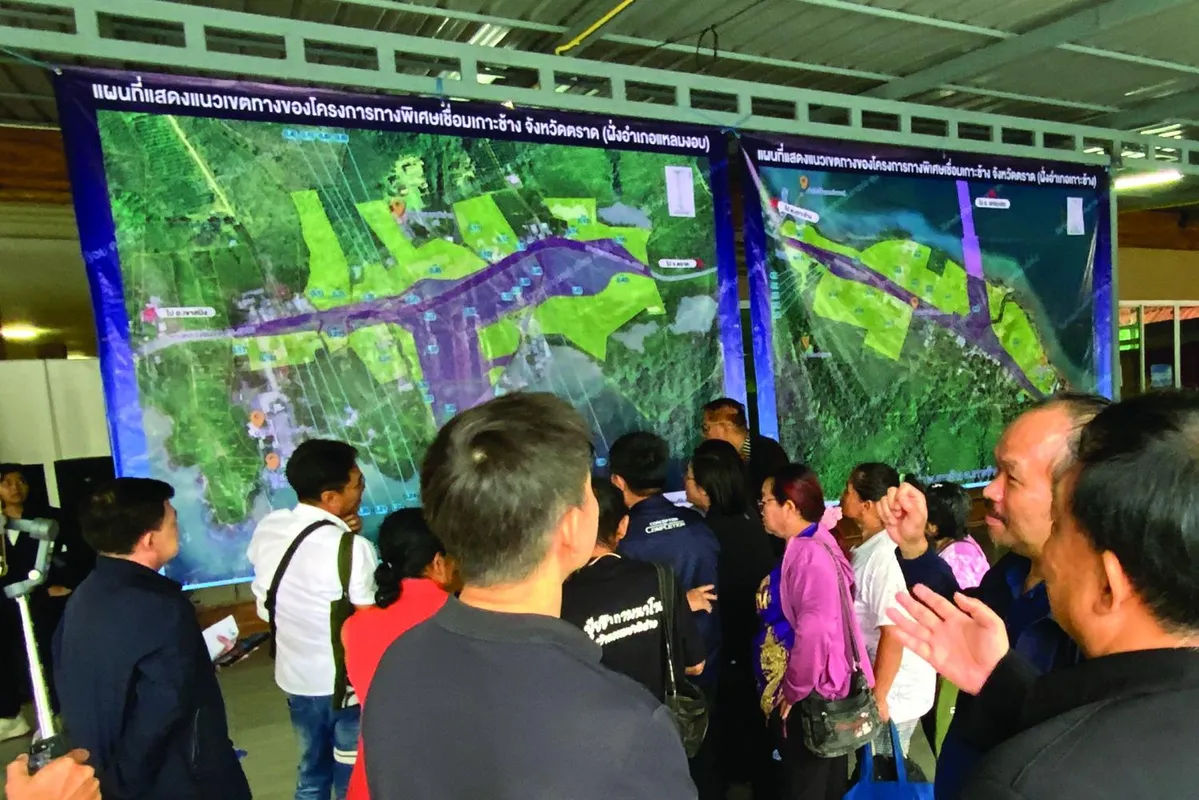
The Expressway Authority of Thailand (Exat) has established draft compensation criteria for landowners whose properties will be acquired for the proposed Koh Chang bridge project. While the project garners broad public support for its potential to improve connectivity and reduce travel times, some residents have voiced concerns that the proposed payouts may not be sufficient to facilitate their relocation.
Project Overview and Timeline
The Koh Chang Expressway Link project aims to connect the mainland with Koh Chang island, promising to shorten travel times significantly and eliminate long ferry queues. This development is expected to enhance access to essential services such as healthcare, schools, and government facilities for residents of both the mainland and the island. The project’s construction was initially slated to begin in 2019, with an expected completion date in 2023. However, the timeline has seen adjustments, with a target for cabinet approval set for 2025. A large-scale public consultation is scheduled for September, incorporating findings from engineering, economic, financial, and environmental studies.
Land Acquisition and Compensation Framework
Exat estimates that 66 landowners will be directly affected by the project. Thirty-two land parcels are located in Pong Nam Ron district, and 34 are situated on Koh Chang island in the Khlong Yai sub-district. The compensation process will adhere to the 2019 Expropriation of Immovable Property Act. A committee comprising representatives from Exat, the Treasury Department, the Land Department, district authorities, and local communities will determine the final compensation amounts. This determination will be based on market prices, ensuring fairness in the valuation of acquired land.
The compensation framework includes several key provisions:
- Landowners will be compensated based on assessed land values.
- An additional 2% of the assessed land value will be provided to landowners who transfer their land within approximately 120 days.
- Owners of houses built on land, including those with overwater structures, may receive compensation for their ownership rights if they can demonstrate improved ownership. However, they might not be compensated for the land itself if they lack formal land rights.
Resident Concerns and Proposed Solutions
During a recent small-group public consultation, residents shared their anxieties regarding the compensation. One 62-year-old resident, whose land is partially required for the project, expressed concern that the compensation might not be enough to purchase new property. “The key issue is how the land is valued,” he stated. “Many people are worried that the compensation won’t be enough for them to buy new land and start over.” He added that some landowners might only lose a small portion of their land, while others could be left with plots deemed too small for practical use.
To address these concerns and ensure the project’s viability, Exat is planning to test private sector interest through a market sounding exercise in October and November. This will help in determining appropriate toll fees that are comparable to current ferry rates, ensuring the bridge remains affordable while maintaining financial sustainability. The authority is committed to transparency and community engagement throughout the process, aiming to balance national development goals with the needs of affected residents.
Environmental and Financial Assessments
Before submission for cabinet approval in 2025, a comprehensive Environmental Impact Assessment (EIA) report will be prepared and reviewed. This assessment will evaluate the potential environmental consequences of the bridge construction and operation, ensuring that mitigation measures are in place. Financial and economic studies are also integral to the project’s planning, aiming to confirm its long-term economic benefits and feasibility. The project’s estimated cost, including land expropriation, is expected to exceed one billion baht.
Conclusion
The Koh Chang bridge project represents a significant infrastructure development with the potential to transform transportation and economic activity in the region. Exat’s proactive approach in drafting compensation criteria and engaging with the public demonstrates a commitment to addressing the concerns of affected landowners. While challenges remain, particularly in ensuring adequate compensation for relocation, the project’s progress, supported by thorough assessments and consultations, moves forward with the aim of balancing development with community welfare.
