

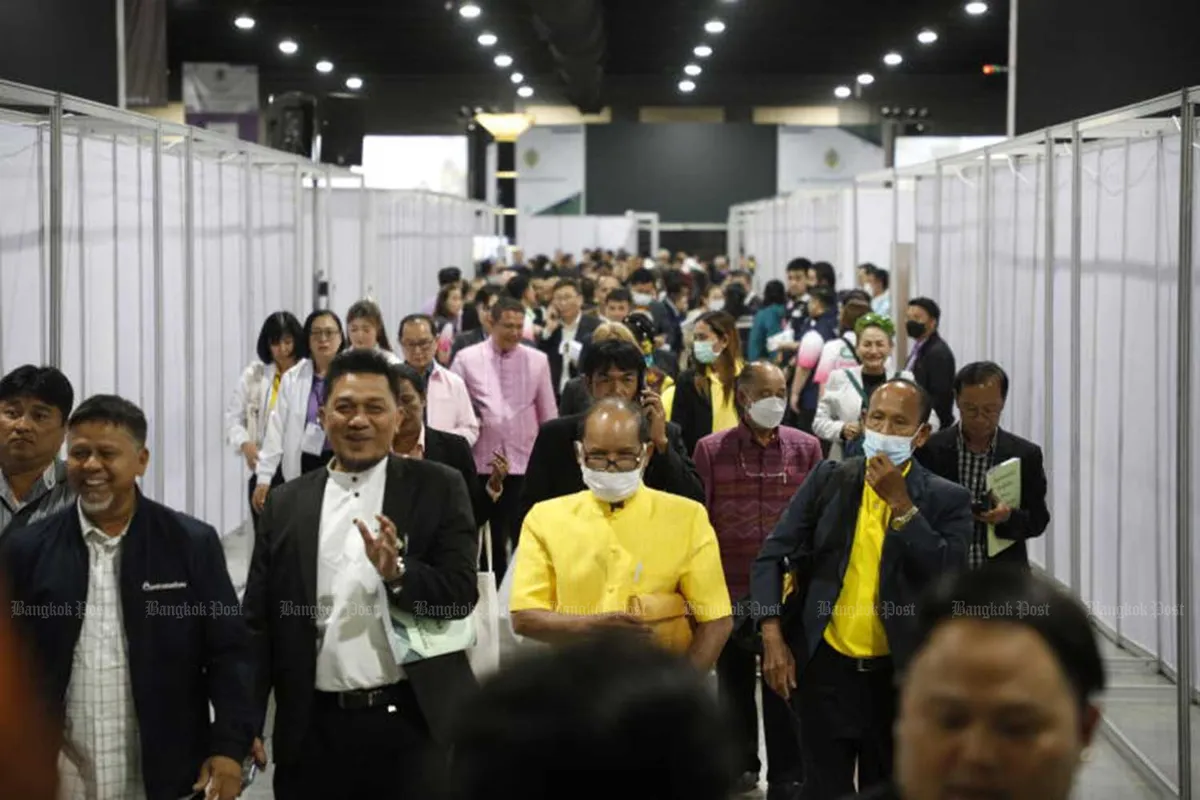
The Bhumjaithai Party (BJT) has called on the opposition to present concrete evidence supporting their allegations of fraud in the recent Senate election. The party remains steadfast and unconcerned about the opposition’s intention to hold a no-confidence debate, asserting that unsubstantiated claims of electoral irregularities cannot be taken seriously.
BJT’s Stance on Election Integrity
A prominent Member of Parliament from the Bhumjaithai Party, speaking on condition of anonymity, stated that the party’s position is clear: any accusations of fraud must be accompanied by verifiable proof. Without evidence, these claims are merely speculative and do not warrant further investigation or political action, such as a no-confidence motion.
The opposition has indicated plans to file a no-confidence motion against the government, citing various issues, including alleged irregularities in the Senate election process. However, the BJT maintains that the opposition has yet to provide any substantive evidence to substantiate these serious accusations. The party believes that the integrity of the electoral process should not be undermined by unsubstantiated allegations, especially in the context of a no-confidence debate, which is a significant parliamentary tool.
The Importance of Evidence in Parliamentary Debates
Parliamentary procedures, particularly those involving debates and no-confidence motions, rely heavily on factual evidence and reasoned arguments. The BJT’s insistence on proof underscores the principle that serious allegations, especially those that could potentially destabilize the government or question the legitimacy of an election, must be rigorously supported. This approach aims to ensure that parliamentary discussions remain focused on facts rather than conjecture.
The party’s statement suggests that while they are prepared to engage in parliamentary scrutiny, they expect the opposition to meet a certain threshold of proof before demanding such serious measures. The no-confidence debate, a critical mechanism for holding the government accountable, is intended to address proven failures or misconduct, not unproven allegations.
Context of Senate Elections
Senate elections are a crucial component of the political system, providing a legislative body that complements the elected House of Representatives. The integrity of these elections is paramount to maintaining public trust in democratic institutions. Allegations of fraud, if proven, could have significant implications for the legitimacy of the elected Senate and, by extension, the broader political landscape.
The BJT’s call for evidence is therefore not just a defense against what they perceive as baseless accusations but also a reinforcement of the standards expected in democratic processes. The party seems to be signaling that it will not be swayed by political rhetoric alone and requires factual backing for any challenges to the electoral outcome.
Opposition’s Next Steps
It remains to be seen how the opposition will respond to the BJT’s demand for proof. The success of a no-confidence motion typically depends on the strength of the evidence presented and the ability to persuade a majority of legislators. If the opposition cannot provide compelling evidence of fraud, their planned no-confidence debate may lose momentum and fail to achieve its intended political objective.
The Bhumjaithai Party’s firm stance highlights the ongoing political dynamics and the importance of evidence-based discourse in parliamentary proceedings. As the situation develops, the focus will likely remain on whether the opposition can produce the necessary proof to support their claims of Senate election fraud.
Conclusion
The Bhumjaithai Party’s challenge to the opposition to present evidence of Senate election fraud sets a clear expectation for accountability and factual rigor in political discourse. While the opposition prepares its no-confidence motion, the BJT’s demand for proof serves as a reminder that serious allegations require substantial backing. The coming days will reveal whether the opposition can substantiate their claims and proceed with their planned parliamentary challenge.
