

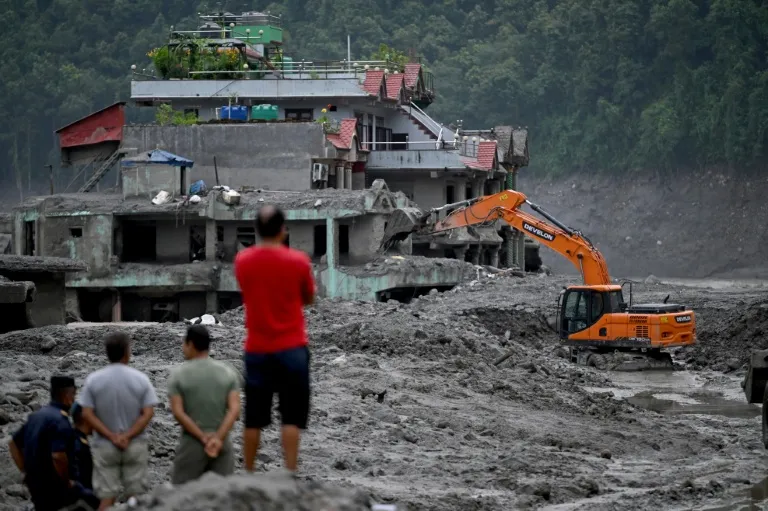
Rescue operations are intensely underway in Nepal following a devastating mudslide that struck hydropower project sites, leading to the recovery of three bodies and an ongoing search for potentially hundreds of trapped workers. The incident, which occurred on Wednesday morning, has raised urgent concerns for the safety of those caught in the disaster, with hopes dwindling but efforts to locate survivors continuing relentlessly.
Ongoing Search and Rescue Efforts
Rescuers have managed to access sections of tunnels inundated with mud and debris, employing specialized equipment and techniques to clear the pathways. At the Upper Trishuli 3A site, teams successfully penetrated the upper portion of a mud-choked tunnel. After pumping air into the space and utilizing drilling and excavation machinery, personnel descended using ropes to attempt communication. However, Prime Minister Balendra Shah reported on Sunday night that there was no response from anyone inside.
The Nepal Army confirmed on Monday morning that work persists to remove water, mud, and sediment from within the tunnel. International expertise has been enlisted to bolster the local efforts, with specialized tunnel-rescue teams from India, China, and South Korea now assisting in the complex operation. The sheer scale of the mud and debris presents a formidable challenge, requiring meticulous and persistent work to ensure the safety of the rescue teams while maximizing the chances of finding survivors.
Recovery of Bodies and Site Updates
Tragically, the search has resulted in the recovery of three deceased individuals. At the Upper Trishuli-1 site, a Chinese team reported entering approximately 300 meters (984 feet) into a tunnel. Their search efforts led to the recovery of one body. Meanwhile, at the Chilime Hydro tunnel, where Indian teams are operating, rescuers managed to penetrate 100 meters before encountering an impassable blockage. A statement indicated that the tunnel beyond that point was buried under mud and soil. During their operation at Chilime, two bodies were recovered.
These recoveries underscore the perilous conditions faced by the workers and the immense difficulty of the rescue mission. The presence of experienced mountain rescue teams, accustomed to aiding climbers on extreme peaks like Everest, highlights the technical demands of navigating the treacherous, debris-filled tunnels.
Broader Impact and Infrastructure Damage
The mudslide and subsequent flooding have had a widespread impact across Nepal, affecting tens of thousands of people. Roads have been destroyed, and bridges washed away, severely hampering transportation and relief efforts. Netra Bahadur Karki, a spokesman for the Armed Police Force, emphasized the ongoing commitment to search, rescue, and relief operations. He stated that rescue teams have reached most affected areas, utilizing both road access and helicopters, with the primary focus remaining on the safety and rescue of individuals.
The disaster has also significantly impacted Nepal’s energy sector. The Nepal Electricity Authority reported that 11 hydropower stations and one solar power station, collectively with a capacity of 431.1 megawatts, have ceased operations. This accounts for approximately 10 percent of the country’s total installed electricity generation capacity. Furthermore, 15 power projects currently under construction, which were slated to add 470 megawatts, have sustained damage, posing a setback to the nation’s energy development goals.
Scale of the Disaster
According to the National Disaster Risk Reduction and Management Authority, a staggering 933 hydropower workers were reported missing following the wall of mud and debris that descended on Wednesday. While contact has not yet been established with any of the individuals feared trapped, the government holds out hope that more than 100 workers may still be alive within the multiple tunnel systems. The sheer number of missing personnel points to the extensive nature of the hydropower projects affected and the catastrophic force of the landslide.
Conclusion
The situation in Nepal remains critical as rescue teams continue their arduous work to find survivors of the devastating mudslide. The recovery of bodies serves as a somber reminder of the risks involved, while the ongoing search effort reflects a deep commitment to saving lives. The disaster’s impact extends beyond the immediate rescue operation, affecting infrastructure and the nation’s power supply, necessitating a comprehensive approach to recovery and rebuilding.
