

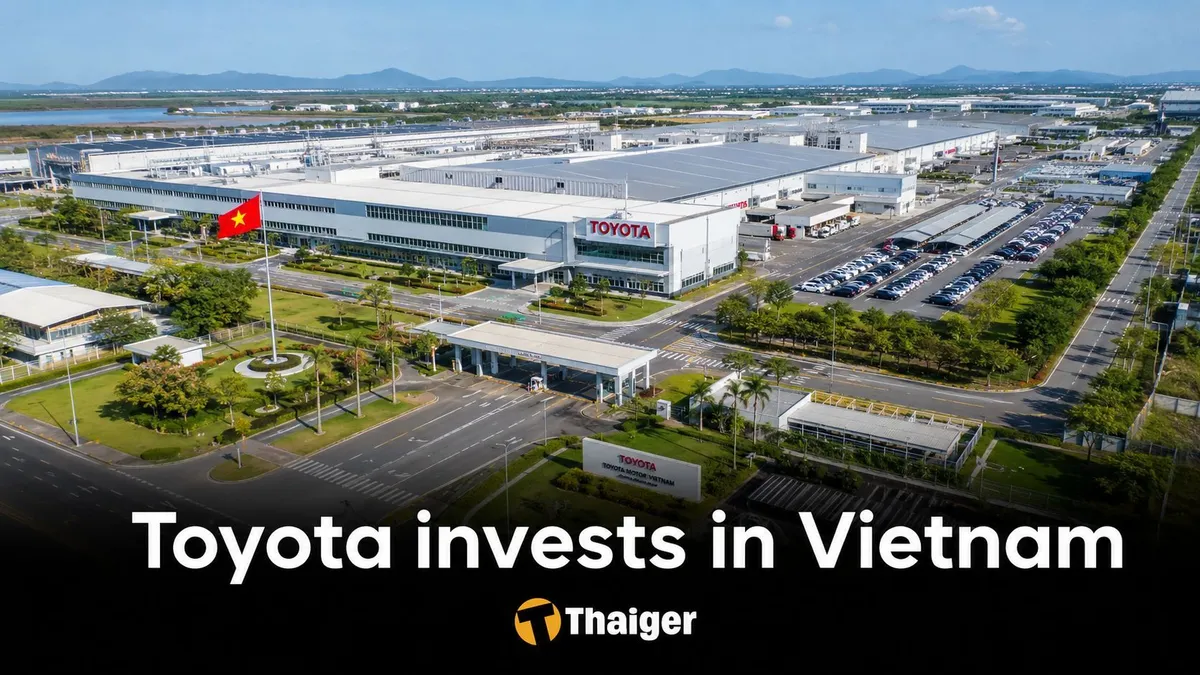
Toyota Motor Vietnam is significantly expanding its manufacturing capabilities in northern Vietnam with an investment exceeding US$283 million (approximately 9.3 billion baht). This substantial capital injection is earmarked for upgrading its existing complex in Phu Tho province to accommodate the production of electrified and completely knocked-down (CKD) vehicles. The expansion signals a strategic move by the automotive giant to bolster its presence in the region amidst a global shift towards lower-emission transportation.
Phu Tho Complex Undergoing Major Transformation
The People’s Committee of Phu Tho province has officially approved amendments to Toyota Vietnam’s investment policy, allowing for the integration of electrified vehicle assembly and manufacturing into its operations. This marks a pivotal step in the company’s long-term strategy for the Vietnamese market. While Toyota has confirmed preparations for locally assembled hybrid electric models, specific details regarding battery-electric vehicle (BEV) production at this site have not yet been disclosed.
The overall manufacturing project, which covers 28.6 hectares, encompasses vehicle assembly, automotive component production, warranty and repair services, and the import of fully built vehicles. The registered production capacity for the expanded facility is approximately 52,000 vehicles per year. It is crucial to note that this figure represents the total manufacturing output and not an annual target for fully electric vehicles.
New Facilities to Enhance Production Efficiency
A key component of this investment involves the construction of a new paint shop and a stamping plant. These state-of-the-art facilities are slated to commence construction in May 2027, with operations expected to begin in 2029. The introduction of modern production technologies and increased automation in these plants is designed to elevate manufacturing capacity, improve product quality, and boost energy efficiency.
Upon completion, these new facilities will be instrumental in supporting the production of new CKD models. CKD production involves importing vehicle components and assembling them domestically, a process that can offer logistical and economic advantages. Toyota intends to leverage this investment to prepare its Vietnamese operations for the manufacturing of new CKD vehicles, including hybrid electric variants. However, the company has not yet announced specific vehicle models or their production launch dates.
Strengthening Local Supply Chains and Economic Impact
Osamu Hirata, general director of Toyota Motor Vietnam, emphasized the importance of this expansion in strengthening Vietnam’s automotive industry. He highlighted the company’s commitment to nurturing its supplier network and increasing the proportion of locally sourced components. This focus is expected to foster the growth of Vietnam’s automotive supporting industries.
Beyond industrial development, the investment is projected to generate significant economic benefits. These include the creation of new employment opportunities, the transfer of advanced manufacturing technologies, and an increase in tax revenue for the region. Furthermore, the project aims to solidify Phu Tho province’s position as a key automotive production hub in northern Vietnam.
This expansion builds upon Toyota Vietnam’s existing infrastructure. The company also broke ground on a new office complex at its Phu Tho headquarters in March 2026, which includes a training center, additional offices, and new production lines. These developments underscore Toyota’s enduring commitment to its operations in Vietnam.
Vietnam’s Role in the Evolving Automotive Landscape
Toyota’s strategic investment in Vietnam aligns with broader regional trends. Southeast Asian nations are actively competing to attract automotive manufacturers and their supply chains as the global automotive industry transitions towards electrification and reduced emissions. Vietnam has been proactive in promoting domestic vehicle assembly and component manufacturing.
Neighboring countries like Thailand and Indonesia are also offering incentives to attract electric and hybrid vehicle projects, creating a dynamic competitive environment. Toyota’s decision to expand hybrid production in Vietnam positions the company to capitalize on the growing demand for these vehicles in the region while contributing to Vietnam’s industrial ambitions.
A Legacy of Production in Vietnam
Toyota Motor Vietnam has a long-standing history in the country, having received its initial investment license on September 5, 1995. Over its nearly three decades of operation, the company has achieved significant milestones, producing more than 700,000 vehicles and recording cumulative sales of one million units. Its extensive service network has catered to approximately 20 million customer visits, reflecting a deep integration into the Vietnamese automotive market.
The current investment is an expansion of its established Phu Tho manufacturing operations, rather than the creation of a standalone electric vehicle factory. Toyota views this initiative as a testament to its long-term dedication to local manufacturing, the development of its supplier base, and the promotion of lower-emission vehicle production within Vietnam.
