

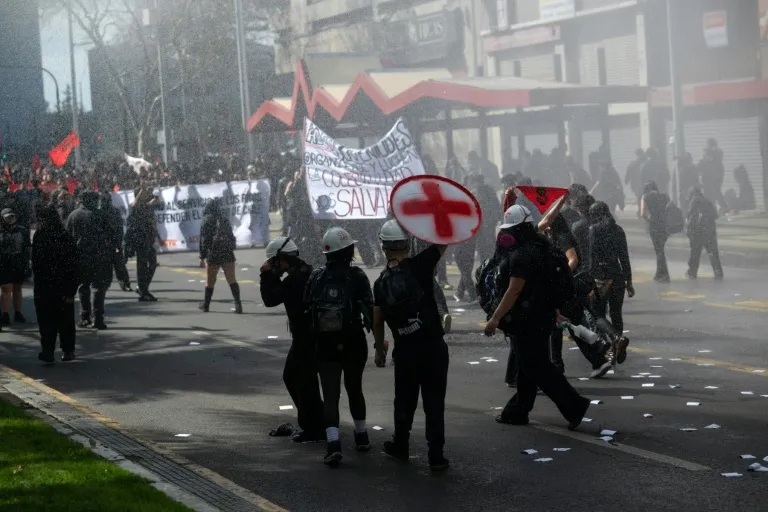
Santiago, Chile – A new security initiative proposed by Chilean President Gabriel Boric has ignited protests and drawn sharp criticism, with opponents drawing parallels to the authoritarian era of Augusto Pinochet. The plan, aimed at combating a recent surge in crime, includes constitutional amendments that critics argue could grant the government excessive powers, potentially infringing on fundamental civil liberties.
Proposed Security Reforms Under Scrutiny
At the heart of the controversy are eight proposed constitutional amendments designed to bolster the government’s ability to combat organized crime and illegal immigration. One of the most contentious provisions would allow the president to declare a state of emergency for up to eight months without requiring prior congressional approval. This extended state of emergency could grant authorities broad powers to restrict freedoms such as movement and assembly. Furthermore, the plan includes provisions for intercepting communications in designated geographic areas, a measure rights groups deem particularly alarming.
These reforms, which have not yet been debated in the Chilean Congress, have faced a swift backlash. Human rights organizations, opposition political figures, and even some members of Boric’s own ruling coalition have voiced strong objections. They contend that the proposed measures overstep the boundaries of democratic governance and echo tactics employed during Chile’s past military dictatorship.
Echoes of the Past: Pinochet Comparisons
Protesters have taken to the streets, notably in Santiago’s central Plaza Italia, chanting slogans that directly link President Boric’s security plan to the legacy of Augusto Pinochet, who led Chile with an iron fist from 1973 to 1990. The comparison highlights deep-seated concerns about the potential for authoritarian drift. While Boric’s government emphasizes its commitment to restoring public order, critics fear the proposed tools could be used to suppress dissent and erode democratic freedoms.
“He is giving himself powers that a president in a democracy shouldn’t have,” stated Camila Aramena, a 22-year-old public administration student who participated in a recent demonstration. Her sentiment reflects a broader anxiety that the proposed security measures, while perhaps well-intentioned in their aim to curb crime, could inadvertently pave the way for governmental overreach.
Context: Rising Crime in a Historically Safe Nation
Chile has long been regarded as one of the safer countries in Latin America. However, recent years have seen a disturbing increase in violent crime, including murders and kidnappings. This trend has been partly attributed to the influx of transnational criminal organizations, such as Venezuela’s Tren de Aragua. Official statistics indicate a significant rise in the homicide rate, which reached 5.4 per 100,000 inhabitants in 2025, a doubling of the rate observed a decade prior.
This escalating crime situation has created a public demand for decisive action. President Boric’s administration has framed the proposed security plan as a necessary response to this evolving threat landscape. The government argues that existing legal frameworks are insufficient to effectively tackle the sophisticated operations of modern criminal networks and the challenges posed by illegal immigration linked to crime.
Key Provisions of the Proposed Security Plan:
- Extended States of Emergency: Allowing presidents to declare emergencies for up to eight months without immediate congressional consent.
- Restrictions on Civil Liberties: Granting authorities the power to limit freedom of movement and assembly during states of emergency.
- Communication Interception: Permitting the monitoring of communications within specific, designated geographic zones.
- Constitutional Amendments: A package of eight proposed changes to the constitution to enable these measures.
Debate and Opposition
The debate surrounding the security plan is multifaceted. Supporters argue that the measures are essential for restoring citizen security and providing law enforcement with the necessary tools to combat sophisticated criminal enterprises. They point to the rising crime statistics as evidence that a stronger approach is warranted.
Conversely, opponents emphasize the potential for abuse and the long-term implications for Chile’s democratic institutions. They advocate for alternative strategies that focus on addressing the root causes of crime, strengthening community policing, and enhancing judicial processes without compromising fundamental rights. The historical context of Pinochet’s regime looms large, serving as a cautionary tale about the dangers of concentrating too much power in the hands of the executive, especially during times of perceived crisis.
The coming weeks and months will be crucial as Congress begins to deliberate on these proposals. The outcome of this debate will not only shape Chile’s approach to public security but also define the balance between state power and individual liberties in the nation’s democratic framework.
Conclusion: Balancing Security and Freedom
Chile stands at a critical juncture, grappling with the dual challenges of rising crime rates and the preservation of its democratic values. President Boric’s proposed security plan aims to address the former, but its far-reaching provisions have ignited fears of the latter. The comparison to the Pinochet era underscores the sensitivity surrounding any measures that could potentially curtail civil liberties. As the legislative process unfolds, the nation will be closely watching to see if a consensus can be reached that effectively tackles crime without sacrificing the hard-won freedoms that define its democracy.
