

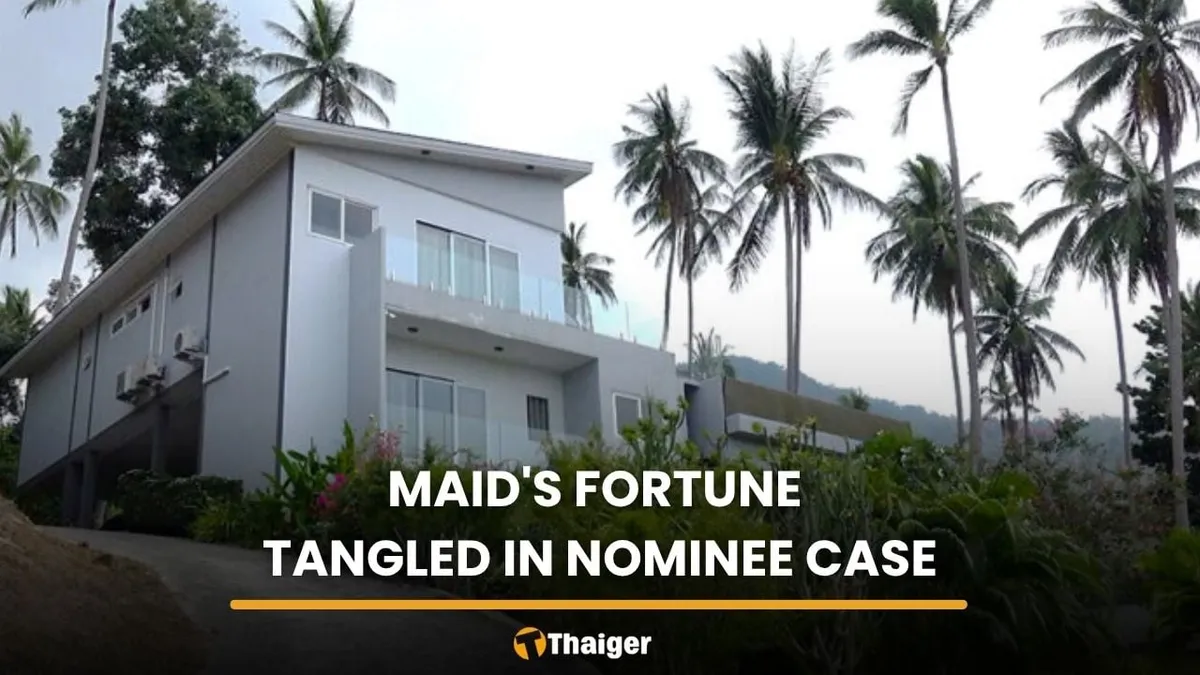
A significant inheritance left to a Thai housekeeper by a deceased French businesswoman has brought to light alleged illegal landholding activities. Police in Surat Thani have concluded an investigation into two companies, G.V.N.E. Co., Ltd. and Maxicate Co., Ltd., which they believe were used by the French national to circumvent Thai law regarding foreign ownership of land. The case, which gained national attention due to the substantial inheritance, has now been forwarded to the Koh Samui prosecutor’s office for further action.
Investigation into Nominee Companies
The investigation, led by Police Lieutenant Colonel Kittisak Charoenroop of Surat Thani City Police, focused on the business dealings of Catherine Delacote, a French businesswoman who died by suicide in Koh Samui in April 2024. Delacote left behind assets valued at nearly 100 million baht, which she bequeathed to her long-time housekeeper. The police investigation file, submitted for approval by Police Major General Suwat Suksri, commander of the Surat Thani Provincial Police, recommends prosecuting G.V.N.E. Co., Ltd. and Maxicate Co., Ltd. The primary charge is operating as foreign nominee companies involved in land trading, a practice prohibited under Thailand’s Foreign Business Act.
In addition to the companies, two Thai nationals, identified as Thongsai (50) and Ratchaprapa (36), are facing charges. They are accused of facilitating the illegal arrangement by acting as nominee shareholders, thereby enabling a foreigner to conduct land business unlawfully. No charges will be filed against the late Catherine Delacote herself, as she is deceased.
Background of the Case
The circumstances leading to the investigation began to unfold following Delacote’s death at her luxury villa in Tambon Mae Nam, Koh Samui, on April 29, 2024. She reportedly died by suicide using a firearm. Her will, which designated her Thai housekeeper as the sole beneficiary of her considerable estate, prompted a closer examination of her assets and business operations.
The Anti-Human Trafficking and Illegal Immigration Operations Centre of Surat Thani Provincial Police, in collaboration with a task force addressing state land encroachment under the Fourth Army Region, initiated a review of Delacote’s land holdings and corporate structures. Investigators uncovered discrepancies that suggested she may have utilized Thai nationals as nominee shareholders to register companies and operate a property business, which is legally restricted to Thai ownership.
Tracing the Business Operations
The police investigation traced the origins of Delacote’s business activities in Thailand back to approximately 2007, when she first relocated to the island and rented a residence in Tambon Bo Phut, Koh Samui. The pivotal moment in establishing her business presence appears to have been in March 2012, when she reportedly engaged a law firm to assist in her registration as an authorized director of Maxicate Co., Ltd. Crucially, the investigation suggests that no Thai nationals made any actual capital contributions to this company.
Following the registration, Delacote, through her companies, proceeded to acquire and develop property. One significant transaction involved the purchase of a plot of land measuring 1 rai and 2 ngan (approximately 0.6 acres) for 2.7 million baht. On this site, five villas were constructed under the “Mapraw” villa brand by G.V.N.E. Co., Ltd. Between 2018 and 2022, three of these villas were sold individually for prices ranging from 7 million to 8 million baht. The remaining two villas were reportedly leased long-term to foreign nationals.
Financial Irregularities
Further scrutiny of Maxicate Co., Ltd. revealed financial irregularities. According to the police findings, the company consistently reported losses since its inception under Delacote’s directorship and had never remitted any taxes. A significant shift in corporate control occurred in 2020, when the company’s board structure was altered, leaving Delacote as the sole individual with control over the land holdings. At the time of her death, these holdings included a substantial three-story villa, valued at approximately 50 million baht, which was awaiting sale.
Wider Implications for Koh Samui
This case is emblematic of a broader trend and a growing concern among Thai authorities regarding the use of nominee arrangements by foreign investors, particularly on popular islands like Koh Samui, which has seen extensive foreign investment in real estate and tourism infrastructure. The incident has contributed to an intensified crackdown by provincial officials on corporate structures that may be exploited by foreign nationals to circumvent laws governing land and property ownership in Thailand.
Authorities are increasing their scrutiny of how foreign entities establish and operate businesses in Thailand, aiming to ensure compliance with existing legislation designed to protect national interests and regulate foreign investment. The outcome of the prosecution against the companies and the Thai nationals involved will likely set a precedent for future cases of alleged illegal landholding through nominee schemes.
