

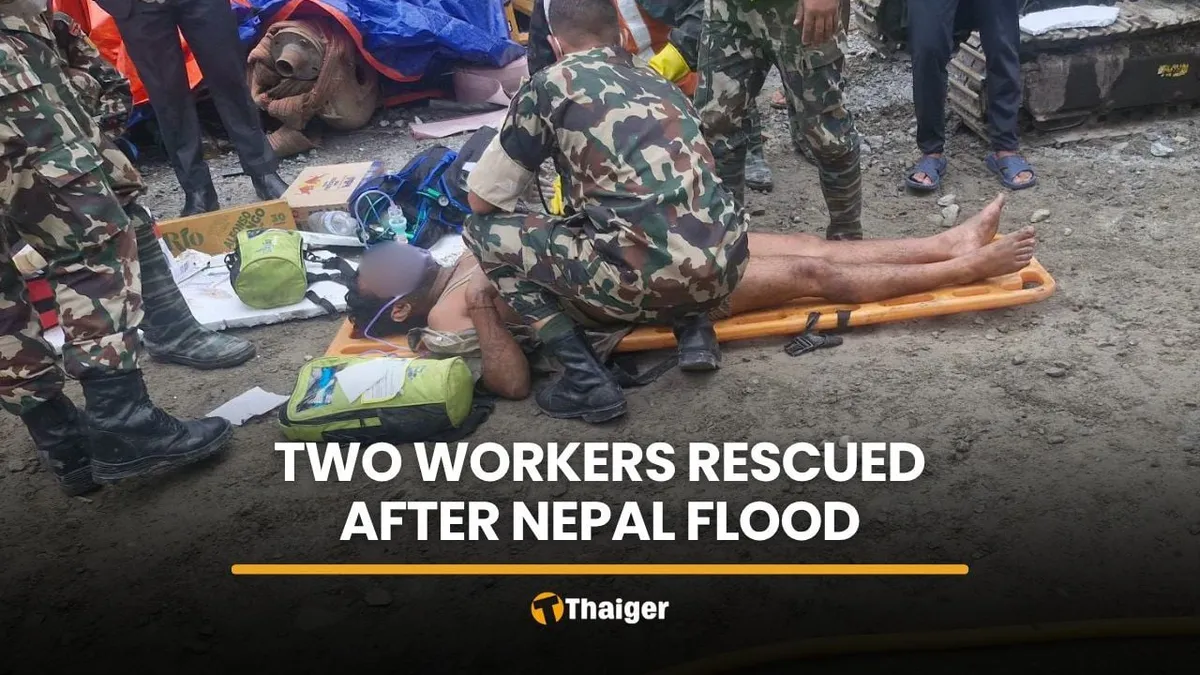
Two workers have been successfully rescued after being trapped for nine days inside a hydropower tunnel in northern Nepal. The dramatic rescue occurred at the Trishuli 3A Hydropower Project in Rasuwa district on September 4, amidst a severe national disaster marked by widespread floods and landslides near the Tibetan border. The operation to extract the men, who were trapped following the devastating weather events, highlights the ongoing search efforts in the region.
Dramatic Rescue Operation
The first worker to be brought to safety was Sanjay Shah, followed shortly by Kabir Maharjan. Both individuals were reportedly in a condition that required immediate medical attention and were subsequently airlifted by helicopter to a hospital in Kathmandu for further care. The successful extraction was confirmed by army spokesperson Brigadier General Raja Ram Basnet, with Nepalese lawmaker Shri Ram Neupane also posting about the second worker’s rescue. Officials identified the rescued men as a chief mechanic and a machinery supervisor, underscoring their roles within the project.
Ongoing Search and Missing Persons
While the rescue of Shah and Maharjan offers a glimmer of hope, the situation remains critical for many others. The Independent Power Producers’ Association of Nepal reported that a staggering 557 workers are still missing from the Trishuli 3A project alone. The project, situated along the Trishuli River, is believed to be holding approximately 115 workers within its main tunnel. Rescue teams on the ground maintain optimism that further survivors may still be located within the complex structure.
Earlier government assessments had indicated a broader crisis, with around 900 workers unaccounted for across 12 different hydropower projects throughout Nepal. Roughly 500 of these individuals were thought to be trapped in various tunnels. The scale of the disaster is immense, with the national disaster management agency reporting a death toll of at least 1,259 people. In addition to the fatalities, over 5,000 individuals remain missing, highlighting the profound impact of the floods and landslides.
International Impact and Damage Assessment
The disaster’s reach extends beyond Nepal’s borders. Chinese officials confirmed on September 3 that 21 people had died in Tibet, in areas close to the Nepal border, with an additional 541 individuals still missing in the region. The catastrophic weather has not only claimed lives and left many missing but has also inflicted extensive damage on homes, private property, and critical infrastructure across the affected areas.
A preliminary assessment of the damage, as reported by Dharmaraj Upreti, head of Nepal’s national disaster risk reduction and management agency, estimates the preliminary economic impact to be at least US$2.56 billion (approximately 84 billion Thai baht). The immediate recovery phase will require significant financial commitment, with an estimated US$52.6 million (around 1.7 billion Thai baht) needed for the first four months. These funds are earmarked for essential rebuilding efforts, including the reconstruction of roads, the provision of temporary housing solutions for displaced populations, and the restoration of vital services such as drinking water and electricity access.
Rebuilding and Future Challenges
The scale of destruction is further illustrated by the fact that at least 7,500 homes have been completely destroyed. In response to this widespread devastation, officials have indicated that Nepal will need to construct approximately 20,000 new homes in locations deemed safer from future natural disasters. Mr. Upreti emphasized that these financial and damage figures are preliminary estimates compiled in collaboration with relevant agencies and sectors. A more comprehensive and detailed assessment is anticipated in the coming weeks as the full extent of the disaster becomes clearer.
The rescue of the two workers marks a significant moment in the ongoing crisis, offering a vital human interest story amidst the overwhelming statistics of loss and destruction. However, the focus remains firmly on continuing search and rescue operations, providing aid to survivors, and embarking on the monumental task of rebuilding communities and infrastructure in the wake of this devastating natural disaster.
