

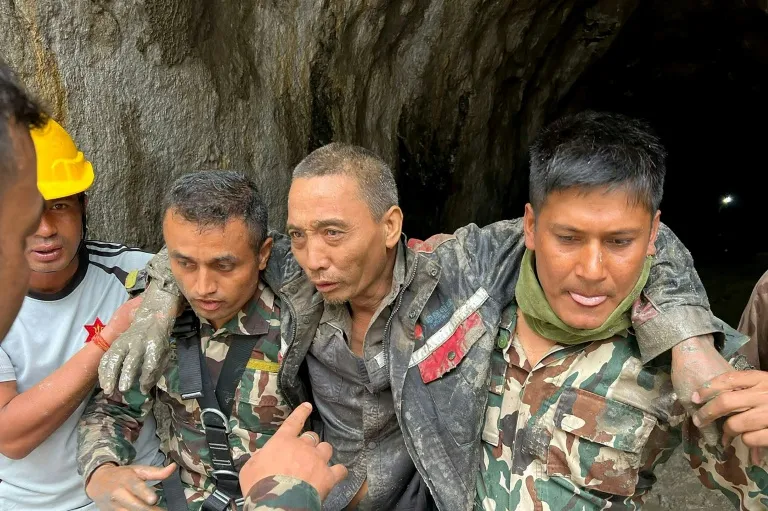
A remarkable rescue operation has brought a glimmer of hope to the aftermath of a devastating flood in Nepal, with one man pulled alive from a tunnel 10 days after a massive deluge swept through the region. The survivor, identified as Luhaitao, was found 225 meters inside a tunnel at the Upper Trishuli-1 Hydropower Project in Rasuwa district. He was part of a joint effort involving the Nepal Army and international experts.
Images released by the army depicted Luhaitao with his arms around the shoulders of two rescuers, appearing alert despite his hands being covered in thick mud. Military officials stated that his health is currently being evaluated, and search and rescue operations are ongoing at various sites. The successful extraction of Luhaitao marks a significant moment in the ongoing efforts to find survivors in the wake of a disaster that has claimed numerous lives and left thousands missing.
The Catastrophic Flood Event
The flood, described as a tsunami-like wall of water and mud, occurred on August 26th following a massive glacial and rock collapse near the China-Nepal border. This catastrophic event inundated multiple hydropower project sites, leading to widespread destruction and a significant loss of life. Hundreds of hydropower workers were reported missing in the immediate aftermath.
Impact on Hydropower Projects and Casualties
At least 12 hydropower projects were destroyed by the floods. The scale of the disaster is reflected in the grim statistics: according to Nepal’s national disaster agency, 1,344 bodies have been recovered within Nepal. Around 5,000 people remain unaccounted for. The disaster also extended into China, where state media reported 31 fatalities and 531 individuals missing. This brings the combined death toll to at least 1,375 people, with over 5,500 individuals still missing across both countries.
Ongoing Search and Rescue Efforts
The Nepal Army, alongside international specialists, has been working tirelessly to locate any potential survivors trapped within the collapsed tunnels and project sites. Army spokesman Raja Ram Basnet confirmed that efforts are actively underway within the tunnels to find individuals who may still be alive. Initially, the government had expressed hope that more than 100 workers might have survived within the various tunnel systems.
Miraculous Rescues and International Assistance
The rescue of Luhaitao follows another miraculous recovery on Friday, when two Nepali hydropower workers were found alive in the Trishuli 3A tunnel. These individuals, also covered in mud, were pulled out nine days after being trapped. They were subsequently hospitalized and are reported to be in stable condition. The successful extractions have been hailed as a testament to the resilience of the human spirit and the dedication of the rescue teams. Experts from India, China, Australia, and South Korea have joined Nepali rescuers, bringing specialized skills and equipment to aid in the challenging search operations within the blocked tunnels.
Addressing the Humanitarian Crisis
The sheer number of fatalities has overwhelmed local facilities, leading to difficult decisions regarding the deceased. Nepal Police reported on Saturday that 1,030 bodies had been buried in mass graves after DNA samples were collected for future identification, a somber measure taken due to overflowing morgues.
Support for Displaced Populations
The disaster has displaced thousands of people who are now residing in temporary relief camps. Prime Minister Balendra Shah has pledged to provide safe and comfortable accommodation for these individuals. Acknowledging the hardships faced by those in the camps, the Prime Minister conveyed a message of hope, promising to help create an environment where displaced citizens can once again envision and build their futures. This commitment underscores the government’s focus on both immediate relief and long-term recovery for the affected communities.
