

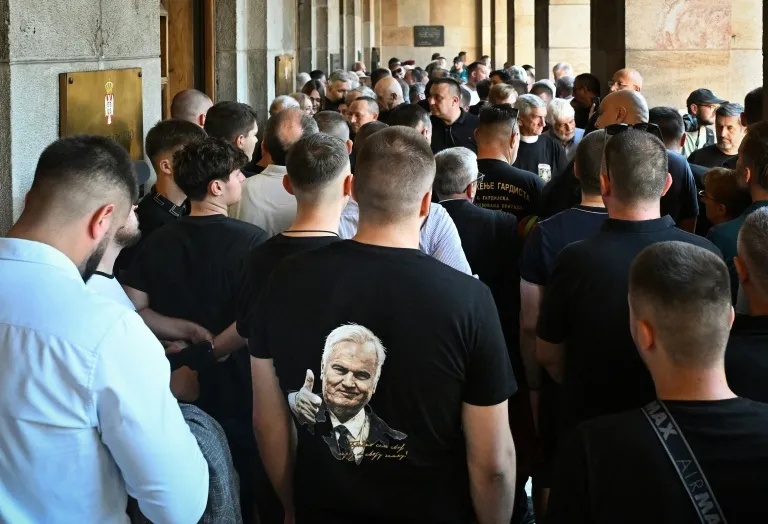
A commemoration ceremony for Ratko Mladić, the former Bosnian Serb military chief convicted of war crimes, was held in Belgrade, Serbia, on Saturday. Mladić died last week at the age of 84 while serving a life sentence at the International Criminal Tribunal for the former Yugoslavia (ICTY) in The Hague, Netherlands. His death followed several strokes. His body was transported back to Serbia on Thursday via a government aircraft and received with military honors, draped in a Serbian flag.
Details of the Commemoration Event
Approximately 300 individuals gathered for the ceremony at a military facility in Belgrade. The event was organized by an association comprising retired and active Serbian army generals. Mladić’s son, Darko, along with other family members, was in attendance. Several notable figures were also present, including Serbian Justice Minister Nenad Vujičić and President of Republika Srpska, Sinisa Karan, representing the Bosnian Serb entity. Many other supporters of Mladić congregated outside the venue due to capacity limitations, with some displaying flags and T-shirts bearing Mladić’s image and the inscription “Serbian Hero.”
Speakers Praise Mladić’s Wartime Role
During the commemoration, speakers lauded Mladić’s actions during the conflicts in Bosnia and Croatia in the 1990s. He was described by those present as a significant figure, both personally and as a military leader. These sentiments stand in stark contrast to the international perception of Mladić, who was widely referred to as the “Butcher of Bosnia” due to the atrocities committed under his command during the violent dissolution of the former Yugoslavia.
Conviction and Legacy
The ICTY found Mladić guilty of genocide, war crimes, and crimes against humanity. His conviction included responsibility for the 1995 Srebrenica massacre, a horrific event where approximately 8,000 Bosniak men and boys were systematically killed within a United Nations-designated safe zone. Despite these convictions and the international condemnation of his actions, Mladić continues to be viewed as a hero by some segments of the Serbian population, particularly within Republika Srpska. In the wake of his death, vigils and gatherings have been observed in his honor in that region.
Background on Mladić’s Sentence and Death
Ratko Mladić was apprehended in Serbia in 2011 after years on the run and subsequently faced trial at the ICTY. The court handed down its final verdict in June 2021, upholding his conviction for genocide and other heinous crimes. He was sentenced to life imprisonment. His death occurred while incarcerated, marking the end of a life defined by military command during a period of intense conflict and ultimately, by international judicial condemnation. His burial is scheduled to take place at a cemetery in Belgrade on Monday, with expectations of a large turnout of mourners.
The 1990s Balkan Wars
The wars that ravaged Bosnia and Croatia in the 1990s were part of a series of brutal conflicts that accompanied the breakup of Yugoslavia. These wars resulted in widespread ethnic cleansing, mass atrocities, and the deaths of hundreds of thousands of people. Mladić, as the commander of the Army of Republika Srpska (VRS), played a central role in the military campaigns in Bosnia, which were characterized by sieges, shelling of civilian areas, and systematic killings. The international community intervened through peacekeeping forces and ultimately through the ICTY, established to prosecute those most responsible for the atrocities.
International Reaction and Mladić’s Trial
The trial of Ratko Mladić was one of the most significant and closely watched proceedings at the ICTY. It aimed to bring accountability for the immense suffering inflicted during the Bosnian War. The verdict against him was seen by many as a crucial step towards justice for the victims and their families. However, the enduring divisions and differing historical narratives surrounding the conflicts mean that Mladić remains a deeply polarizing figure. While international bodies and many governments condemned his actions and the crimes for which he was convicted, his commemoration in Serbia highlights the persistent divisions in how his legacy is perceived.
Conclusion
The commemoration ceremony for Ratko Mladić in Belgrade underscores the complex and often painful legacy of the 1990s Balkan wars. While international justice systems have definitively pronounced judgment on his wartime conduct, his figure continues to evoke strong emotions and divergent interpretations within Serbia and the wider region. His burial is expected to be a significant event, reflecting the ongoing societal debates surrounding the wars and their key figures.
