

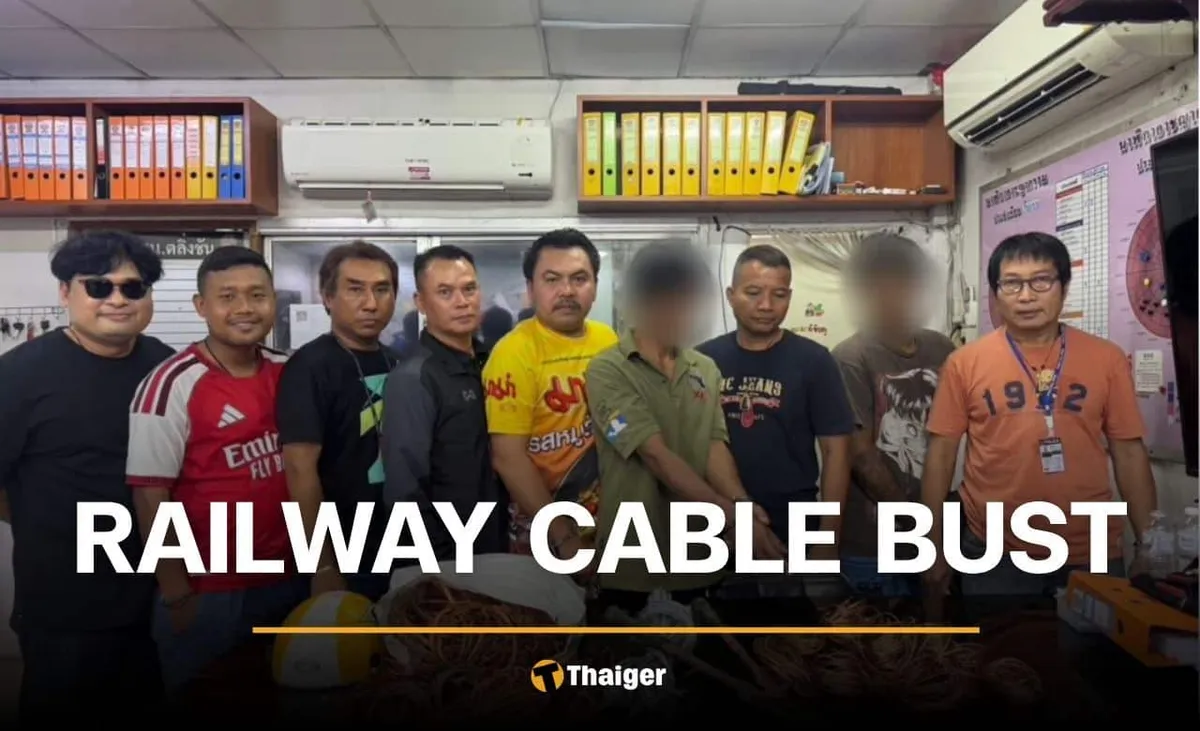
Authorities have apprehended two individuals in connection with the theft of crucial railway cables belonging to Bangkok’s Red Line train system. The arrests, made by Taling Chan police on September 10th, target alleged copper cable pilfering that disrupts vital rail infrastructure. The suspects, identified as Manoch Phutong, 47, also known as ‘Wao’, and Khomsan Phumrat, 38, known as ‘Long’, are accused of cutting and stealing cables situated between the Bang Bamru and Taling Chan stations.
Details of the Arrest and Charges
The pair faces charges of joint theft and receiving stolen goods. During their apprehension at an unnumbered residence on Soi Ratchaphruek 26 in the Taling Chan district, police confiscated approximately 10 kilograms of silver-colored cable, a pair of wire cutters, a utility knife, and a black Honda Wave motorcycle. These items are believed to be instrumental in the alleged cable thefts.
According to Manoch’s statement to investigators, the duo admitted to cutting cables that were lying on the ground during daylight hours. He claimed they operated about 20 meters away from a security guard who did not intervene. Each incident reportedly yielded between 3 to 4 kilograms of copper, which they then sold to a scrap metal dealer located beside the railway tracks for 400 baht per kilogram. Manoch further disclosed that they had engaged in this activity approximately seven times, with the proceeds being used to fund their consumption of alcohol and methamphetamine.
Investigation and Broader Context
The investigation leading to the arrests was initiated following an order from Pol. Col. Kunlachet Bangphran, deputy commander of Metropolitan Police Division 7. Investigators utilized CCTV footage to track the suspects, eventually recovering stolen copper wire from the scrap metal shop. The owner of this establishment has been charged with operating as a dealer of second-hand goods without the necessary license.
Police also revealed that both Manoch and Khomsan have previous records related to drug offenses, adding another layer to the case.
Red Line Operator’s Stance on Security
Air Chief Marshal Kongsak Chandrasopha, who serves as the acting managing director for SRT Electrified Train Co., the operator of the Red Line, commented on the persistent issue of cable theft. He stated that intruders frequently target cables within the railway premises. To combat this, the Red Line operator collaborates with police forces across all districts along the route to maintain surveillance over the rail lines.
Further reinforcing security measures, Pol. Maj. Gen. Amnat Traiphot, a deputy Metropolitan Police commissioner and a board member of the train operator, presides over the company’s security sub-committee. The operator employs dedicated security personnel who, alongside police, conduct daily patrols along the entire Red Line. These comprehensive patrols are designed to deter and prevent further instances of cable theft.
Ongoing Challenges and Previous Incidents
The theft of railway cables poses a significant threat to the operational integrity and safety of public transportation systems. The economic impact can be substantial, with past incidents in other regions, such as Chachoengsao, resulting in millions of baht in damages. The metallic components of these cables are often targeted by thieves seeking to sell them on the black market, driven by the value of materials like copper.
This incident in Taling Chan is part of a broader pattern of metal theft affecting infrastructure across Thailand. Similar arrests have occurred in other areas, including Trang and Bang Lamung, highlighting the widespread nature of this criminal activity. In one notable case, a suspected cable thief in Trang sustained severe injuries, breaking both legs after an attempted escape.
Neither the arrested individuals nor the scrap metal dealer have issued public statements regarding the ongoing legal proceedings. The authorities continue their efforts to secure the railway infrastructure and bring those responsible for such disruptive crimes to justice.
