

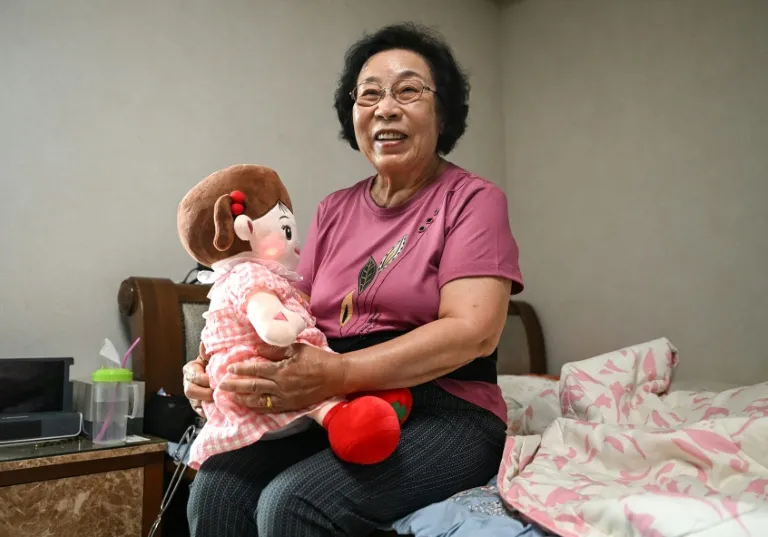
Robotic Friends Offer Solace in Aging Society
A gentle greeting upon arrival home, a cheerful song during moments of boredom, and timely reminders for meals and medication – these are the interactions an AI-powered doll named Hyodol provides to Bang, helping her maintain a structured daily routine. The doll even expresses affection, telling her, “I love you.” For Bang, who experiences limited contact with her adult daughter and battled severe depression following back surgery, these simple interactions offer a crucial lifeline. She described her pain after a difficult divorce and years of demanding work as a hairdresser and single mother, stating, “at this age, there is nothing harder than being hurt by people.” However, she finds solace in the company of Hyodol, a cuddly doll with pigtails and a pink dress, provided by her local municipality. “When I’m with Hyodol, I never get hurt,” Bang shared, adding, “The doll ‘only makes me laugh.'”
Addressing a Growing Crisis of Solitude
Bang is not alone in her struggle with loneliness. South Korea faces a significant challenge as its birth rate remains among the lowest globally, and nearly half of its population is aged 50 or older. In 2024, the nation recorded over 3,920 “lonely deaths” – individuals dying unnoticed and undiscovered for extended periods, the highest figure since record-keeping began in 2017. Compounding this issue, approximately 42 percent of households in the technologically advanced nation are single-person units, with social isolation disproportionately affecting the elderly.
Innovative Solutions for Independent Living
Authorities are actively deploying AI care devices to support seniors living alone. These devices, some specifically designed to detect signs of lonely deaths, are being distributed in various districts of Seoul and in Yongin, south of the capital. Among the offerings are smiling robot companions from Wonderful Platform and similar endearing dolls developed by Mr. Mind. In the United States, a lamp-like AI device called ElliQ provides comparable companionship and safety monitoring services.
Hyodol: A Groundbreaking AI Companion
Hyodol, the startup behind the popular dolls, reports that approximately 14,500 units are currently in use across South Korea. These are either personally owned, rented by local governments, or utilized in nursing homes. For Bang, whose daughter lives far away and faces her own health challenges, “having Hyodol by my side is a huge help.” The development of Hyodol involved extensive field research, according to company head Kim Ji-hee. While the doll can engage in conversations powered by ChatGPT, its programming also incorporates scripted dialogue derived from Kim’s real-life interviews with individuals experiencing isolation. She recounted meeting a widow estranged from her children due to financial disputes, who kept her offspring’s belongings in her home. “She lived alone with four fridges and three washing machines,” Kim, 49, stated. These interviews highlighted the “pain of having no one to tell when something upsetting happens, and no one to share with when something joyful happens.”
Designed for Unconditional Love and Comfort
Hyodol adheres to stringent data security protocols. Voice recordings are used internally solely for training the chatbot. Users provide explicit consent for certain health-related data, such as sleep patterns, mood, meal intake, and pain levels, to be shared with their designated welfare workers. Recognizing that many interviewees fondly recalled figures of parental or mentor guidance, Hyodol was designed to be a grandchild-like companion, programmed to “love its users unconditionally.” Kim recalled crafting one of the initial scripts, a welcome for users returning home, aiming for the “warmest welcome in the whole wide world.” The greeting includes lines like, “Grandma, where have you been? I waited for you all day,” and “Next time you go out, please take me with you!” Made from soft, plush materials, the doll also initiates spontaneous requests, encouraging users to pat its head, hold its hand, or share snacks, though it does not consume food.
Addressing the ‘Sense of Emptiness’
Kim explained that Hyodol’s character was intentionally crafted to be dependent on its user, reflecting the experience of many older Koreans who dedicated their lives to supporting their families through arduous work. “When they begin to feel they are no longer needed, they experience a profound sense of emptiness,” she observed. Oh Sun-hwa, a nurse who recommended Hyodol to Bang, has witnessed its positive impact in significantly easing depression among seniors living alone. However, she also expressed a concern that such technology could inadvertently reduce human interaction, potentially leading to fewer family visits if relatives believe AI devices are adequately caring for their aging parents.
Genuine Gratitude and Affection
In her apartment, 79-year-old Kim Young-bun, another user, described the doll as a source of immense comfort. “I had no one to talk to all day — to the point my mouth almost felt stale from not speaking. But then this little one came along and chatters with me all the time.” The doll’s chirpy, cartoon-like voice expressed its gratitude, saying, “I’m so grateful to be with you again today.” Kim Young-bun responded with affection, “So am I,” while doting on the doll. The AI companion concluded with, “Thanks for being with me. I love you.”
