

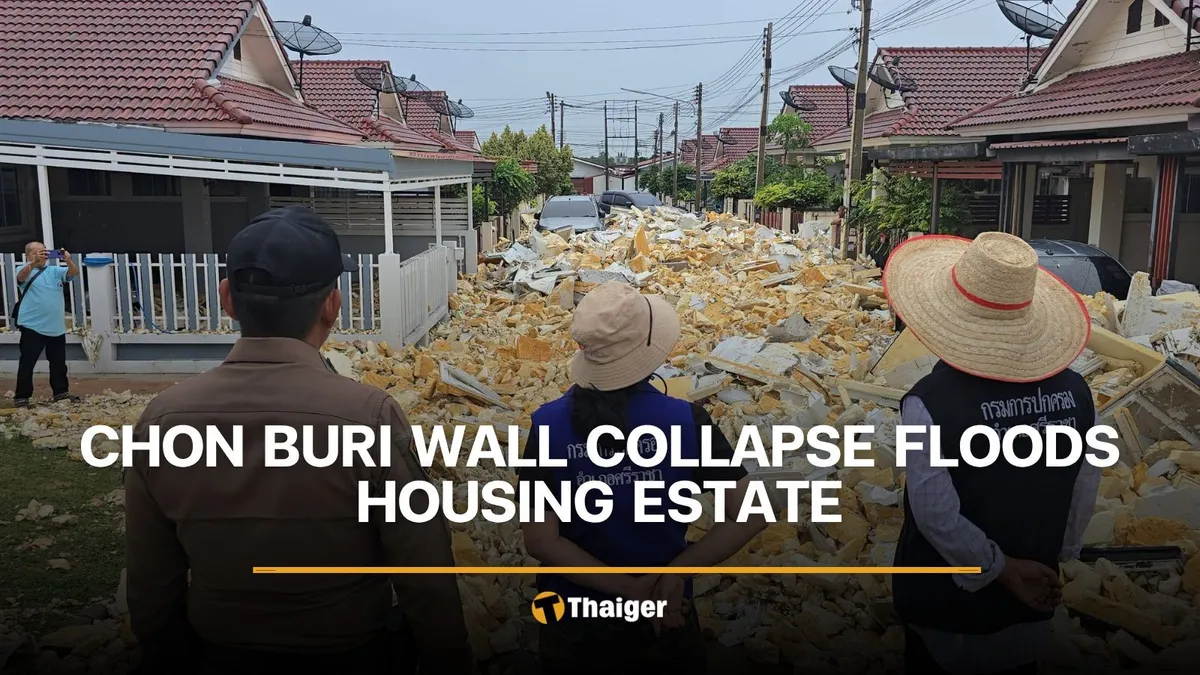
A significant wall collapse in Chon Buri’s Si Racha district on Saturday led to the flooding of a residential housing estate, the Legacy Boonraksa Ville 2, with a deluge of foam waste and rainwater. The incident occurred in the late morning in tambon Bo Win, following a period of intense rainfall. The wall, which separated the housing estate from a neighboring recycling plant, failed under the pressure of accumulated rain and debris.
Wall Failure and Foam Influx
Arthit Inprasit, president of the Boonraksa Ville 2 homeowners’ association, explained that the land adjacent to the estate is privately owned and has been leased long-term to foreign operators managing a recycling facility. This plant processes old refrigerators and freezers, extracting valuable components and leaving behind substantial quantities of foam waste. When the heavy rains began, this foam accumulated and compacted, forming a dense mass that exerted immense pressure on the estate’s boundary wall. Eventually, the structural integrity of the wall was compromised, leading to its collapse and allowing the floodwater mixed with foam waste to surge into the housing estate.
Emergency Response and Investigation
Following the incident, officials from the Bo Win municipality and the Si Racha district administration were quickly dispatched to the affected area. Their immediate actions focused on clearing the foam debris and opening drainage channels to alleviate the flooding within the housing estate. Authorities have also initiated plans to conduct a thorough survey of the site to assess the full extent of the damage caused by the collapse and subsequent inundation. The homeowners’ association has formally requested an investigation into the recycling operation. Residents are seeking assurances that the plant is adhering to proper waste management protocols and operating in full compliance with environmental regulations.
Broader Flood Concerns in Thailand
This event in Chon Buri highlights broader issues concerning waste management and infrastructure resilience in the face of extreme weather. In a separate but related concern, Bangkok’s persistent flooding problems have been exacerbated by the accumulation of rubbish in its canals. Despite daily efforts by the Bangkok Metropolitan Administration (BMA) to remove substantial amounts of waste – estimated at 5 to 10 tonnes daily – the continuous dumping of items like furniture, plastics, and general litter continues to overwhelm pumping stations. This blockage of drainage systems significantly worsens the recurring flood situations that plague the capital city, underscoring the critical need for effective waste disposal and infrastructure maintenance across the country.
Impact on Residents and Future Measures
The immediate aftermath for the residents of Boonraksa Ville 2 involved dealing with the cleanup of foam and floodwater within their properties. The homeowners’ association is working with local authorities to address the damage and prevent future occurrences. The incident has spurred calls for stricter oversight of industrial operations located near residential areas, particularly those involving waste processing. The long-term implications include potential demands for improved boundary wall construction, enhanced drainage systems, and more rigorous environmental impact assessments for such facilities. The investigation into the recycling plant’s operations is expected to determine accountability and inform future preventative measures, aiming to safeguard residential communities from similar environmental hazards.
Recycling Operations and Environmental Responsibility
The nature of the recycling operation, specifically dealing with old refrigerators and freezers, presents unique waste management challenges. The foam insulation within these appliances, when exposed and saturated, can become a significant pollutant. The process of stripping appliances for valuable parts, while economically driven, must be accompanied by responsible disposal or containment of residual materials like foam. The collapse serves as a stark reminder that industrial activities, even those focused on recycling, must be conducted with robust environmental safeguards. Ensuring that businesses comply with regulations regarding waste containment, runoff prevention, and structural integrity of adjacent barriers is paramount to protecting neighboring communities and the environment.
Conclusion: A Call for Enhanced Oversight
The wall collapse and subsequent flooding at the Boonraksa Ville 2 housing estate in Chon Buri underscore the critical intersection of industrial waste management, infrastructure resilience, and community safety. The incident, triggered by heavy rainfall and exacerbated by accumulated foam waste from a nearby recycling plant, has prompted immediate cleanup efforts and calls for a thorough investigation. As authorities work to assess damages and ensure compliance with environmental laws, the event also draws attention to similar waste-related flooding issues in other parts of Thailand, such as Bangkok. Moving forward, a concerted effort involving stricter regulatory oversight, improved waste management practices, and robust infrastructure planning will be essential to prevent such disruptive and damaging incidents from recurring.
