

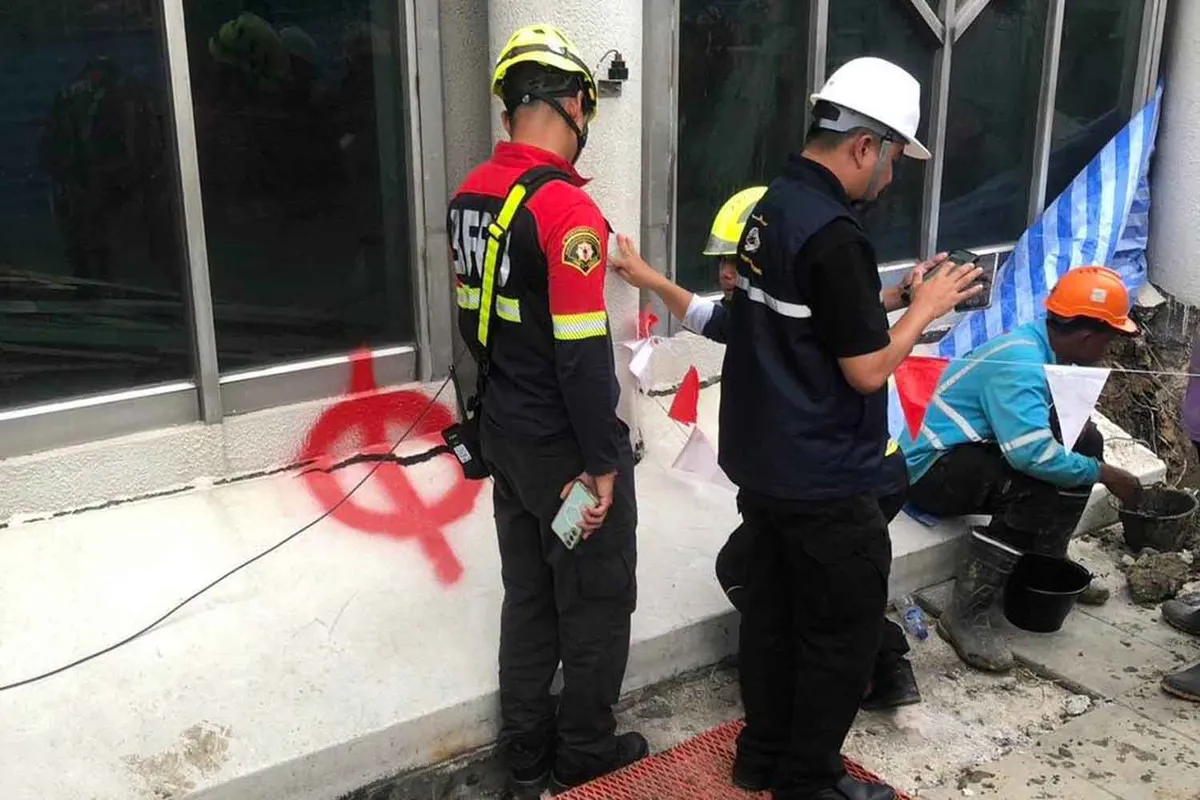
The ground at the site of the Purple Line electric railway construction project in Bangkok has been declared stable following a water leak that caused subsidence and cracks on Prajadhipok Road. The incident, which occurred on July 8 on the Tao Poon-Rat Burana section, led to temporary road closures, building evacuations, and extensive inspections of surrounding structures.
Ground Conditions Stabilize After Leak Incident
Deputy Transport Minister Siripong Angkasakulkiat reported that initial surveys indicated an average ground settlement of 30 to 32 centimeters. Crucially, no further subsidence has been detected since the initial event. In areas where construction crews injected chemically treated cement grout into underground voids to reinforce the soil, a slight upward movement of the ground has even been observed, signaling a return to normalcy.
To ensure continuous monitoring and provide detailed insights into ground movement, the Urban Search and Rescue Team (Usar Thailand), in collaboration with Kasetsart University, has implemented enhanced surveillance measures. Ten additional monitoring sensors have been installed, and drones equipped with LiDAR technology have been deployed to generate precise three-dimensional maps. These advanced tools allow for real-time tracking of any ground shifts. Despite recent periods of rainfall, which could potentially exacerbate soil instability, authorities confirmed that no further settlement has occurred.
Road Reopening and Ongoing Repairs
Traffic restrictions are expected to remain in place for a limited period as contractors work to seal approximately 30 identified underground voids. These repairs are critical to fully restoring the integrity of the affected area. Officials anticipate that unaffected sections of Prajadhipok Road will begin to reopen gradually within the next week, easing traffic congestion for commuters.
Mr. Siripong expressed confidence that the repair work would be completed in a timely manner, drawing a contrast with the prolonged disruption experienced during a previous road collapse incident near Vajira Hospital. This assurance aims to mitigate concerns about the duration of inconvenience for residents and businesses in the vicinity.
Government Support for Affected Residents
Prime Minister Anutin Charnvirakul has directed relevant government agencies to prioritize and expedite assistance for all residents impacted by the subsidence. The Mass Rapid Transit Authority of Thailand (MRTA), along with the involved contractors, is actively engaged in providing support.
This support includes conducting door-to-door visits to affected households to assess needs and offer solutions. Relocation costs for residents who had to evacuate their homes are being covered, and compensation is being provided where appropriate to address losses or damages incurred. This comprehensive approach underscores the government’s commitment to supporting its citizens during the recovery process.
Building Safety and Continued Monitoring
Inspections conducted by the Department of Disaster Prevention and Mitigation (DDPM) have provided reassurance regarding the structural integrity of buildings in the vicinity of Wongwian Yai. These assessments revealed no significant movement in any of the inspected structures. While some minor, additional cracks were observed in certain locations, these were not associated with structural compromise or further road subsidence.
Continuous monitoring of the area is being maintained, with inspections occurring three times daily to ensure the situation remains stable. This diligent oversight provides an additional layer of security for the community.
Expert Assessment of Soil Stability
Assoc. Prof. Amorn Pimanmas, president of the Structural Engineers Association of Thailand, shared positive findings from recent assessments. He noted that for two consecutive days, no abnormalities had been detected in the area, further bolstering confidence in the ground’s stability. Data also indicates a significant improvement in underground water flow conditions. The flow rate has decreased to approximately 20 cubic meters per hour, down from a previous rate of 50 cubic meters per hour. This reduction is a strong indicator of enhanced soil stability.
Despite the positive developments and assurances, Assoc. Prof. Pimanmas advised residents to refrain from returning to their homes until authorities are fully satisfied that the area is completely safe for reoccupation. This precautionary measure prioritizes public safety above all else.
Conclusion: A Return to Stability and Safety
The incident at the Purple Line construction site, while concerning, has been managed effectively with a focus on stabilization, repair, and resident support. The implementation of advanced monitoring technologies, coupled with expert engineering assessments, confirms the ground’s stability. With ongoing repairs nearing completion and government agencies providing dedicated assistance to affected individuals, the project is moving towards a safe and stable conclusion for the Tao Poon-Rat Burana section.
