

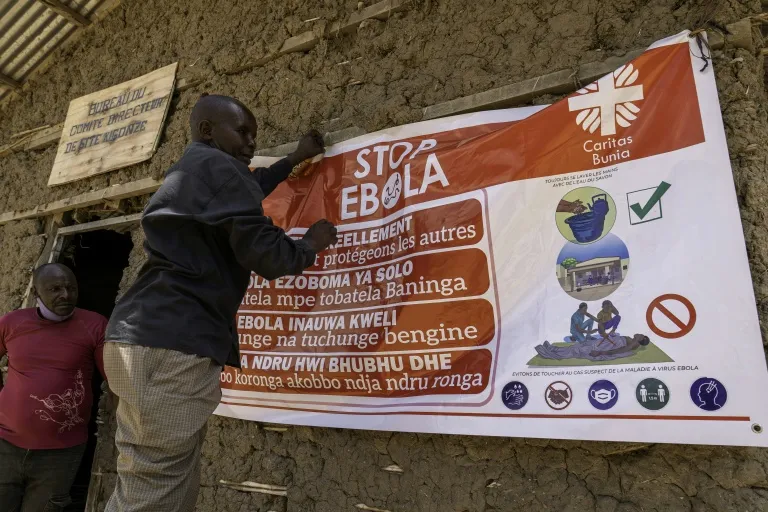
Authorities in the Democratic Republic of Congo have reopened the airport in Bunia, the capital of the Ituri province, a region grappling with a significant Ebola outbreak. The decision comes as health officials report a notable decline in suspected cases.
Airport Reopens After Health Assessment
The airport, which had been closed to commercial flights since May 23, has now resumed operations. The suspension was initially put in place to allow for the implementation of essential health measures to safeguard travelers. A thorough assessment of the outbreak’s monitoring protocols has concluded, indicating that conditions are now conducive for a gradual and secure resumption of air traffic, according to a statement from the transport ministry.
Ebola Outbreak Declared in May
The Democratic Republic of Congo, a nation of 100 million people, declared a major epidemic of the highly contagious hemorrhagic fever on May 15. This declaration prompted the World Health Organization (WHO) to issue an international health alert. The current outbreak was initially declared in the Ituri province in the northeast of the country.
Case Numbers Show Decline
Recent data indicate a significant reduction in suspected Ebola cases. The WHO reported on Tuesday that the number of suspected cases had fallen to 116, a sharp decrease from 906 recorded late last week. This assessment is based on information provided by Congolese health authorities.
Earlier reports the African Union’s health agency, Africa CDC, had cited a higher number of suspected cases, with a report released on Friday indicating 1,139 suspected cases, including 246 probable deaths. Health officials explain that many cases initially flagged have since been cleared after being diagnosed with other illnesses exhibiting similar early symptoms or unrelated fevers.
Congolese health authorities and the WHO have confirmed 321 cases of infection, resulting in 48 deaths. Additionally, neighboring Uganda has reported 15 cases, including one fatality, according to its Ministry of Health.
Efforts to Control the Situation
The Congolese government has launched a comprehensive communication campaign to reassure the public that the situation is under control, highlighting the recovery of several patients. Despite these efforts, laboratory testing for the virus has been limited, primarily due to resource constraints within the Democratic Republic of Congo.
The current outbreak is caused by the Bundibugyo strain of the Ebola virus, for which no vaccine or approved treatment is currently available. Containment efforts are largely focused on preventative measures. This differs from many past major outbreaks, which were caused by the Zaire virus, the only strain with an approved vaccine.
The WHO has assessed the health risk to neighboring countries as “high” but maintains that the global risk remains “low.”
Protests Erupt in Kenya Over Quarantine Facility
In separate but related developments, violent protests occurred in Kenya on Monday concerning an Ebola quarantine facility designated for U.S. patients arriving from the DRC. Demonstrators expressed anger over the United States utilizing Kenyan territory and potentially bringing Ebola patients into the country. Police responded with tear gas, and the rights group VOCAL Africa reported that a 27-year-old man was fatally shot during the protests.
Kenyan President William Ruto defended the facility, stating it is integral to a broader national preparedness system designed to serve both the Kenyan population and international partners, including Americans.
Ebola’s Historical Impact
Ebola, transmitted through close contact and bodily fluids, has claimed over 15,000 lives across Africa in the last 50 years. The most devastating outbreak in the DRC occurred between 2018 and 2020, resulting in nearly 2,300 deaths from 3,500 cases. The Africa CDC has expressed optimism that a Bundibugyo vaccine could be available by the end of the year.
