

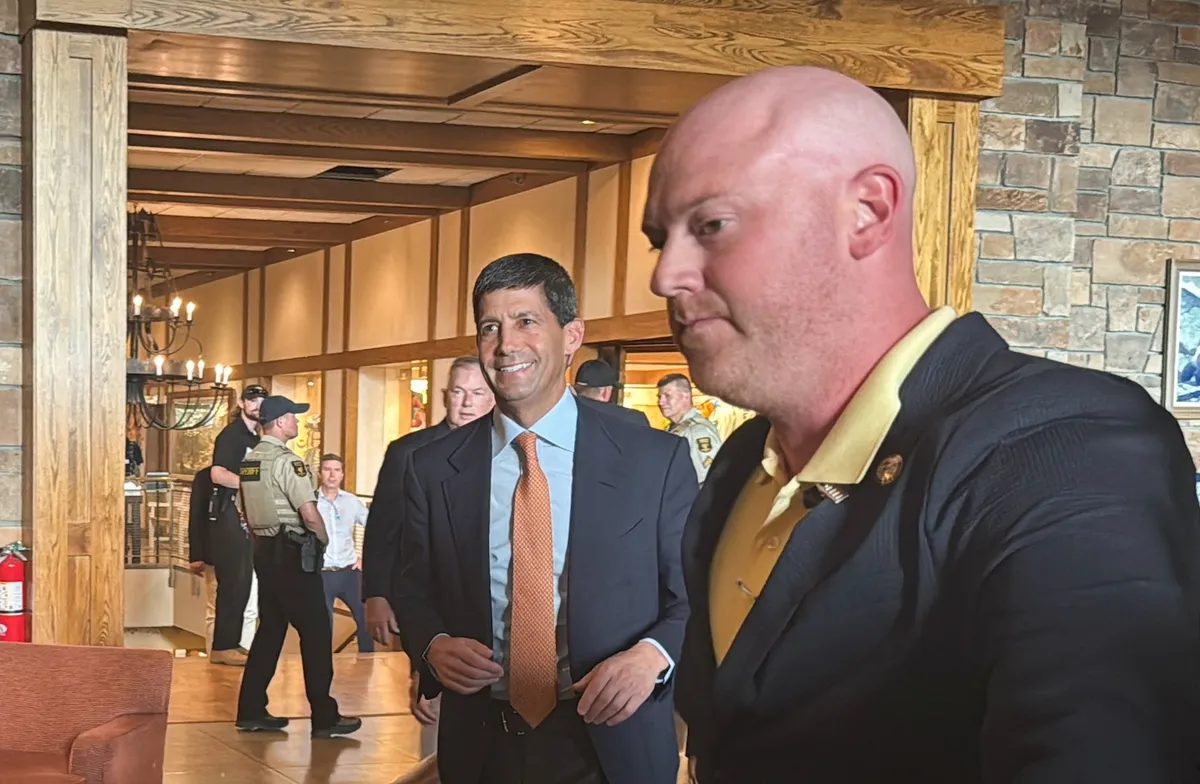
Federal Reserve Governor Philip N. Warsh indicated that the central bank must remain vigilant and prepared to take further action if inflation does not show clear and sustained movement toward the Fed’s 2% objective. Speaking at the Federal Reserve’s annual economic symposium in Jackson Hole, Wyoming, Warsh emphasized that fulfilling the Fed’s mandate requires confidence that underlying inflation trends are improving sufficiently.
Inflation Concerns and Fed’s Mandate
Warsh’s prepared remarks, while also touching on long-term considerations such as the impact of artificial intelligence on the economy, directly addressed the current policy landscape. He reiterated that short-term interest rates are the primary instrument for achieving the Fed’s dual mandate of maximum employment and price stability. His comments aimed to clarify the Fed’s stance on inflation, a topic that some observers felt was underspecified in his previous public statements.
“We must be confident that underlying inflation is moving to our objective, clearly and at sufficient speed. Otherwise, we have work to do. That’s our job… our mandate… and our charge to keep,” Warsh stated. He highlighted that progress in bringing inflation down over the past two years has been modest. As of July, the Fed’s preferred inflation gauge, the Personal Consumption Expenditures (PCE) price index, remained at an annual rate of 3.7%. Warsh noted that recent data did not signal a significant improvement in underlying inflation trends.
He elaborated on this point by observing that approximately half of the components within the PCE basket were experiencing annual price increases exceeding 3%. While this ratio is lower than during the peak of the COVID-19 inflation surge, it remains higher than the pre-pandemic norm. This suggests that inflationary pressures are still more widespread than desired.
Market Reactions and Policy Tools
Following Warsh’s remarks, financial markets adjusted their expectations. Traders began pricing in a higher probability of an interest rate hike at the upcoming Federal Open Market Committee (FOMC) meeting, with odds increasing from around 40% to approximately even. The yield on 2-year Treasury notes climbed to a one-month high, and stock markets saw a slight extension of gains. Despite these market movements, Warsh did not specify a timeline for potential rate increases.
He explicitly stated that his comments should not be interpreted as forward guidance or a defined reaction function for future policy decisions. Warsh believes that providing such explicit signals would be neither appropriate nor feasible given the complexities of economic forecasting. However, his remarks represent his most detailed explanation to date regarding the Fed’s ongoing efforts to return inflation to the 2% target after an extended period above it.
The Role of Inflation Expectations
Warsh also addressed the crucial issue of inflation expectations, noting that they currently appear to be anchored. However, he stressed the importance of closely monitoring these expectations to ensure they do not become unanchored. “It’s the Fed’s job to make sure that inflation expectations do not get unanchored,” he asserted. Maintaining stable inflation expectations is vital for the Fed’s ability to control inflation effectively.
Economic Resilience and Potential for Further Tightening
The Federal Reserve Governor observed that the U.S. economy appears resilient. He pointed out that, considering current market interest rates and the Fed’s policy rate, which has been held steady since December, credit and loan markets are showing minimal signs of policy restraint. These observations could support arguments for further monetary tightening if inflation proves persistent.
The sentiment at the July FOMC meeting indicated a leaning towards policy tightening, as evidenced by three policymakers dissenting from the decision to maintain the federal funds rate in its current range of 3.50% to 3.75%. This range has been in place since December. Upcoming economic data, including key reports on unemployment, job growth, and consumer inflation for August, are expected early next month and will be closely watched for their potential influence on future policy deliberations.
Future Policy Considerations
Warsh mentioned that recommendations from five task forces he commissioned to examine longer-term economic issues would be released later. He clarified that these future recommendations would not influence current policy decisions. However, he believes that this “intellectual investment” will better prepare the Fed for future policy challenges.
While not directly commenting on recent market interventions by Treasury Secretary Scott Bessent, Warsh underscored the Fed’s need for clear and unfiltered market signals to formulate effective monetary policy. This emphasis on transparency and clear communication is crucial for the central bank’s operations.
Conclusion
In summary, Governor Warsh’s remarks signal a cautious but resolute stance from the Federal Reserve. The central bank remains committed to its inflation target and is prepared to utilize its tools, primarily interest rates, to achieve price stability. The persistence of inflation above the 2% goal, coupled with an apparently resilient economy and limited signs of policy restraint in credit markets, suggests that further monetary tightening remains a distinct possibility if incoming data do not confirm a sustained disinflationary trend.
