

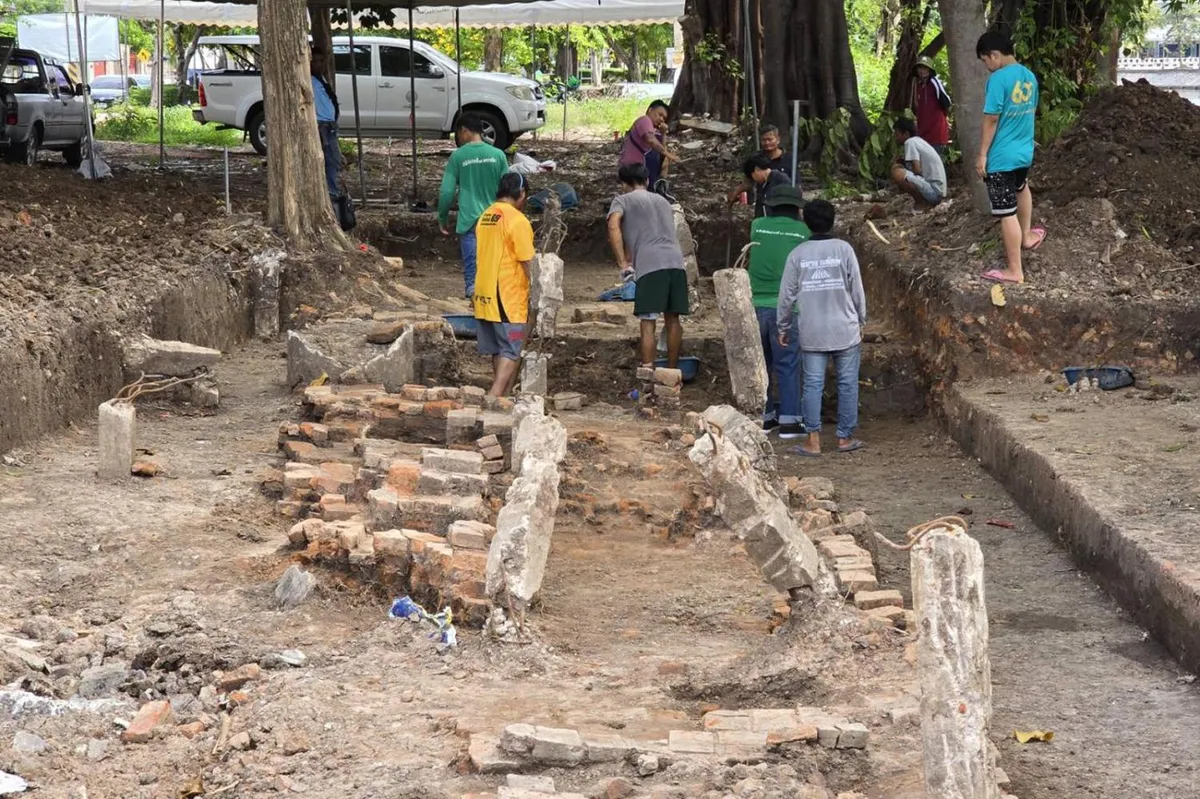
An archaeological excavation in Nakhon Ratchasima, commonly known as Korat, has successfully uncovered a previously unknown section of the ancient city’s defensive wall. The discovery, made during a project to study soil layers and the historical development of the city, offers significant new insights into the region’s past. The dig is situated in the Phon Lan moat area and is scheduled to conclude on August 8th.
Unearthing Korat’s Fortifications
The excavation, a collaborative effort between the 10th Regional Office of Fine Arts and the Nakhon Ratchasima Municipality, aims to thoroughly examine the historical strata of the ancient city. This research is a precursor to planned landscape improvements in the Phon Lan moat area. The unearthed wall alignment represents a crucial find, having been overlooked during a survey conducted earlier in 2024. Experts are hailing this discovery as the most important advancement in understanding Korat’s ancient fortifications since extensive research was carried out between 1999 and 2006.
Evidence of Ancient Habitation
Beyond the significant wall discovery, the site has yielded compelling evidence of human presence dating back an estimated 1,500 to 2,500 years. Archaeologist Wannapong Palakawong Na Ayudhya reported the recovery of various artifacts, including animal bones, pottery shards, charcoal, ash, and shells. These findings are invaluable for reconstructing the daily lives of people who inhabited the area during the Bronze Age and Iron Age, extending through to the dawn of the historical record period.
While acknowledging that some soil layers show signs of disturbance due to past land use and waste disposal, researchers emphasize the enduring historical significance of the discovered wall. It remains a vital component of Korat’s rich heritage, offering tangible links to its ancient past.
Scientific Analysis and Historical Context
To precisely pinpoint the construction timeline of the ancient fortifications, including the walls, gates, and associated structures, samples of organic material found beneath the brick foundations are undergoing scientific dating. Additionally, traces of rice husks embedded within the bricks will be analyzed. These scientific methods are expected to provide definitive dates for the city’s defensive infrastructure.
Historical records and previous studies suggest that the ancient city of Korat was designed in a rectangular shape, spanning approximately 5.2 kilometers in length. This fortified enclosure was further protected by a moat and fifteen strategically placed fortresses. Access to the city was controlled through gates situated at each of the four cardinal directions, underscoring the sophisticated urban planning and defensive capabilities of the era.
Significance of the Discovery
The unearthing of this lost wall section is more than just an archaeological find; it is a vital step in piecing together the complex history of Nakhon Ratchasima. The artifacts and structural remains provide a direct connection to the people who built and lived within these ancient defenses. Understanding the layout and construction techniques of the city walls helps historians and archaeologists interpret the social, economic, and military structures of the time.
The project’s dual focus on soil layers and historical artifacts allows for a comprehensive understanding of the city’s evolution. By studying the soil, researchers can learn about the natural environment in which the city was built and how it may have changed over millennia. The artifacts, in turn, tell the stories of the inhabitants – their diet, their craftsmanship, and their daily routines.
Future Implications and Heritage Preservation
The data gathered from this excavation will be crucial for future preservation efforts and for informing the public about the historical significance of the Phon Lan moat area. The findings will contribute to a more accurate historical narrative of Korat, potentially leading to enhanced heritage tourism and educational initiatives.
The ongoing analysis, including the scientific dating of materials, promises to shed further light on the chronological development of the ancient city. This detailed understanding is essential for safeguarding this invaluable historical site for future generations. The collaboration between different governmental and municipal bodies highlights a commitment to uncovering and protecting the region’s rich cultural legacy.
The discovery reinforces the importance of archaeological research in urban development projects, ensuring that historical assets are identified and protected before they are lost to modernization. The insights gained from this dig will undoubtedly enrich the historical understanding of this important northeastern Thai city.
