

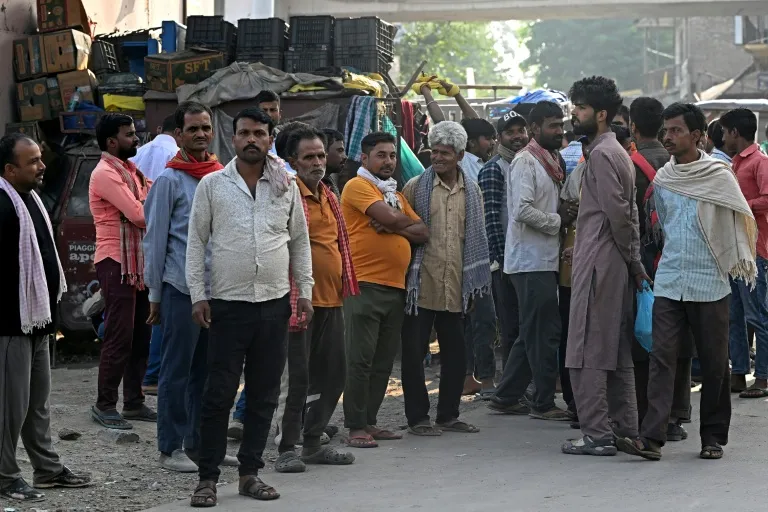
An estimated half a million migrant workers journey to India’s northernmost region of Kashmir each year, forming a crucial pillar of its economy. These laborers, primarily from India’s less affluent states, fill essential roles that are increasingly difficult for local populations to meet. This reliance on external labor has persisted for decades, even as the region grapples with a long-standing insurgency and targeted militant attacks that have, at times, made these workers vulnerable.
Economic Draw of Kashmir for Migrant Laborers
Despite the inherent risks, the economic incentives for migrant workers in Kashmir are significant. For individuals like Sarwar, a 25-year-old from Bihar, the prospect of earning substantially more than they could in their home states makes the journey worthwhile. Sarwar reports earning 1,200 rupees ($12) daily in Kashmir, a stark contrast to the approximately 700 rupees he might earn for similar work in Bihar, assuming such opportunities are even available.
This financial advantage, coupled with the relative ease of migration compared to seeking employment overseas, draws many to the Himalayan territory. While millions of Indians look to the Gulf states for work, Kashmir offers a comparable earning potential without the extensive costs and logistical hurdles of international migration. Sarwar expressed his commitment, stating, “Kashmir is real paradise. I will keep coming every year for as long as I have the strength to work.”
Kashmir’s Growing Dependence on Migrant Labor
The Muslim-majority region, which contends with some of India’s highest unemployment rates, has become increasingly reliant on an external workforce. Migrant laborers are essential for a wide array of jobs that many local residents are either unwilling or unable to perform. These roles span critical sectors such as agriculture, construction, and domestic work.
Local businesses have highlighted the challenges in sourcing sufficient local labor. Mohammad Ashraf Mir, representing the Kashmir Chamber of Commerce and Industry, noted, “Outside the handicrafts sector there is not nearly enough local skilled labour available in Kashmir.” He further observed, “We see a rising dependence on migrant workers, tending towards absolute dependence.” This sentiment underscores the vital role these workers play in maintaining the region’s economic activities.
Daily Life and Security Measures
Each morning, numerous laborers congregate in public squares in Srinagar, the region’s main city, awaiting daily hiring. Most workers stay for approximately eight months, departing before the onset of Kashmir’s severe winter, a period when construction projects slow down and agricultural activities diminish.
The region has a complex history, having been divided between India and Pakistan since 1947. An insurgency against Indian rule, which began in 1989, has resulted in tens of thousands of fatalities. Although the intensity of the rebellion has lessened in recent years, sporadic attacks continue to occur.
Reports indicate that since 2019, at least 24 migrant workers have been killed in militant attacks across the territory. The most recent incident involved gunmen fatally shooting two brick kiln workers from Chhattisgarh. These attacks, while deeply concerning, have not entirely deterred the flow of migrant labor.
Sarwar recounted witnessing the killing of a barber from his home state by suspected militants some years prior. Despite the tragedy, he remains undeterred, reflecting a common sentiment among his peers: “Life and death are in the hands of God. If I remain fearful, I will have nothing. But if I overcome, I will have everything.”
Living conditions for many migrant workers are basic. Sarwar shares accommodation in Srinagar with around 200 other laborers, often with 7-10 individuals occupying small rooms where they sleep and cook. Despite the cramped quarters, the cost is minimal, often just over five dollars per month per person.
Enhanced Security Presence
The presence of security forces is noticeable throughout the region, with paramilitary troops, armored vehicles, and police special operations units conducting regular patrols. CCTV cameras are installed and monitored around the clock in key areas.
A senior security official, speaking anonymously, acknowledged that migrant workers have been “soft targets for the terrorists in the past.” However, the official added that “security arrangements for them have become robust over time.” Authorities encourage laborers to reside in designated clusters and to limit their movements after dark.
Navigating Fear and Seeking Stability
Some laborers, particularly Hindu workers from West Bengal, reportedly adopt Muslim-sounding names while in Kashmir to avoid potential targeting based on their religious identity. Rebel groups have claimed that their attacks on migrant workers are in retaliation for alleged police harassment of their families.
Many workers are hesitant to speak openly about their security concerns. However, some express a sense of relative peace. Mohammad Iqbal, a 53-year-old painter from Uttar Pradesh who has worked in Kashmir since before the insurgency began and is now accompanied by his son, stated, “I face no troubles here. It feels peaceful.”
Others are more candid about their apprehensions but still find the overall environment conducive to work. Shahid Sofi, a 24-year-old mason from Bihar who previously worked in Delhi and Mumbai, admitted, “I am afraid of terrorists here.” Yet, he continued, “But overall working conditions here are good, the weather is good, and I like working in the wide, open spaces of Kashmir.” This perspective highlights a complex reality where economic opportunity and personal safety remain intertwined for migrant workers in the region.
Conclusion
The influx of migrant workers into Kashmir underscores the region’s economic needs and the workers’ pursuit of better livelihoods. Despite facing security challenges and the lingering threat of militant violence, the economic benefits and the search for stability continue to draw laborers from across India. Enhanced security measures and the resilience of the workers themselves contribute to the ongoing presence of this vital labor force in the Himalayan economy.
