

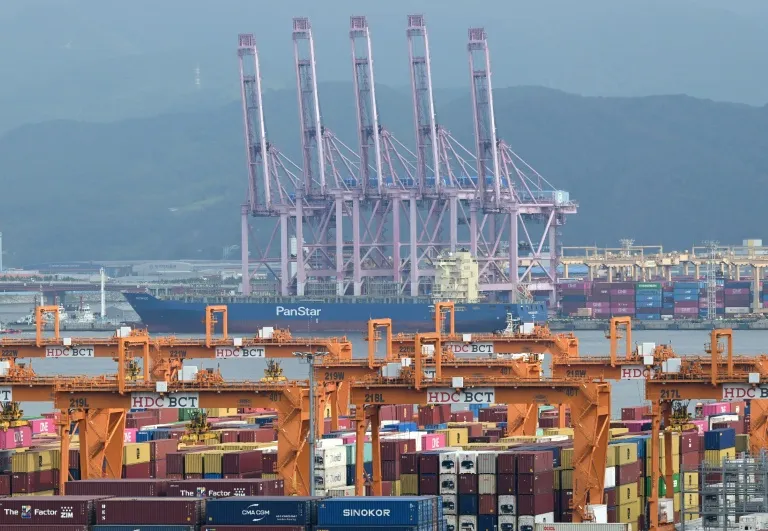
South Korea is embarking on a significant trial voyage, sending its first container ship through the Arctic to Europe. The vessel, named PanStar Acro, is set to depart from Busan New Port, aiming to assess the commercial viability of a northern sea route that is opening up due to melting Arctic ice. This initiative comes at a critical time as global shipping faces severe disruptions, prompting a search for alternative trade pathways.
Exploring the Northern Sea Route
The PanStar Acro’s journey is scheduled to take approximately 45 days, a considerable reduction compared to the conventional route through the Suez Canal. The ship will call at Felixstowe in Britain, Rotterdam in the Netherlands, and Gdansk in Poland before commencing its return voyage. This experimental passage highlights South Korea’s proactive approach to navigating the complexities of international trade in an era of geopolitical uncertainty and evolving climate conditions.
This endeavor follows closely on the heels of a similar voyage undertaken by the Chinese container ship “Dubai Tower,” which also set sail for Europe via the Bering Strait and along Russia’s Arctic coast. These parallel expeditions underscore a growing trend among Asian nations to explore and potentially normalize the Northern Sea Route (NSR) as a viable alternative to traditional shipping lanes.
Benefits of the Arctic Passage
According to research from the Korea Institute for International Economic Policy, utilizing the Arctic route can shorten the distance between Asia and Europe by roughly 7,000 kilometers (4,300 miles) and save about 10 days of transit time. This efficiency gain is a major draw for shipping companies looking to optimize logistics and reduce costs.
South Korea’s Vice Oceans Minister, Nam Jae-hon, expressed optimism about the NSR’s potential, stating it “is bound to become an alternative” to Middle Eastern shipping lanes. He cited increasing geopolitical risks in traditional routes and advancements in technology as factors making the Arctic passage more competitive.
Geopolitical and Economic Considerations
The increasing accessibility of the NSR is attributed to the accelerating pace of climate change, which is causing Arctic sea ice to recede. This environmental shift is creating new opportunities for maritime transport, but it also raises complex geopolitical and economic questions.
Marc Lanteigne, a political science professor at the Arctic University of Norway, noted that the concurrent voyages by South Korea and China signal the normalization of the NSR as a “secondary maritime transit corridor.” He suggested that a successful South Korean voyage would demonstrate the nation’s commitment to “developing alternative shipping sea lanes,” potentially preventing it from falling behind as Chinese companies expand their services along this route.
Concerns Regarding Sanctions and Russia
A significant point of contention surrounding the use of the NSR involves potential implications for Western sanctions against Russia. Some experts caution that South Korean vessels might inadvertently breach these sanctions if they rely on Russian navigation and weather services, which often involve payments, even if nominal. Russia is a key security ally of North Korea, adding another layer of complexity to South Korea’s foreign policy considerations.
When questioned about these concerns, South Korea’s foreign ministry declined to comment. However, the oceans ministry indicated that “consultations with key relevant countries and agencies” had been completed to ensure the necessary administrative procedures for the voyage were in place.
Vladimir Tikhonov, a professor of Korean Studies at the University of Oslo, offered a nuanced perspective, noting that “strictly speaking, US and EU sanctions are not international law, unlike UN sanctions.” He also pointed out that given the ongoing instability in the Middle East, which is partly influenced by US actions, South Korea might have limited alternatives if the Arctic route proves economically feasible.
Lanteigne further contrasted the motivations of China and South Korea, suggesting that Beijing’s interest in the NSR is more politically driven, viewing the Arctic as a “strategic new frontier.” This perspective has raised security concerns among Western nations.
Environmental Impact and Future Viability
Beyond the geopolitical and economic factors, the increasing use of the Arctic route also raises environmental alarms. Environmental groups have warned that a surge in shipping traffic along the NSR could exacerbate the loss of Arctic sea ice, which is already being accelerated by global warming. Major shipping carriers, including CMA CGM, MSC, and Hapag-Lloyd, have publicly stated their intention to avoid Arctic shipping routes.
The NSR is typically only navigable during specific periods when ice melt allows passage without the need for icebreakers. A statement from the South Korean environmental group Paran Ocean Citizen Science Center last year highlighted that while the NSR is becoming more viable due to Arctic warming (which is occurring at approximately four times the global average), achieving commercial viability might necessitate further warming. This scenario places the pursuit of economic benefits from the route in potential conflict with global efforts to combat climate change.
Conclusion
South Korea’s pioneering voyage through the Arctic represents a bold step in exploring new frontiers for global trade. While the potential benefits of reduced transit times and costs are significant, the journey also brings to the forefront complex geopolitical, economic, and environmental challenges that will need careful consideration as the Northern Sea Route becomes an increasingly discussed option in international shipping.
