

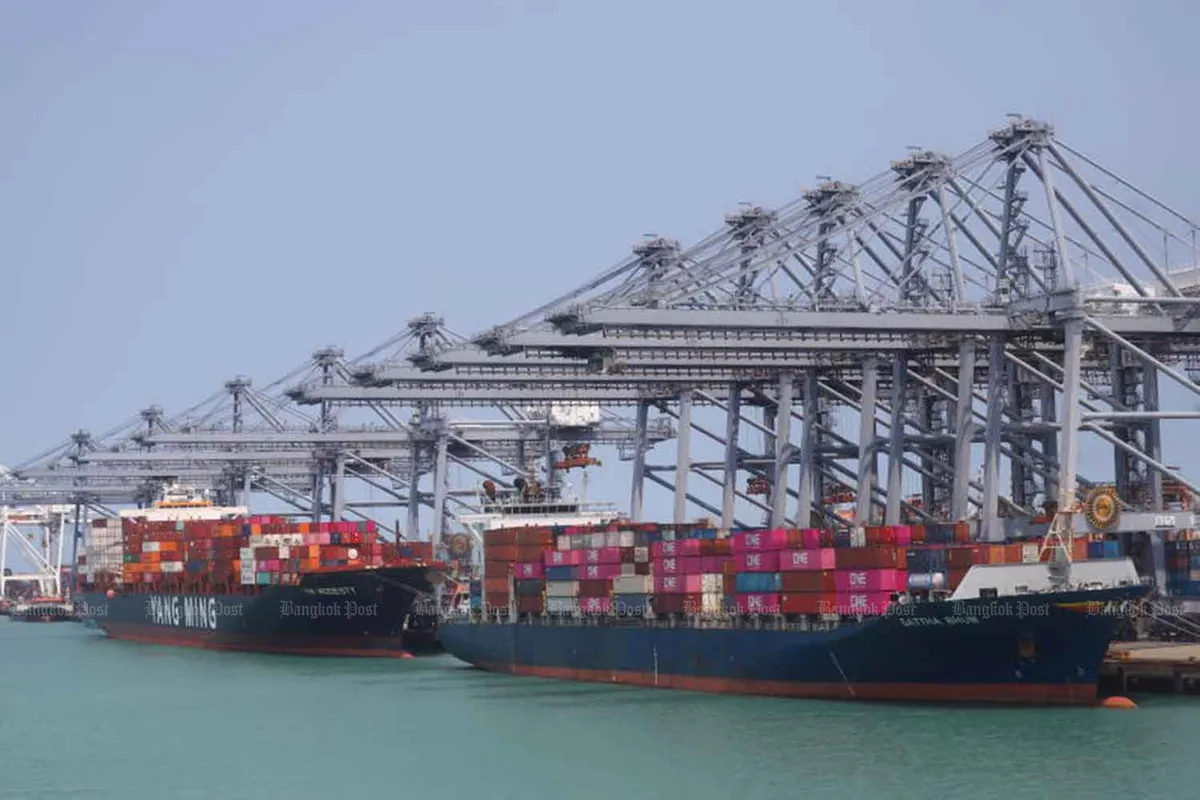
Thailand’s export sector is demonstrating remarkable resilience, with shipments to the United States experiencing a significant surge of 33.7% in the first nine months of the fiscal year. This robust performance contrasts sharply with more modest growth in other key markets, highlighting a strategic shift in Thailand’s trade dynamics. The total value of exports to the US reached 2.13 trillion baht during this period, driven by strong demand for telecommunications equipment, electronic components, and tires.
Thai Trade Performance Overview
Data from the Customs Department reveals a substantial increase in Thailand’s overall trade value, encompassing both imports and exports, which climbed to 19 trillion baht from 11 trillion baht year-on-year for the fiscal period spanning October 1 to June 30. Total imports grew by 23% in Thai baht terms and 30% in US dollar terms, reaching 10.2 trillion baht. Exports, meanwhile, saw a healthy rise of 8.4% in baht and 14% in dollar terms, amounting to 8.8 trillion baht.
Phantong Loykulnanta, director-general of the Customs Department, noted that while the US market was a standout performer, exports to China registered a more subdued growth of 0.78%, totaling 1 trillion baht. Imports from China, however, saw a considerable increase of 30%, reaching 3.1 trillion baht. This divergence underscores the differing economic conditions and trade relationships influencing Thailand’s key partnerships.
Key Export Drivers and Market Focus
The strong performance in exports to the US is attributed to several factors, including the continued global demand for technology and manufacturing components. Major export products that contributed to this growth include:
- Telecommunications equipment
- Electronic components
- Automotive tires
Imports from the US also saw a healthy increase of 22%, reaching 610 billion baht, indicating a balanced trade relationship with the American market.
Government Revenue and Tariff Policies
The Customs Department plays a crucial role in national revenue collection, gathering import duties, Value-Added Tax (VAT), excise tax, and interior tax. Over the first nine months of the fiscal year, the department collected 476 billion baht in revenue, an increase of 7% or 31.1 billion baht compared to the previous year. Projections indicate that full-year revenue is expected to surpass 600 billion baht, exceeding the 596 billion baht collected in the prior fiscal year.
A significant development highlighted by Mr. Phantong is the notable decline in Thailand’s average import tariff rate. Currently, for every 100 baht of imports, the department collects only 83 satang in import duties. This reduction is largely a consequence of numerous free trade agreements (FTAs) with major partners like Japan, China, and ASEAN member states, alongside investment promotion policies facilitated by the Board of Investment (BoI). BoI privileges alone saw a nearly 40% increase in utilization during the period.
Despite the decrease in import duty revenue, the shortfall has been effectively offset by robust VAT collections. As import values have risen, so too has the VAT collected, which increased by 8.4% to 308 billion baht during the first nine months. This demonstrates the dynamic nature of government revenue streams and their responsiveness to trade volumes and economic activity.
Digital Transformation Enhancing Trade and Efficiency
The Customs Department’s commitment to digital transformation has been a key enabler of trade growth and enhanced competitiveness. Initiatives such as the National Single Window and the digitalization of paper-based documentation, including the electronic Delivery Order system, have dramatically reduced cargo release times. Processing times have been cut from an average of three hours to less than one minute, significantly streamlining logistics for businesses.
Further innovations include pre-arrival processing, allowing importers to settle duties before goods even reach Thai ports. Additionally, the implementation of artificial intelligence (AI)-powered risk management systems has revolutionized inspection processes. The proportion of shipments subjected to discretionary physical inspections by customs officers has been reduced from 30-40% to a mere 15%. AI and sophisticated algorithms now assess shipment risks, enabling over 85% of goods to be cleared through the ‘Green Line’ for expedited processing.
Mr. Phantong emphasized that these technological advancements not only improve the flow of goods but also contribute to greater transparency and public trust. By reducing the need for discretionary physical inspections, the system helps curb opportunities for illicit payments, thereby enhancing the agency’s reputation and operational integrity. The department’s strategic adoption of modern technologies and facilitation of customs procedures are pivotal in driving both Thailand’s overall trade value and its government tax revenue, positioning the nation favorably in the global marketplace.
