

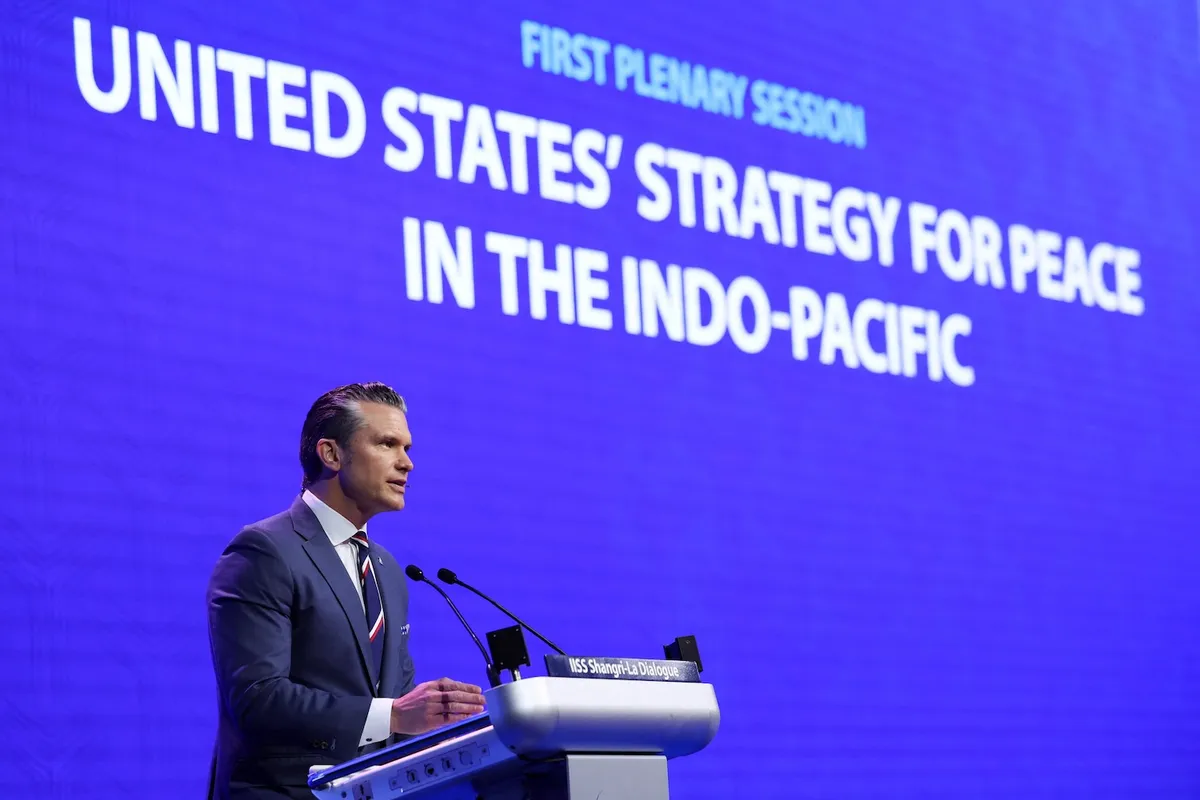
A senior Pentagon official has voiced significant concerns regarding China’s substantial military buildup and its expanding regional activities. Speaking at a prominent security conference in Singapore, the official emphasized the critical need for a robust and self-reliant network of allied nations to deter potential aggression and maintain the current balance of power in Asia.
Growing Regional Tensions
The official stated, “There is rightful alarm regarding China’s historic military buildup and the expansion of its military activities in the region and beyond.” He further elaborated that a region dominated by any single hegemonic power would disrupt the existing equilibrium. “No state, including China, can impose its hegemony and hold the security or prosperity of our nation and our allies in question,” he asserted.
In conjunction with this assessment, the United States anticipates its Asian partners will increase their defense spending to 3.5% of their Gross Domestic Product. This expectation is set against the backdrop of a planned $1.5 trillion investment in the U.S. military. The official’s message to allies was clear: “Less Shangri-La, more ships, more subs.” He stressed that allies are seeking stability, not escalation, and that the United States is committed to providing “strength that is disciplined, resolve that is steady, and leadership that is confident enough to speak and walk softly while carrying a big stick.”
Improving Communication Channels
Despite the heightened concerns, the Pentagon representative adopted a measured tone when discussing U.S.-China relations, describing them as “better than they have been in many years.” He pointed to increased military-to-military engagement as a key factor in managing tensions. “We are meeting more frequently with our Chinese counterparts by maintaining open lines of military-to-military communication,” he noted.
A senior fellow from Tsinghua University and retired People’s Liberation Army senior colonel, Zhou Bo, who was part of the Chinese delegation, characterized U.S.-China relations as “complicated.” Nevertheless, he observed that the Pentagon official’s tone was more constructive this year compared to the previous one, attributing this shift partly to a recent presidential visit to China. “Both sides have open channels of communication, the situation is not as exaggerated as the outside world makes it out to be,” Zhou commented.
Allies Must Shoulder More Defense Costs
Echoing a long-standing demand, the official reiterated the call for allies to assume greater responsibility for their own defense expenditures. He stated, “The era of the United States subsidizing the defense of wealthy nations is over.” The emphasis was placed on fostering genuine partnerships rather than protectorates, with the assertion that a strong alliance requires universal commitment. “We need partners, not protectorates. We don’t have a strong alliance unless everyone has skin in the game. No freeloading,” he declared.
Praise was given to allies including South Korea, Thailand, the Philippines, Australia, Singapore, and Malaysia for their contributions. Japan was also highlighted for taking concrete steps to enhance its defenses, with the official stating that both Tokyo and Washington must collaborate to strengthen their bilateral alliance.
Stance on Iran and Taiwan Arms Sales
Turning to the Middle East, the official confirmed that the United States is prepared to resume strikes against Iran if diplomatic efforts to secure a nuclear deal fail. He indicated that the U.S. possesses the capability to recommence military action if necessary, adding that the president remains patient and is seeking a “strong deal” to prevent Iran from acquiring nuclear weapons.
Regarding arms sales to Taiwan, the official downplayed concerns that a significant package could be impacted by the drawdown of U.S. weapons stockpiles amidst Middle East conflicts. “We feel very good about our stockpiles and how we use them,” he stated.
Taiwan has been awaiting U.S. approval for an arms sale reportedly valued up to $14 billion. The official clarified that any decisions on future arms sales would ultimately rest with the president, signaling no deviation from Washington’s established policy despite recent engagements with Beijing. “Those decisions will depend on the president and the nature of that relationship,” he concluded. “There’s been no change in our status.”
