

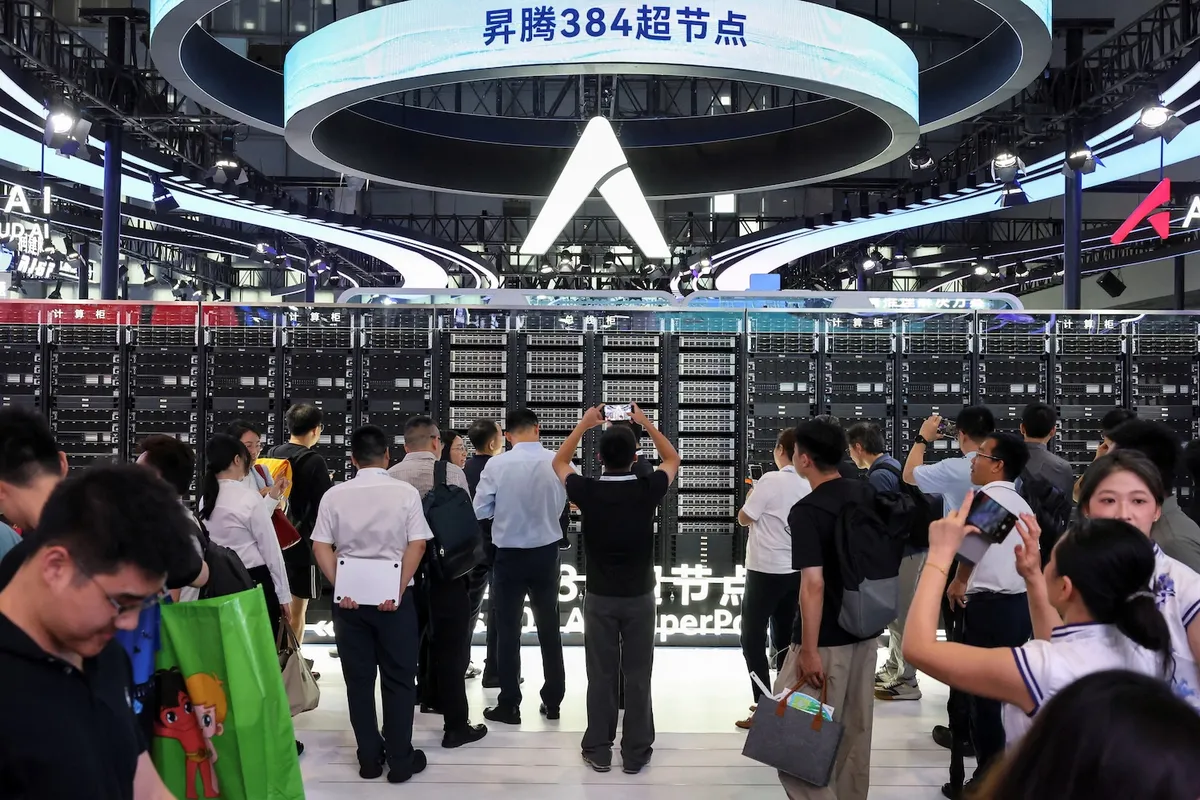
Chinese President Xi Jinping is set to attend the World Artificial Intelligence Conference (WAIC) in Shanghai, marking a significant moment as he outlines his vision for “AI diplomacy.” This move highlights Beijing’s strategic emphasis on artificial intelligence as a crucial engine for economic expansion and a key player in global technological competition. The conference, running from July 17-20, will also feature Thai Prime Minister Anutin Charnvirakul and UN Secretary-General Antonio Guterres, underscoring the international significance of the discussions.
China’s Push for AI Self-Sufficiency
A notable demonstration of China’s ambition to reduce reliance on US technology will be the public debut of Huawei’s Atlas 950 SuperPoD large-scale AI computing system. This system is engineered for intensive AI training and inference, capable of linking thousands of Huawei’s Ascend AI processors into a unified computing cluster. This development aims to showcase China’s progress in building independent AI ecosystems, exemplified further by DeepSeek’s V4 model, which has been successfully adapted to operate exclusively on clusters built with Huawei’s Ascend chips. Chinese chipmakers like Biren and MetaX are also anticipated to unveil new “supernode” computing clusters, signaling a concerted effort towards domestic AI hardware innovation.
AI Governance: A Geopolitical Stage
The WAIC convenes at a critical juncture, with Washington and Beijing preparing for their first government-level AI talks under the current US administration. The conference is thus poised to become more than just a technological exhibition; it’s evolving into a geopolitical arena where China intends to articulate its approach to global AI governance. This follows recent diverging perspectives presented by the US and China at a UN AI dialogue. While the US advocates for less regulation to foster innovation, China champions its low-cost, open-source AI models as a means to democratize access and address global AI inequality.
George Chen, chair of digital practice at the Asia Group, observed that the WAIC has transformed into a “geopolitical stage where Beijing seeks to articulate its vision of AI as both a national priority and a diplomatic instrument.” President Xi himself has drawn parallels between AI and the transformative impact of the steam engine, emphasizing AI as an “epoch-making, major technological transformation.” Beijing’s strategy hinges on integrating AI across its economy and achieving self-sufficiency in cutting-edge technologies.
Promoting Open-Source and Global AI Initiatives
China’s diplomatic push at the conference is expected to include the promotion of its open-source AI models. Beijing frames these as accessible, cost-effective alternatives to Western offerings, aiming to broaden global access to AI technology. A commentary in People’s Daily stated, “The development of AI must never move toward a technological monopoly that walls itself in, but should always be anchored to the fundamental goal of serving humanity.” This aligns with China’s proposal from the previous year’s conference to establish a World AI Cooperation Organisation (WAICO), although formal memberships have yet to be announced. The current conference coincides with a High-Level Meeting on Global AI Governance in Shanghai, where progress on WAICO and the Global AI Governance Initiative is expected to be discussed.
International Participation and Tech Showcases
The event is drawing significant international attention, with notable figures like Nobel laureates and deep learning pioneers Yoshua Bengio and Richard Sutton scheduled to attend. However, representation from major US tech firms appears limited. An Asian diplomat noted that China is actively engaging with Southeast Asian nations on AI capacity-building, positioning itself as an advocate for developing countries potentially being left behind in the AI race. Beyond the high-level discussions, the conference will also feature product launches, including AI agent smartphones from ZTE-owned Nubia and offerings from AI startup StepFun, further illustrating the rapid advancements in AI applications.
Conclusion: AI as a Diplomatic Tool
The World Artificial Intelligence Conference in Shanghai serves as a critical platform for China, under President Xi Jinping’s leadership, to articulate its vision for AI’s role in global affairs. By showcasing its technological advancements, particularly in developing independent AI infrastructure, and by advocating for open-source models and international cooperation frameworks like WAICO, Beijing aims to shape the future of AI governance and solidify its position in the global technological landscape. The event underscores the growing recognition of AI not just as a technological and economic force, but as a significant instrument of international diplomacy.
