

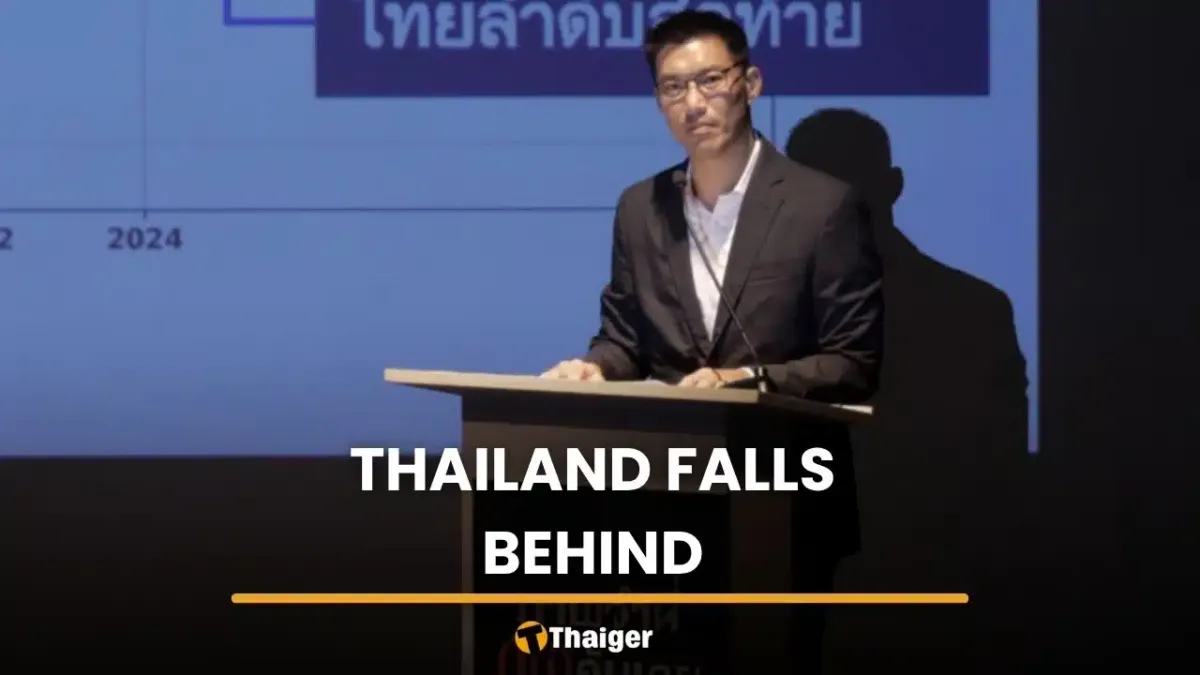
Former Future Forward Party leader Thanathorn Juangroongruangkit has asserted that Thailand’s economic progress has been significantly hampered by recurrent military coups and persistent political instability over the past two decades. Speaking at a seminar in Bangkok on September 19, Thanathorn, now the chair of the Progressive Movement, argued that military resources could be repurposed for more productive economic and public benefit.
Political Turmoil and Economic Lag
The seminar, held to commemorate the 20th anniversary of the 2006 military coup, provided a platform for Thanathorn to detail his analysis of the political and economic repercussions of military interventions in Thailand. He presented data suggesting that Thailand’s average annual GDP growth over the last 20 years stood at approximately 2.6%, falling short of the global average of 3.3%. To illustrate this point, he used 2006 as a baseline (index of 100), showing that while Vietnam’s economy grew to an index of around 300, and Indonesia and the Philippines reached approximately 250, Thailand only managed to reach 162.
Thanathorn contended that this relative economic stagnation, compared to regional peers, is directly linked to the cycle of political disruptions. He highlighted Thailand’s turbulent political landscape since the 2006 coup, citing the implementation of three constitutions, ten changes in prime ministers (five of whom were removed by Constitutional Court rulings), nine major political party dissolutions, two annulled elections, and another coup in 2014. This analysis, he clarified, represents his own political and economic interpretation rather than an official government finding.
Bureaucratic Bloat and Fiscal Strain
Beyond the direct impact of coups, Thanathorn also critiqued the expansion of the state bureaucracy during this period. He noted an increase in government agencies from 166 to 225, a public sector workforce numbering around 3 million, and a national budget reaching 3.8 trillion baht. A significant concern he raised was the projected rise in government interest payments, which are estimated to consume 13.6% of state revenue by 2029. This, he warned, would inevitably reduce the funds available for critical sectors such as education and social welfare programs.
Repurposing Military Assets for Development
Shifting from critique to proposals, Thanathorn outlined four key recommendations aimed at leveraging existing military assets for economic development and public services. He pointed to substantial military holdings, including 71 golf courses, 196 radio stations, 12 buildings and hotels, and over 5.8 million rai of land. His argument was that assets not crucial for national defense could be managed more efficiently, allowing the armed forces to maintain robust combat readiness.
Specific Proposals for Asset Utilization:
- Convention Hall Redevelopment: Thanathorn identified the Royal Thai Army’s Ram Inthra International Convention Hall, valued at 3.4 billion baht and reportedly unused for three years, as a prime candidate for transfer to the Treasury Department. He suggested its operation by the private sector could generate an estimated 3 billion baht in rental income over two decades.
- Public Park and Transport Hub: He proposed converting the Royal Thai Air Force’s Thupatemi Golf Course in Pathum Thani into a large public park. Additionally, a portion of its Phahonyothin Road frontage could be developed into a transport hub connecting the Red and Green Skytrain lines, potentially serving over 300,000 local residents.
- Smart Grid Technology Testing: Thanathorn suggested upgrading the Royal Thai Navy’s electricity operations in Sattahip to serve as a testing ground for smart-grid technology.
- Dual-Use Defense Systems: His fourth proposal focused on developing domestic defense technologies, such as AI and sensor-based border surveillance systems, which could be adapted for civilian applications like wildfire detection and disaster monitoring.
Thanathorn expressed confidence that some within the military establishment are open to reform, based on his experience working with military representatives on a House committee. He framed these proposals not as a reduction of the military’s defense role, but as an opportunity to integrate military capabilities with more productive use of state resources, ultimately benefiting the nation’s economy and its citizens.
